
Dishwasher Stops Mid-Cycle: Causes and Fixes
 August 4, 2026
15 min read
August 4, 2026
15 min read
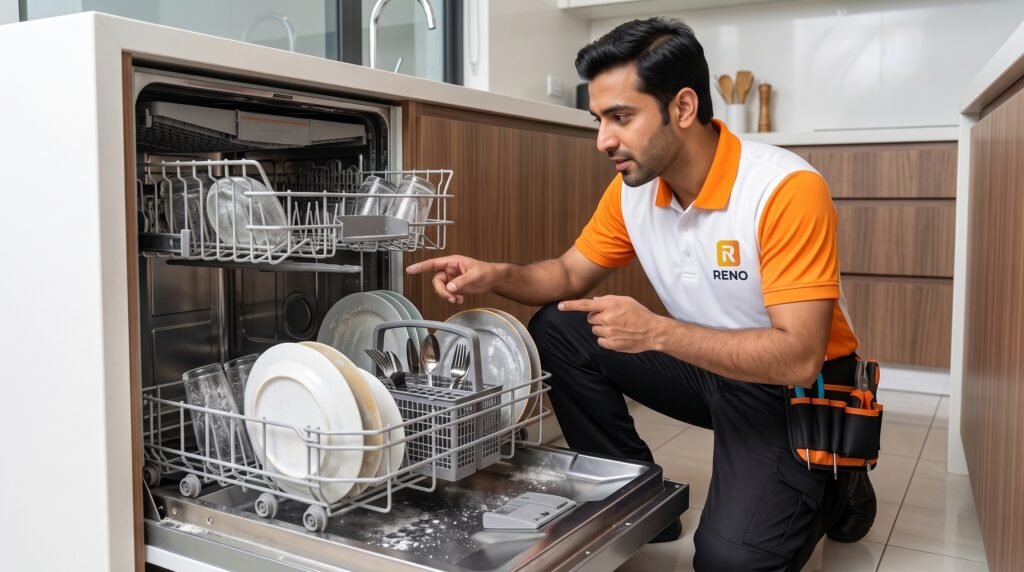
A dishwasher that stops halfway has lost a condition required by its cycle control. The missing condition usually involves drainage, filling, heating, door closure, electronic switching, or stable mains power.
A dishwasher that stops mid-cycle creates more than an unfinished load. It can leave standing water, cold wash water, dirty dishes, or a programme that keeps restarting without explanation. In many Dubai homes, the fault appears suddenly even though the machine fills and starts normally.
The stop point gives the first useful clue. A dishwasher that stops at the same stage often points to a specific component, such as the drain pump, inlet valve, heater, or door switch. Random stops direct attention toward the control board, wiring, or mains supply.
This guide explains:
- The main causes of cycle interruption
- The checks that are safe to perform at home
- The faults that require a technician
It also covers error codes, stop-stage diagnosis, failed components, and typical dishwasher repair costs in Dubai.
When basic checks do not restore the programme, professional dishwasher repair in Dubai can diagnose pump, heater, door switch, wiring, or electronic faults.
Why is your dishwasher stopping mid-cycle?
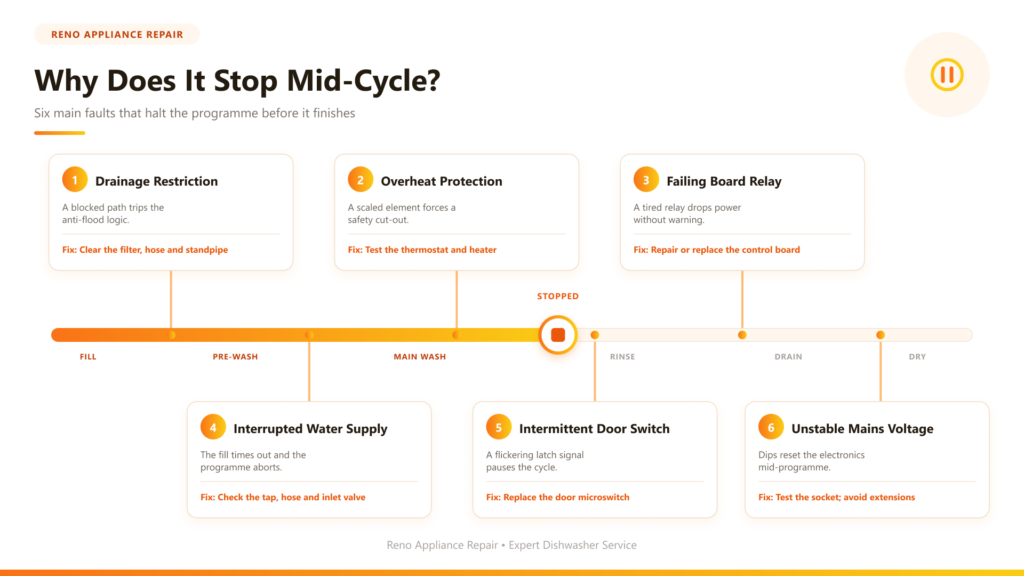
A drainage restriction is the likeliest of six practical causes when a dishwasher stops mid-cycle; interrupted water supply and an unstable door latch follow. You can clean the filter, inspect accessible hoses, open the supply valve, and correct loading yourself.
A dishwasher that stops halfway has lost a condition required by its cycle control. The missing condition usually concerns drainage, filling, heating, door closure, electronic switching, or stable power.
A programmed pause does not always indicate failure. Some models pause two or three times for thermal holds while water reaches the target temperature. A true interruption fails to resume, repeats with a code, or leaves the tub unfinished.
Start with the stop-point pattern, then inspect the subsystem active at that moment.
This table ranks diagnostic priority, not published failure prevalence.
| Diagnostic priority | Cause | Typical pattern | Owner check | Technician clue |
|---|---|---|---|---|
| 1 | Drain restriction | Stops before or during drain | Clean the filter and inspect the hose | Water remains after cleaning |
| 2 | Interrupted water supply | Initial drain completes, then filling stalls | Open the valve and inspect the inlet hose | The tub remains dry despite adequate supply |
| 3 | Door latch or switch instability | Pauses when racks move or vibration rises | Remove door obstructions and close firmly | Light door pressure changes operation |
| 4 | Heating or temperature fault | Repeats during main wash | Record water temperature and code | Heater code returns |
| 5 | Control-board relay fault | Stops at changing points | Record display resets | Loads lose power randomly |
| 6 | Mains voltage dip | Display blanks or programme restarts | Check breaker and other appliances | Lights dim or another appliance resets |
As a diagnostic inference, a same-point stop supports a stage-specific fault. A random stop supports the control board, wiring, door signal, or incoming supply.
What causes a cycle interruption?
Six main faults cause a dishwasher to stop mid-cycle:
- A drainage restriction
- Interrupted water supply
- Overheat protection
- An intermittent door switch
- A failing control-board relay
- Unstable mains voltage
Drain, fill, and wash-stage stops usually identify one subsystem, while random stops point toward the board or electrical supply.
Several common dishwasher problems can interrupt the programme, but the stop stage helps separate drainage, filling, heating, door-signal, electronic, and supply faults.
How does a drainage fault pause the cycle at the drain stage?
A drainage fault prevents the controller from completing the drain stage. The machine may pause, end early, display a drain code, or keep the pump running.
Inspect this cause when water remains above the filter. Whirlpool Product Help names the filter, drain hose, and sink connection as first checks. Samsung Gulf assigns 5C or 5E to drainage failure.
Disconnect power, clean visible debris, and straighten an accessible hose kink. LG UAE links the OE code with drain restriction and recommends filter and hose checks. LG also advises monthly filter cleaning in hard-water areas for suitable models.
A dishwasher not draining may stop before the next stage because the controller cannot confirm that wastewater has left the tub.
How does an interrupted water supply stall the fill stage?
An interrupted water supply leaves the tub below the level required for circulation. You may hear the initial drain, a short inlet-valve hum, then silence.
Check the under-sink valve, inlet hose, building supply, and model-specific float. Samsung Gulf assigns 4C or 4E to insufficient water supply and lists a closed valve, supply interruption, blocked hose, or inlet restriction.
Use the kitchen tap as a building-supply check. Then confirm that the dishwasher valve sits fully open and the hose has no visible fold.
Bosch Home Appliances identifies E30-00 with a flow-meter or filling-system failure and E32-00 with a low water level or restricted inflow.
A machine that is not filling can pause after the initial drain when the inlet path, valve, float, flow meter, or building supply fails to provide the required water level.
How does an overheat cut-out stop the machine at the wash stage?
An overheat cut-out interrupts heating when the control detects abnormal temperature or unsafe heater operation. The dishwasher often stops during the main wash because that stage requests sustained heat.
Samsung Gulf links HE, HE1, HE2, and HE3 with poor heating, excessive temperature, thermostat trouble, element failure, or wiring faults. Samsung cites at least 50°C (122°F) as an incoming-water check for supported models.
Let the machine cool and record whether the water felt cold, normally hot, or unusually hot. Do not meter a connected heating circuit.
A technician tests the element, Negative Temperature Coefficient (NTC) sensor, thermostat, wiring, and control output.
How does an intermittent door switch abort a running cycle?
An intermittent door switch tells the controller that the door opened during operation. Rack movement, cabinet pressure, hinge wear, or a weak latch can break the signal.
The latch operates the safety switch that confirms door closure. Check for dishes near the front and large items touching the door.
Remove protruding utensils and reseat both racks. Apply light inward pressure during one supervised test. A beep, restart, or display change supports alignment or switch trouble.
A dishwasher that is not turning on may have an unconfirmed door-latch signal, although the outlet, breaker, and mains supply should also be checked before replacing latch parts.
How does a failing control board relay stop the cycle at random points?
A failing relay removes power from a pump, valve, or heater when the control board requests that load. The dishwasher keeps stopping, but the elapsed time may change.
Bosch Home Appliances assigns E02 and E03 to main control-board relay faults. Bosch assigns E80-00 to a door-sensor circuit fault and E90-01 to low incoming supply.
Record the programme, stop time, display state, and last sound. A blank display suggests a reset. An active display with one dead load suggests relay, wiring, or component trouble.
A control panel dead symptom during a random stop can indicate a loss of low-voltage supply, a failed relay path, loose wiring, or an electronic reset.
A technician checks the supply and load before quoting a board.
How does a mains voltage dip reset the programme?
A voltage dip can reboot the electronic control while a pump or heater draws current. The display may be blank, return to the start, or lose the selected programme.
The Dubai Electricity and Water Authority Electrical Installation Regulations specify 230/400 V at 50 Hz with a 10% tolerance. For a 230 V appliance, that equals 207 to 253 V at the supply reference.
Check whether lights dim, a breaker trips, or another appliance resets. Avoid extension leads and shared adapters.
Ask a qualified electrician to test the outlet and circuit when the symptom repeats.
How do you diagnose a cycle interruption step by step?
Diagnose a cycle interruption in 5 steps:
- Record the stop stage and elapsed time
- Confirm whether it repeats
- Capture the error code
- Check for standing water
- Test the door response
Same-point stops isolate a stage component, while random stops indicate a shared control fault.
- Note the exact stage and elapsed time at which it stops
Record the displayed minutes and last operation heard. Fill follows the initial drain. Wash follows spray action. Drain leaves pump noise or standing water.
Repeat once on the same programme. Do not restart a leaking, overheating, or electrically unstable machine.
- Check whether it stops at the same point every cycle
Run one controlled retest after basic checks. The same elapsed time supports a stage component. Different points support the door signal, board, connector, or power.
Change one variable per retest. Multiple changes erase useful evidence.
- Record any error code shown at the stop
Photograph the complete code and indicator pattern before resetting power. Brand codes separate drainage, fill, heating, pump, communication, and temperature-sensor faults.
Samsung Gulf maps 4C to supply, 5C to drainage, HC or HE to heating, CA to communication, and 3C to pump operation.
- Check for standing water at the stop point
Inspect the quiet tub after safe opening. Water above the filter supports a drain restriction. A dry tub after fill attempts supports an inlet problem.
Some designs retain water below the filter. Compare the level with the model manual.
- Press the door firmly during the cycle and observe
Apply light inward pressure without pulling the handle or defeating the latch. Note any beep, display change, restart, or pause.
A response supports alignment, latch wear, or switch instability. Stop if water leaks or the latch moves.
Which checks can you safely do yourself?
Isolate power before touching the filter, sump, or hoses. Close the water valve before loosening any connection.
- Record the stop point. Write the programme, elapsed time, last sound, water condition, and display state.
- Note the code. Photograph the code or flashing pattern before any reset.
- Check for water. Inspect the filter area, accessible drain hose, supply valve, and inlet hose.
- Retest with a different programme. Run one short supervised programme after correcting a clear restriction.
Whirlpool Product Help permits a 30-second power disconnection as a control reset. Treat the reset as a test, not a repair.
Professional home appliance repair is appropriate when checks require cabinet removal, electrical measurements, fixed pump access, or testing of powered components.
DIY vs technician decision box
| Continue with an owner check | Stop and use a technician |
|---|---|
| Food debris covers the removable filter | The breaker trips again |
| The supply valve sits partly closed | You smell hot plastic or burning insulation |
| An accessible hose has a visible kink | A heater, sensor, relay, or communication code returns |
| A utensil prevents full door closure | Light door pressure changes operation |
| One reset follows a confirmed outage | Standing water returns after filter cleaning |
Which of these faults needs a technician?
Board relay diagnosis needs controlled electrical testing. The technician checks incoming voltage, harness condition, relay output, and load current before replacing the board.
NTC sensor replacement needs model-specific resistance data. Samsung Support identifies tE as a dishwasher temperature-sensor error.
Door switch replacement requires continuity testing, strike alignment, hinge inspection, and wiring checks. Heating circuit testing covers the element or heat pump, thermostat, sensor, insulation resistance, wiring, and control output.
Stop using the machine after repeated heater codes, burning smells, abnormal heat, or breaker trips.
A technician should test incoming voltage, wiring, connected loads, and relay output before replacing the control board.
How much does it cost to fix a cycle interruption in Dubai?
Dubai repair prices vary by brand, built-in cabinet access, part availability, and whether the call-out fee becomes part of the repair. Published June 2026 benchmarks place diagnosis near AED 150 to AED 250, minor blockage work near AED 150 to AED 350, and major heating or board work near AED 700 to AED 1,000 or more.
A current Dubai provider lists door-latch work at AED 150 to AED 250, drain pumps at AED 200 to AED 350, inlet valves at AED 150 to AED 280, and control boards at AED 300 to AED 500. These are advertised ranges, not tariffs.
| Cause or repair scope | Indicative Dubai cost | What changes the quote |
|---|---|---|
| Filter, hose, or minor drain blockage | AED 150 to AED 350 | Access, cleaning time, and call-out policy |
| Drain pump | AED 200 to AED 500 | Pump type, brand, and sump access |
| Water inlet valve | AED 150 to AED 400 | Valve assembly, hose condition, and cabinet access |
| Door latch or switch | AED 150 to AED 300 | Mechanical latch versus electrical switch |
| NTC sensor or heating diagnosis | AED 300 to AED 800 | Sensor access, wiring damage, and test time |
| Heater, heat pump, or heating electronics | AED 700 to AED 1,000+ | Integrated heat-pump design and part availability |
| Control board repair or replacement | AED 300 to AED 1,000+ | Board repair, new board, programming, and brand |
| Voltage diagnosis | AED 150 to AED 250+ | Appliance call-out only; electrician work is separate |
Ask for the diagnosis, part number, labor, warranty, and final test-cycle result in writing. Diagnosis, replacement parts, labor, cabinet access, testing, and warranty terms should all be compared against the expected dishwasher repair cost in Dubai before the quotation is approved.
Does your dishwasher stop at the same point in every cycle?
A dishwasher that stops at the same point usually points to the subsystem active then. Fill indicates the inlet path. Wash indicates circulation or heating. Drain indicates the filter, pump, hose, or water-level feedback.
Random stops shift attention to shared controls. The board, door signal, wiring connector, and incoming power affect several stages.
The United States Department of Energy measures dishwasher energy and water through defined normal-cycle testing and uses 215 cycles for annual calculations. That equals about 4.1 cycles each week, so repeated restart testing adds avoidable use.
What does the stop point tell you about the failed component?
The stop point identifies the last cycle command that did not complete. Match that command with the components that create the action or confirm its result.
Which components can stop the cycle at fill?
The supply valve, inlet hose, inlet screen, water inlet valve, float, pressure sensor, flow meter, and door switch can stop filling.
Confirm building water first. Open the valve, straighten the hose, and confirm unrestricted door closure.
Escalate when the tub stays dry despite adequate supply or the fill code returns. Bosch flow-meter codes and Samsung 4C or 4E codes provide model-specific evidence.
Which components can stop the cycle at wash?
The circulation pump, heater, heat pump, thermostat, NTC sensor, diverter, control relay, and wiring can stop the wash stage.
Cold water supports heating trouble. Silence after filling supports circulation trouble. Unusually hot water supports temperature-control trouble.
Mineral deposits can add load. Bosch UAE defines E12 as limescale build-up in the heating system and recommends descaling.
Which components can stop the cycle at the drain?
The filter, pump cover, drain pump, hose, sink waste connection, pressure sensor, and control output can stop drainage.
Clean the removable filter and inspect the accessible hose. Book service when the pump hums without lowering the water, the drain code returns, or water reaches the base tray.
Bosch links E61-01 with pump trouble and E61-02 or E61-03 with blocked pumps, loose covers, kinked hoses, or clogged drain paths.
Labelled photo of the inspection point
Insert a top-down photograph after removing the lower rack and isolating power. Add 6 labels:
- A: Filter assembly
- B: Sump opening
- C: Pump cover
- D: Standing-water line
- E: Model-specific float
- F: Drain outlet path
Which related dishwasher problems share the same cause?
Shared components create related symptoms, so each internal link should continue through the failed subsystem.
- A restricted inlet, closed valve, or weak flow connects with dishwasher cycle stops during filling and dishwasher water inlet valve diagnosis.
- A stuck float or false level signal connects with dishwasher float-switch symptoms and testing.
- Cold wash water may result from a failed heater, defective NTC sensor, or faulty thermostat.
- Standing water after the cycle often points to an obstruction in the filter, hose, or pump.
- Scale on the heater can delay water heating while excess minerals leave marks on dishes.
Bosch code E12 specifically links limescale build-up with the heat pump and recommends descaling.
Stop-point diagnosis remains a useful split. Same-point stops identify a stage and its failed component. Random stops shift attention toward the board, door signal, connector, or supply.
Fix the cause, not just the interrupted cycle
A dishwasher that stops mid-cycle gives useful evidence before any part is removed. The drain, fill, or wash stage identifies the subsystem that failed to complete its task. A stop at different points shifts the diagnosis toward the door signal, control board, wiring, or mains supply.
Start with the safe checks. Record the stop time, capture the error code, inspect the water level, and remove visible filter or hose restrictions. One careful retest provides better evidence than several resets.
Stop using the dishwasher when the breaker trips, burning smells appear, water leaks, or a heating code returns. These signs require electrical testing and component-level diagnosis. A clear record of the stop point also helps a Dubai technician test the correct circuit and quote the repair more accurately.
FAQs
Yes, some dishwashers pause during a thermal hold, but a fault pause fails to resume, repeats consistently, or displays an error code.
A full programme restart usually points to a voltage dip, loose electrical connection, intermittent door signal, or control-board reset.
Repeated resets can increase water and electricity use while allowing a drain, heating, wiring, or pump fault to continue.
Yes, mineral scale can load the heater or heat pump, delay temperature rise, and trigger a heating-related interruption.
Ahmed Al Mansoori
Ahmed Al Mansoori is a UAE-based home appliance repair specialist with over 12 years of hands-on experience in diagnosing and repairing washing machines, refrigerators, dishwashers, ovens, dryers, and other household appliances across Dubai and Abu Dhabi. He has worked with leading appliance brands and is known for delivering reliable repair solutions, preventive maintenance guidance, and same-day technical support for residential clients. Ahmed specializes in troubleshooting modern smart appliances and energy-efficient systems commonly used in UAE homes.
