
Dishwasher Control Panel or Buttons Not Working: Causes and Fixes
 August 5, 2026
14 min read
August 5, 2026
14 min read
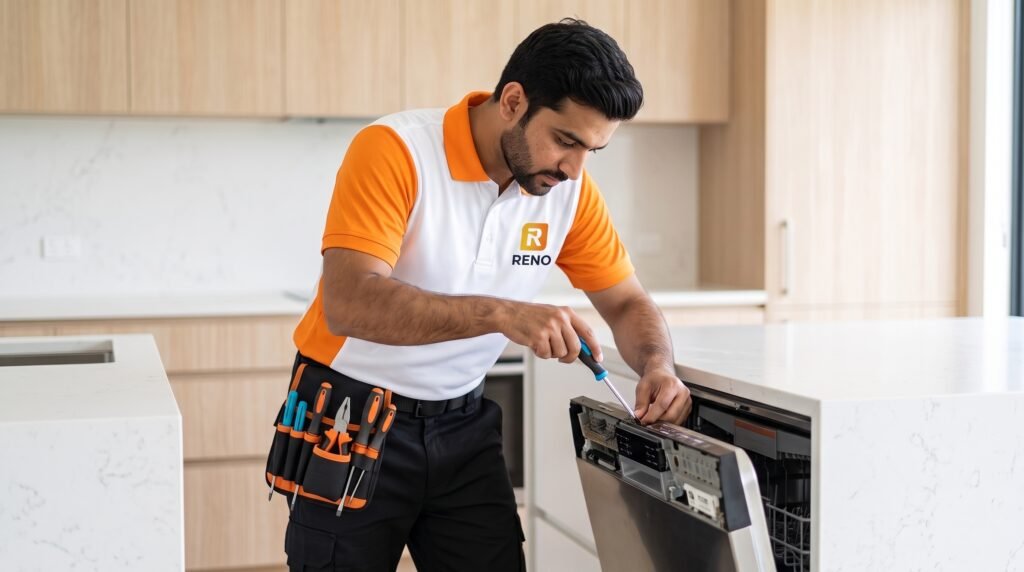
A dishwasher control interface includes the display, buttons, touch membrane, ribbon cable, user-interface board, and main controller. A fault along this signal path can leave the dishwasher touchpad not responding.
A dishwasher that lights up but ignores every button creates a confusing fault. The appliance has power, yet the wash cycle cannot start. In some cases, an active child lock or temporary control error causes the problem. In others, moisture, a damaged ribbon cable, a worn touch membrane, or a failed control board interrupts the control signal.
The difference matters because a reset or unlock sequence costs nothing, while internal electronic repairs can exceed AED 1,000 in Dubai.
When external checks do not restore the controls, professional dishwasher repair in Dubai can diagnose interface, wiring, moisture, or electronic-controller faults.
This guide explains how to:
- Read the display
- Test individual buttons
- Check child lock
- Demo mode
- Separate safe home checks from technician-only work
It also examines how steam, condensation, and a worn door seal can damage panel electronics in humid Dubai kitchens.
Why is your dishwasher unresponsive at the control panel?
An active child lock ranks first when the display lights but every command fails. Panel moisture and a temporary control fault follow. You can check all three, while ribbon, membrane, board, or internal moisture damage requires a technician.
Samsung Support identifies accidentally enabled Control Lock as the most likely explanation when a powered dishwasher’s buttons stop working. LG Support confirms that “CL” or a lock icon disables cycle and option keys.
The table ranks causes by diagnostic priority, not by a universal failure percentage. Manufacturers publish no Dubai-wide incidence dataset for dishwasher control-interface faults.
| Symptom pattern | First cause to check | Priority | Safe owner action |
|---|---|---|---|
| Display on; every cycle key disabled | Child or Control Lock | High | Follow the model’s unlock command |
| Panel wet or recently exposed to steam | Surface moisture | High when visible | Dry the panel |
| The panel froze after an interruption | Temporary control lock-up | Medium | Isolate power, then restart |
| One or two buttons fail repeatedly | Worn membrane | High for isolated keys | Book an inspection |
| A row of keys works intermittently | Ribbon cable or connector | Medium to high | Technician inspection |
| The display stays dark with verified power | Interface, harness, or board | High after supply checks | Electrical diagnosis |
A lit display points toward a lock, touch input, or communication fault. A dead dishwasher panel shifts attention toward power, wiring, the interface, or the main board.
What causes a control panel fault?
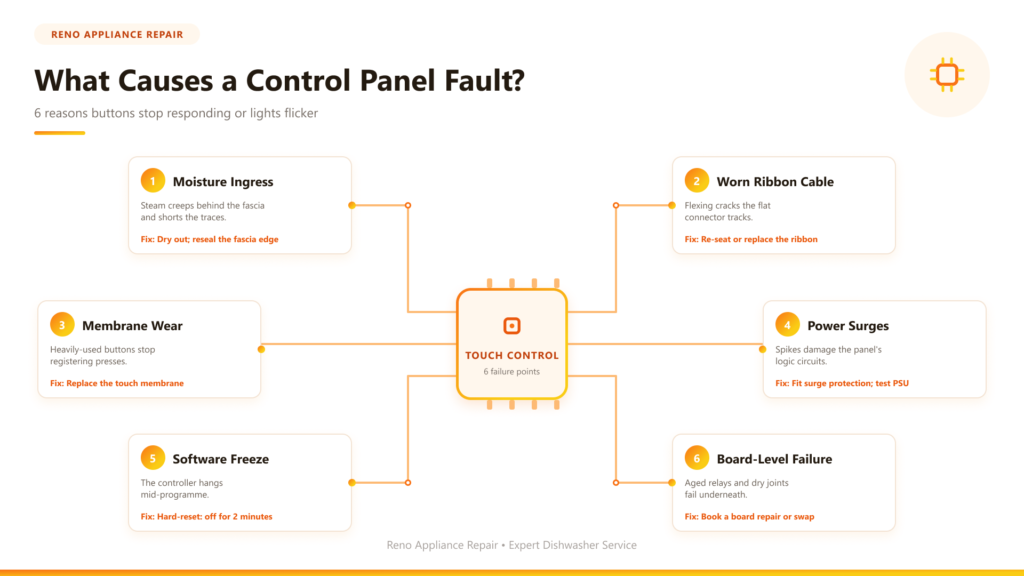
A dishwasher control panel fault occurs when the interface cannot register, transmit, or process your command. The failed component can sit on the touch surface, inside the door, or on the controller.
Among common dishwasher problems, an unresponsive panel is distinctive because power may reach the appliance while button signals fail between the interface and the main controller.
How does moisture ingress behind the touch panel cause dead buttons?
Moisture can block touch detection or create an unintended conductive path across contacts. External moisture sometimes clears after drying. Moisture inside the fascia can leave residue or corrosion.
LG Support tells owners to remove moisture and debris with a soft cloth after disabling Child Lock. That check ends at the external surface. Trapped moisture requires internal inspection.
How does a detached or corroded ribbon cable disable the panel?
A ribbon cable carries signals between the touch membrane and electronic control. A loose connector interrupts the path. Corroded or migrated silver traces can create resistance, open circuits, or bridging.
A Whirlpool technical service pointer names loose wiring, displaced button domes, wear, corrosion, and silver migration. The bulletin covers 10 listed models and four serial-prefix groups. It directs inspection where the ribbon bends into the door.
Door movement can make a weak trace work at one angle and fail at another. That pattern commonly appears as intermittent Start, Cancel, or programme buttons.
Intermittent stopping mid-cycle can occur when vibration or door movement briefly breaks a weak ribbon-cable connection.
How does a worn touch membrane stop registering presses?
A touch membrane uses layered contacts or domes beneath the fascia. A press closes the selected circuit. Wear, cracking, delamination, or a displaced dome prevents reliable contact.
One dead Start, Cancel, programme, or option key points toward membrane wear. Harder pressing rarely repairs the contact. Whirlpool lists ordinary wear and misplaced button domes among documented causes of intermittent keypad operation.
How does an active child lock disable every button?
An active child lock deliberately blocks cycle and option commands. Many models leave Power active, which makes the dishwasher appear electronically faulty.
Samsung Support and LG Support specify three seconds on many models. LG states that the lock can remain active after power-off, although key combinations vary.
How does showroom or demo mode make the panel appear faulty?
Showroom or demo mode configures a dishwasher for retail display. The interface may light and accept limited input, while normal washing remains unavailable.
Bosch retail demonstration instructions document separate procedures across Series 4, Series 6, and Series 8 dishwashers. Several listed models use Power Plus Start for about 10 seconds. Three LED flashes confirm activation on those models.
Demo mode deserves attention after a showroom purchase, delivery, control replacement, or accidental long key press.
How does a failed control board kill the display?
A failed control board can remove the display’s low-voltage supply or data signals. Interface, harness, terminal, and door-circuit faults can create the same symptom.
Whirlpool Product Help includes incorrect terminal wiring and an unresponsive control within its diagnostic sequence. Testing supply and communication prevents unnecessary board replacement.
How do you diagnose a control panel fault step by step?
Diagnose the control panel from visible evidence toward hidden components. Record the display, working keys, indicators, and behavior after one reset.
Check whether the display lights at all
A lit display confirms that part of the interface receives power. Look for “CL,” a padlock, Demo, Shop, delayed-start symbols, or flashing programme lights.
A dark display requires a safe supply check. Confirm the breaker, appliance isolator, and accessible plug. Stop if the breaker trips again, water reaches electrical areas, or a burning smell appears.
A dishwasher not turning on after the supply has been verified requires diagnosis of the interface, harness, door circuit, or electronic controller.
Labelled photo of the inspection point
Use a straight photo of the open upper door edge. Add 5 labels:
- A: Control surface, showing buttons and display.
- B: Lock or demo indicator, showing the icon.
- C: Upper door gasket, showing dirt, flattening, or tears.
- D: Steam escape path, showing the top corner and cabinet gap.
- E: Ribbon-cable route, marked “technician access only”.
The image connects the visible symptom to the seal, steam path, and hidden signal route without encouraging disassembly.
Test whether any single button responds
Test Power, one programme key, one option key, and Start. Wait between presses. The response pattern matters more than rapid tapping.
Power only suggests Control Lock. One failed key suggests membrane wear. A dead group suggests a ribbon trace. A dark panel points toward supply or electronics.
Dirt, edge pressing, simultaneous touches, and rapid repeated pressing are touch-panel factors. One covered panel can recover sensitivity after one minute.
Hold the child lock key for the model’s stated duration
Hold the documented Child Lock, Control Lock, or named key pair for the stated duration. Watch for “CL” or the padlock to disappear.
Samsung and LG commonly specify three seconds, yet combinations vary. LG uses two keys on some panels, while Samsung uses Multi tab on a DW50 group.
Use the model number on the rating plate. A control sequence from another series can change an unrelated setting.
Perform the model’s hard reset by isolating power
Isolate power for five minutes, restore power, close the door, and test one normal cycle.
Samsung Support publishes a 1- to 5-minute reset range. Whirlpool Product Help publishes at least 1 minute on its current reset page. Another Whirlpool page lists 30 seconds.
5 minutes covers those ranges. One reset clears transient logic, not damaged components.
Check for a demo mode indicator in the display
Check the manual for Demo, Showroom, Shop, or a model-specific symbol. This check ranks higher after a display purchase or electronic repair.
Bosch’s retail instructions use different layouts across series. Several 60-centimetre models require about 10 seconds and signal the change with three LED flashes. Follow only the matching panel image.
Which checks can you safely do yourself?
You can check power, lock settings, demo mode, and external moisture without opening the console.
- Isolate power for 5 minutes. Restore power once, then test one cycle.
- Hold the child lock key. Use the manual’s named key and duration.
- Check for demo mode. Match the indicator and exit sequence to the model.
- Dry the panel area. Use a soft cloth and let visible moisture evaporate.
The following decision box separates external checks from internal electrical work.
| DIY check | Stop and call a technician |
|---|---|
| “CL,” padlock, or lock light appears | Correct unlock procedure fails |
| The surface feels damp | Moisture appears inside the fascia or cabinetry |
| The panel froze once after an interruption | Fault returns after one reset |
| Some keys still respond | The display stays dark despite verified power |
| The demo indicator matches the manual | Exact demo-exit procedure fails |
Bosch assigns internal appliance repairs to trained specialists and warns against operating damaged electrical equipment.
Which of these faults needs a technician?
Touch-panel replacement, ribbon repair, control-board replacement, and internal moisture assessment require a technician. These jobs expose wiring, sharp panels, sealed parts, and model-specific electronics.
Professional home appliance repair is appropriate when the fault requires console access, electrical measurement, ribbon testing, or internal moisture assessment.
A technician usually follows 4 repair paths:
- Replace the touch panel after repeatable membrane-key failure.
- Repair or replace the ribbon interface after continuity or corrosion testing.
- Replace the control board after supply and communication tests isolate the board.
- Assess moisture damage across connectors, seals, insulation, and cabinet exposure.
Ask the technician to name the failed component. “Control panel” can mean the fascia, touch membrane, interface board, ribbon cable, harness, or main controller.
Whirlpool instructs technicians to replace the console assembly when inspection confirms corrosion or silver migration on the ribbon tail.
How much does it cost to fix a control panel fault in Dubai?
Dishwasher control panel repair in Dubai commonly ranges from AED 150 for diagnosis to AED 1,000 or more for major electronic-board work. Brand, parts, built-in access, and warranty terms affect the quote.
These planning ranges were set on 4 August 2026. They combine published Dubai diagnosis, panel, seal, and board figures. They are market benchmarks, not regulated tariffs.
| Confirmed cause or service scope | Planning range | Quote requirement |
|---|---|---|
| Lock, demo check, or reset visit | AED 150 to AED 250 | Call-out and diagnosis |
| External moisture cleaning and testing | AED 150 to AED 350 | Drying and test cycle |
| Door seal correction or replacement | AED 150 to AED 800 | Part, alignment, and access |
| Ribbon cable or interface repair | AED 300 to AED 600 | Repair or console replacement |
| Touch membrane or panel replacement | AED 300 to AED 600 | Part number and warranty |
| Main control-board work | AED 300 to AED 1,000+ | Board, programming, labour, test |
One Dubai service page lists control-board work at AED 300 to AED 500. A broader June 2026 guide places major board jobs around AED 700 to AED 1,000 or more. Compare scope before price.
Comparing diagnosis, parts, labour, cabinet access, testing, and warranty provides a clearer assessment of the quoted dishwasher repair cost in Dubai.
Is your dishwasher in child lock or in demo mode?
Child lock blocks commands for safety. Demo mode restricts normal operation for retail display. Both can illuminate the panel without delivering a wash cycle.
| Evidence | Child lock | Demo mode |
|---|---|---|
| Typical sign | “CL” or padlock | Demo, shop, display pattern |
| The power button works | Common | Possible |
| Cycle keys remain blocked | Common | Possible |
| Common published duration | 3 seconds on many Samsung and LG models | About 10 seconds on listed Bosch models |
| Published confirmation | The lock icon disappears | Three LED flashes on listed Bosch models |
| Hardware required | No, if the setting clears | No, if the setting clears |
Power cycling does not always clear Child Lock. LG states that the lock can remain after a cycle and power-off. Demo mode remains model-specific, so use the rating plate before changing settings.
Why do control panels fail earlier in humid Dubai kitchens?
Dubai’s outdoor climate does not prove an individual panel failure, but it increases moisture exposure around cooled kitchens and hot appliances.
On 4 August 2026, the UAE National Center of Meteorology listed a 45°C maximum temperature, 70% maximum humidity, and 20% minimum humidity for Dubai City.
That 50-point range shows changing outdoor moisture conditions. Air conditioning can cool cabinet fronts while a hot rinse raises vapour beside the door.
How does steam escaping the door reach the panel electronics?
Steam can rise through gaps inside the door and around a weak upper seal. Many integrated dishwashers place interface electronics near that upper route.
A 2024 V-ZUG dishwasher service bulletin documents rising steam inside the door. Steam can escape through outer-panel openings and condense on metal decor handles. Its correction uses two foam profiles and two sealing strips.
Visible steam identifies an exposure route, not confirmed electrical damage.
How does condensation on an integrated panel corrode contacts?
Condensation forms when moist air meets a surface below its dew point. An air-conditioned cabinet front can remain cooler than vapor released during rinsing.
V-ZUG tells technicians to check the seal, gasket, door hook, fan setting, and installation niche. Those five inspection points control where steam travels and where condensation forms.
A NASA Jet Propulsion Laboratory humidity test found contact resistance rising from 5.16 to 6.44 micro-ohm square centimeters after 100 hours at 85°C and 85% relative humidity. The increase measured roughly 20%.
That NASA result is not a dishwasher failure rate. It demonstrates that sustained heat and humidity can change electrical-contact performance in non-hermetic electronics.
How does a worn door seal accelerate panel failure?
A worn, dirty, twisted, or misaligned seal creates a mechanical escape path for hot vapor. Steam then reaches the upper door and cabinet more often.
A damaged door seal can let hot vapor escape toward the upper panel, where condensation may reach connectors and ribbon traces.
The causal chain is specific:
- Seal wear opens a vapor path.
- Hot rinse steam reaches the upper door.
- Cooler surfaces collect condensation.
- Moisture wets ribbon traces or connectors.
- Corrosion disrupts button signals.
V-ZUG links seal straightness, gasket condition, door-hook adjustment, and steam control. Replacing only the panel can leave the original moisture path active.
Which related dishwasher problems share the same cause?
A failed control component can create several symptoms because the same board, ribbon cable, or moisture path carries more than one command. The next symptom to isolate is a dishwasher cycle that stops after starting.
- Dishwasher stops mid-cycle: Board, harness, moisture, or interface communication can interrupt the sequence.
- Dishwasher not turning on: A dark panel can share the same supply, wiring, board, or moisture cause.
- Dishwasher display not working: The interface supply or communication path may fail.
- Dishwasher leaking water: A worn seal can create the leak and later panel corrosion.
- Dishwasher door not locking: Latch or alignment faults can block cycle input and weaken sealing.
The shared attribute is the failed component, not the visible symptom. A cycle that stops points back to the control layer. The next diagnostic node isolates the interface, door circuit, board, or another cycle-stage component.
Fix the cause before replacing the control panel
A dishwasher control panel that stops responding does not always need a new electronic board. Start with the evidence already visible. A lock icon points toward Child Lock. One dead button points toward membrane wear. A dark display points toward the power, wiring, interface, or control board.
Complete one controlled reset, check the correct model instructions, and dry visible moisture. Stop there if the fault returns. Ribbon cables, internal corrosion, touch membranes, and control boards require proper electrical testing. Replacing parts without isolating the failed component can increase the repair bill without restoring the dishwasher. The door seal also deserves attention. A damaged seal can release steam toward the upper door, where condensation reaches connectors and ribbon traces. Repairing the electronic symptom without correcting that moisture path can allow the same fault to return.
The safest decision rests on a simple strategy:
- Settings and surface moisture allow external checks
- Repeated faults
- Internal moisture
- Dead key groups
- Electrical smells
- Breaker trips require a technician
FAQs
Hard pressing rarely restores a worn membrane and can place more stress on the damaged button surface.
Door movement can temporarily reconnect a weak ribbon trace, so angle-dependent response usually points toward the cable or connector.
A new seal can reduce repeat steam exposure when seal wear created the moisture path, although existing corrosion still requires inspection.
No, a blank display can also result from a supply fault, loose terminal, damaged harness, or failed user-interface module.
Ahmed Al Mansoori
Ahmed Al Mansoori is a UAE-based home appliance repair specialist with over 12 years of hands-on experience in diagnosing and repairing washing machines, refrigerators, dishwashers, ovens, dryers, and other household appliances across Dubai and Abu Dhabi. He has worked with leading appliance brands and is known for delivering reliable repair solutions, preventive maintenance guidance, and same-day technical support for residential clients. Ahmed specializes in troubleshooting modern smart appliances and energy-efficient systems commonly used in UAE homes.
