
Common Dishwasher Problems, Causes and Fixes
 July 30, 2026
11 min read
July 30, 2026
11 min read
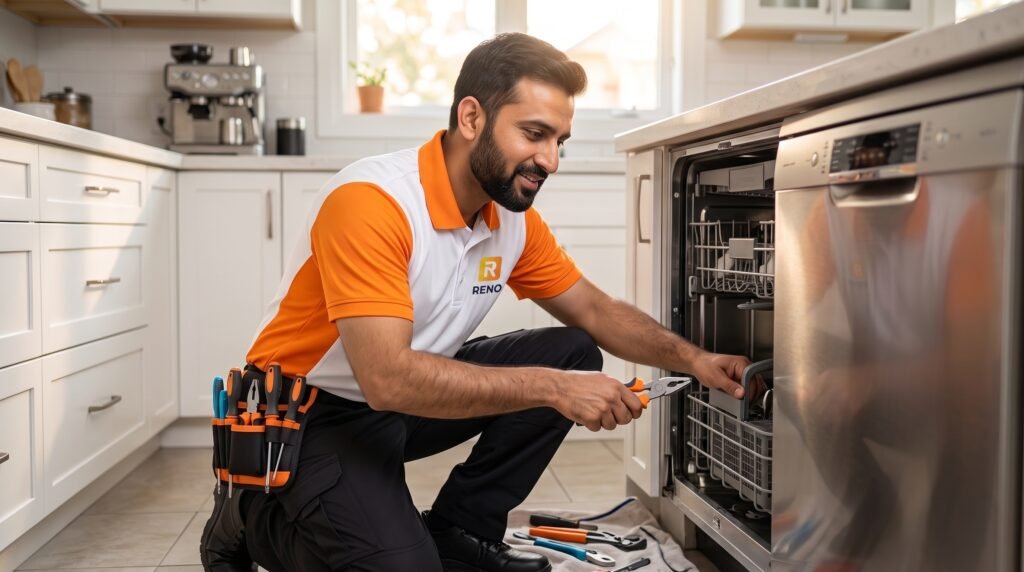
Standing water points to drainage. Cold, wet dishes point to heat or drying. A dead panel points to power, controls, or the door circuit. Treating every symptom as the same problem wastes time and can turn a simple blockage into a costly repair.
This guide organizes common dishwasher problems into 13 fault classes, including drainage, filling, leaks, poor cleaning, drying, heating, power, door, noise, odour, residue, cycle interruption, and control faults.
The guide of dishwasher repair also explains how hard water, drain-hose installation, and apartment water pressure can affect dishwashers in Dubai homes. By starting with the symptom, you can narrow the fault without replacing parts at random.
What are the most common dishwasher problems?
The 13 common dishwasher fault classes are power failure, control faults, drainage, water intake, leaks, cycle interruption, poor cleaning, poor drying, heating faults, door faults, noise, odour, and white residue, ranked broadly by real repair-call patterns.
No public Dubai dataset separates every symptom class. The closest current service dataset records 224,554 dishwasher interventions between July 2019 and March 2026.
The measured categories come first. The remaining positions reflect major manufacturer troubleshooting libraries, not Dubai market shares.
| Rank | Fault class | Typical visible symptom | Frequency evidence |
|---|---|---|---|
| 1 | Power | Dishwasher does not start | “Won’t start” 15.0% |
| 2 | Controls | Code, dead keys, electrical fault | Error code 14.3% |
| 3 | Drainage | Water remains in the tub | Won’t drain 12.4% |
| 4 | Water intake | Tub stays dry or underfills | Won’t fill 10.0% |
| 5 | Leaks | Water appears below or beside unit | Water leak 8.6% |
| 6 | Cycle interruption | Programme freezes or stops | Locks up 6.1% |
| 7 | Wash quality | Soil remains on dishes | Manufacturer troubleshooting class |
| 8 | Drying | Dishes remain wet | Manufacturer troubleshooting class |
| 9 | Heating | Water and dishes remain cold | Error-code and support class |
| 10 | Door | Door does not latch | Start-inhibit support class |
| 11 | Noise | Knocking, grinding, buzzing | Mechanical support class |
| 12 | Odour | Food or drain smell returns | Maintenance support class |
| 13 | Residue | White film or spots remain | Water-quality support class |
This order guides triage. It does not identify a failed part.
Why is your dishwasher not draining?
Your dishwasher usually fails to drain because food blocks the filter, debris jams the pump, or the drain hose kinks. Check those causes in that order. A humming pump suggests obstruction or pump damage.
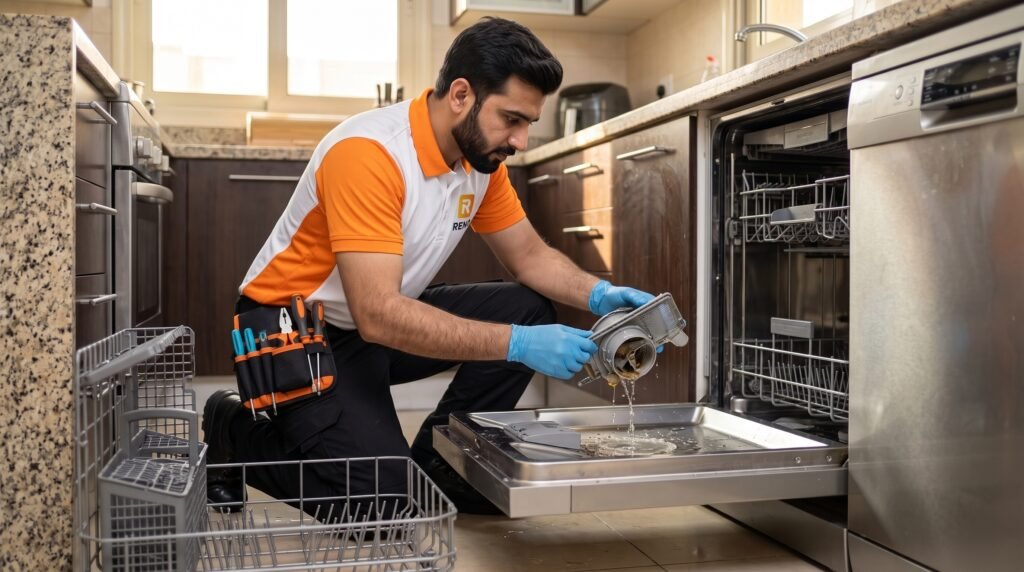
The filter, pump area, and drain hose are the main owner checks. Disconnect power and protect your hands because glass can remain below the filter.
Why is your dishwasher not cleaning dishes properly?
Your dishwasher usually cleans poorly because loading blocks water, spray holes clog, the filter restricts circulation, water arrives too cold, or detergent does not suit the water. Start with rack clearance because a tall item can stop a spray arm.
Whirlpool advises running the nearest hot tap for at least 30 seconds on relevant installations. Bosch directs owners to clean blocked spray arms.
Why is your dishwasher not filling with water?
Your dishwasher usually fails to fill because the tap is closed, the inlet hose is kinked, the flood float is stuck, the pressure is low, or the inlet valve has failed. Check nearby tap flow before blaming the dishwasher.
GE identifies a stuck flood float as one no-fill cause. Manufacturer pressure ranges vary. Bosch lists 0.5 to 10 bar, while Samsung lists 20 to 120 psi for relevant models.
Why is your dishwasher leaking water?
Your dishwasher can leak from a loose connection, a damaged hose, a dirty door seal, poor levelling, excess suds, or an internal pump seal. Stop the cycle, isolate electricity and water, and then locate the first leak point.
Electrolux warns that hand-washing liquid creates excess foam and leakage. Bosch warns that folded or broken hoses can obstruct flow or leak after installation.
Why is your dishwasher not drying dishes?
Your dishwasher usually leaves dishes wet because rinse aid is empty, loading traps water, the programme limits drying, or plastic loses heat quickly. Cold glass and metal point toward a heater, fan, vent, or sensor fault.
Rinse aid improves water runoff. Plastic stores less heat than ceramic or metal.
Why is your dishwasher not heating water?
Your dishwasher does not heat water when the heater, heat pump, temperature sensor, thermostat, wiring, or control circuit fails. Confirm the fault on a hot programme. Repeated cold loads provide stronger evidence than one eco cycle.
The hot water heater should be set to deliver approximately 120 °F (49 °C) [max. 140 °F/60 °C] water to the dishwasher.
Why will your dishwasher not turn on?
Your dishwasher does not turn on when power is absent, the wall switch is off, the door remains unlatched, Control Lock is active, leak protection has engaged, or the electronic control has failed. Check external power first.
Test the outlet and check the electrical panel. The machine cannot start until the door closes and latches.
Why will the dishwasher door not lock?
The dishwasher door does not lock when a rack, utensil, shifted strike, worn latch, bent hinge, or cabinet alignment prevents full closure. Remove obstructions and reseat the racks. Do not force the door.
Electrolux uses CL or Cd when the control does not receive a successful closed-and-latched signal. The code confirms a door-circuit problem, not a specific failed part.
Why is your dishwasher making a loud noise?
Your dishwasher makes loud noise when a spray arm strikes cookware, hard debris reaches the pump, the filter sits loose, or a motor bearing wears. Rhythmic knocking follows rack position. Empty-cycle grinding suggests a mechanical fault.
Filling hiss, pump hum, and one dispenser clunk are normal. Repeated clunking can mean a spray arm is hitting a tall item.
Why does your dishwasher smell bad?
Your dishwasher smells bad when food remains in the filter, grease coats the tub, stagnant water sits in the sump, mould grows around the seal, or sink waste returns through the drain hose. Clean the filter first.
Filter cleaning at least monthly and links persistent odour with a blocked drain hose. A sewage smell after cleaning points toward drainage or installation.
Why do dishes come out with white film on them?
White film usually contains hard-water minerals or detergent residue. Test a small area with an approved acidic cleaner. Removable film indicates deposits. Permanent cloudiness can indicate irreversible etching.
White film appears most often in hard-water areas. USGS classifies 121 to 180 mg/L as hard and more than 180 mg/L as very hard.
Why does your dishwasher stop mid-cycle?
Your dishwasher stops mid-cycle when power drops, the door signal opens, filling times out, drainage slows, leak protection activates, or heating leaves its permitted range. Record the stage and code before restarting.
Mid-cycle stop with power loss, a dirty filter, and a blocked hose. An item striking the door can trigger a false open-door signal.
Why is the dishwasher control panel not responding?
The control panel often stops responding because the control lock is active, moisture covers touch sensors, a temporary control fault freezes the interface, or communication between electronic modules fails. Clean, dry, unlock, then reset once.
Ignored presses, continuous beeping, and self-selecting options are control symptoms. Some Samsung error codes indicate failed communication between the panel and dishwasher.
What does a dishwasher error code tell you?
A dishwasher error code identifies the system that detected abnormal operation, such as filling, drainage, heating, leakage, door closure, motor movement, or control communication. A code narrows the fault area but rarely proves the failed part.
One repair database recorded 29,047 dishwasher code occurrences.
- Bosch E15 appeared 4,429 times
- Electrolux i30, 1,126 times
- Miele F70, 1,099 times
- Bosch E09, 1,029 times
Which dishwasher problems can you fix yourself?
You can safely correct loading errors, clean accessible filters and spray arms, straighten visible hoses, refill salt or rinse aid, unlock controls, and perform one approved reset. Stop at wiring, valves, heaters, motors, sealed bases, or control boards.
The table separates owner-safe dishwasher fixes from technician work.
| Symptom | Likely cause | Owner-safe fix | Technician boundary |
|---|---|---|---|
| Standing water | Dirty filter or hose kink | Clean; straighten | Pump or hidden blockage |
| Dirty dishes | Blocked arm or poor loading | Reload and clean the jets | Pump or heater |
| No fill | Closed tap or kinked hose | Open and straighten | Valve or sensor |
| Door leak | Dirty seal or suds | Wipe with the correct detergent | Seal, hinge, base leak |
| Wet dishes | Low rinse aid | Refill and reload | Heater, fan, sensor |
| Dead controls | Lock or frozen control | Unlock and reset once | Wiring or board |
Bosch directs unresolved internal faults to service. Whirlpool warns against drain-opening chemicals because they can damage components and create hazards.
Use this DIY versus technician decision tree:
- Stop for floor water, smoke, a burning smell or electrical tripping.
- Isolate power and close the water valve.
- Check only owner-accessible parts named in the manual.
- Run one short test after the correction.
- Book service when the fault returns.
When should you call a dishwasher technician in Dubai?
Call a dishwasher technician in Dubai for floor water, a burning smell, repeated residual current device trips, recurring codes, failed heating, exposed wiring, or grinding after safe cleaning. Disconnect power and water first.
Electrical Safety First advises stopping when burn marks, arcing, blown fuses, breaker trips, or excessive heat appear.
Give the technician 4 details:
- Model and serial number;
- Exact error code;
- Cycle stage where the fault appears;
- First location of any leak.
Which conditions in Dubai homes cause dishwasher faults?
Dubai homes can add 3 external fault variables:
- Mineral concentration
- Drain-hose installation
- Apartment water pressure
Test those conditions before replacing parts. A valid code can still originate outside the appliance.
Dubai Electricity & Water Authority (DEWA) advises full dishwasher loads for efficient water, energy, and detergent use. DEWA also advises customers to inspect internal water connections when unexplained leakage or consumption appears.
How does hard water accelerate component failure?
Hard water accelerates failure by depositing calcium and magnesium scale on heaters, valves, sensors, spray holes, and moving rack parts. Scale narrows passages and insulates heated surfaces. Test the apartment supply because building treatment can change hardness.
USGS defines 0 to 60 mg/L as soft, 61 to 120 mg/L as moderately hard, 121 to 180 mg/L as hard, and more than 180 mg/L as very hard.
How does incorrect installation cause drainage and odour faults?
Incorrect installation causes drainage and odour faults when the hose kinks, sits too low, lacks a high loop, or connects to a blocked waste fitting. Those errors slow discharge or allow sink water to return.
A Bosch guide requires a high loop or air gap and places part of the hose at least 33 inches, or 84 cm, above the floor. It lists a 150-inch, or 380-cm, maximum hose length for that model family.
How does apartment water pressure affect fill faults?
Apartment pressure causes fill faults when available flow falls below the model range or changes during peak building demand. Weak nearby taps point toward property supply. Normal flow points toward the dishwasher.
Bosch specifies 0.5 to 10 bar for one installation range. Samsung specifies 20 to 120 psi for relevant models. Use the exact manual because fill timers differ.
How do you prevent the most common dishwasher problems?
Prevent common dishwasher problems by cleaning the filter, keeping spray arms free, loading without contact, using automatic dishwasher detergent, maintaining rinse aid and salt, checking hoses, and matching hardness settings to measured water. Record new noises and codes first.
Use this maintenance sequence:
- After each load: remove hard debris and check spray arm movement.
- Each month: clean the filter and inspect the door seal. Whirlpool recommends at least monthly filter cleaning.
- After plumbing work: inspect inlet and drain hoses.
- When film appears: test hardness and adjust detergent, salt, and rinse aid.
- When a code repeats: record the code before one approved reset.
Run full loads rather than repeated partial cycles.
Diagnose the symptom before replacing the part
A dishwasher fault becomes easier to manage once the visible symptom is matched with the correct system. Standing water points toward drainage. A dry tub shifts attention to water intake. Cold dishes suggest a heating or drying problem. The symptom provides the starting point, not the final diagnosis.
Begin with safe checks such as the filter, spray arms, loading pattern, detergent, visible hoses, door closure, and control lock. One careful test cycle can confirm whether the correction worked. Repeated resets only hide the evidence when the underlying fault remains.
Stop troubleshooting when water reaches the floor, electrical protection trips, a burning smell appears, or the same error code returns. These signs move the fault beyond routine dishwasher maintenance. Recording the model number, code, cycle stage, noise, and leak position gives a technician clearer evidence and reduces guesswork.
Dubai homes add another diagnostic layer. Hard water, low apartment water pressure, and poor drain-hose routing can imitate internal component failure. Check the appliance and its surrounding water and drainage conditions before replacing a valve, pump, heater, or control board. A symptom-first approach protects the dishwasher, limits unnecessary repair costs, and gets the machine back to normal operation sooner.
FAQs
Yes, a restricted filter or weak water circulation can cause dirty dishes, longer cycles, unusual noise, and incomplete drainage.
A reset clears the temporary control state, but a blocked hose, failing sensor, leak, or electrical fault remains until the cause is corrected.
Provide the model number, exact error code, affected cycle stage, sound description, and the first location where water appears.
Yes, low water pressure, drain backflow, hard-water scale, or a kinked hose can produce fill, drainage, odour, residue, and cleaning problems.
Ahmed Al Mansoori
Ahmed Al Mansoori is a UAE-based home appliance repair specialist with over 12 years of hands-on experience in diagnosing and repairing washing machines, refrigerators, dishwashers, ovens, dryers, and other household appliances across Dubai and Abu Dhabi. He has worked with leading appliance brands and is known for delivering reliable repair solutions, preventive maintenance guidance, and same-day technical support for residential clients. Ahmed specializes in troubleshooting modern smart appliances and energy-efficient systems commonly used in UAE homes.
