Dishwasher Error Codes Explained by Brand
 August 5, 2026
16 min read
August 5, 2026
16 min read
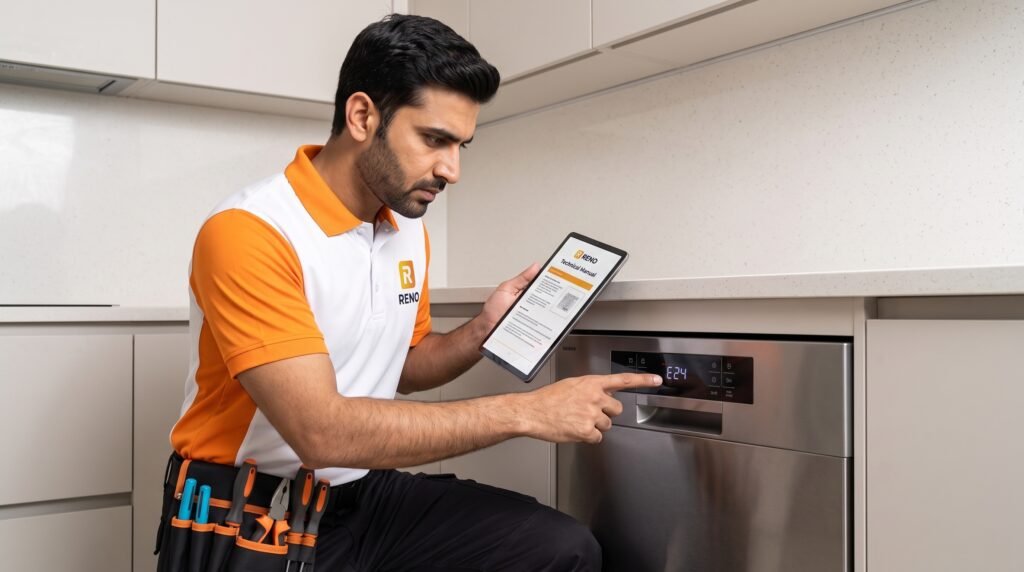
A dishwasher error code names the failed subsystem, not the failed part. The control board reports a coded fault when filling, drainage, heating, leak protection, door control, or electronic communication falls outside its programmed range.
A flashing E15, 5C, IE, or F9E1 code can stop a dishwasher mid-cycle and leave you guessing. The code points to a subsystem, such as drainage, filling, heating, or leak protection. It does not confirm that one part has failed.
That difference matters. Replacing a pump, valve, heater, or control board based on the code alone can waste money and leave the original fault unresolved. The correct diagnosis starts with the full code, the dishwasher model, the cycle stage, and the symptoms around the failure.
This guide explains dishwasher error codes by brand, including Bosch, Siemens, Samsung, LG, Whirlpool, Beko, Hotpoint, Teka, Baumatic, Ariston, and Indesit. It covers digital displays, blink patterns, reset-safe codes, technician-only faults, and code-to-subsystem mapping. It also examines Dubai-specific causes, including low building water pressure, hard-water scale, and voltage dips that can trigger valid codes without proving component failure.
When an error code returns after safe external checks, professional dishwasher repair in Dubai can test the supply, wiring, sensors, pumps, heaters, and electronic modules before any part is replaced.
What is a dishwasher error code?
A dishwasher error code is a coded signal produced when the control board detects an operating value outside its programmed range. The code identifies the subsystem. Testing finds the blockage, installation issue, supply condition, wiring fault, or defective component.
Among common dishwasher problems, error-code faults require careful separation of the displayed code, the visible symptom, and the component that performs the monitored function.
A code names the subsystem. A symptom describes its behavior. A component performs the monitored function. Keeping these layers separate reduces unnecessary parts replacement.
How do you read a dishwasher error code?
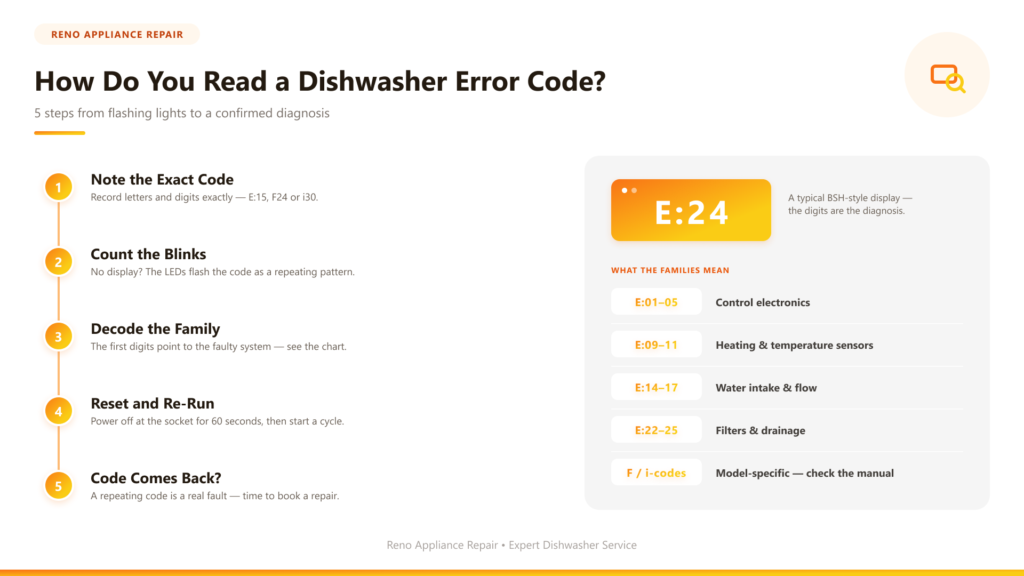
Read the full code, record the model number, and note the cycle stage. E15, 5C, IE, and F9E1 use different brand code families, even when two codes point to the same subsystem.
Use this 4-step sequence:
- Photograph the code before switching off the dishwasher.
- Record standing water, pump noise, leakage, heat, and recent power interruptions.
- Find the complete model number on the door edge or rating plate.
- Match the code with the official manual for that exact model.
How do you read a code on a display model?
Record every letter, digit, and separator exactly. E15, 5C, IE, and F9E1 belong to different brand code families. Photograph the display before switching off because a reset can erase stored evidence.
Also note standing water, pump noise, visible leakage, and any recent power interruption. These details connect the coded signal to the actual dishwasher symptom.
Repeated stopping mid-cycle gives the code more diagnostic value because the stage of interruption identifies the subsystem active when the programme failed.
How do you read a blink pattern on a display-less model?
Count each flash group and each pause. Whirlpool Product Help uses 2 flash groups on supported models.
7 flashes, a 1- to 2-second pause, one flash, and a 5-second pause mean F7E1. The first group gives the function number. The second gives the error number.
Hotpoint Support also uses LED combinations. The layout can be horizontal or vertical, so each light position must match the model documentation.
How do you enter service or test mode safely?
Enter service mode only through the exact service document for the model. Teka’s service manual shows test stages for filling, heating, washing, regeneration, and drainage.
Do not remove panels or bypass the door interlock. Service mode can energize pumps and the 1,800-watt heater listed in Teka’s documented platform. A sequence from another model can produce misleading results.
Professional home appliance repair is appropriate when test mode exposes live circuits, hidden pumps, heater loads, or model-specific service functions.
What do error codes mean by subsystem?
Most dishwasher error codes fit 6 subsystem groups. The group determines the first checks and the point where technician testing begins.
- Water intake codes
Water intake codes mean the control did not confirm enough water within its time or flow limit. Check the tap, inlet hose, filter, building pressure, and previous-cycle drainage.
LG Support records IE after 10 minutes without the required water level. LG specifies 20 to 120 pounds per square inch. Bosch lists a 10-litre-per-minute flow check for supported fill faults. Beko specifies 0.3 to 10 bar.
A dishwasher not filling after the tap, hose, and building pressure have been checked requires testing of the inlet valve, flow meter, level sensor, or related wiring.
- Drainage codes
Drainage codes mean water remained after the allowed pump-out period. Check the filter, sump, pump cover, drain hose, sink connection, and disposal inlet where fitted.
Bosch E24 and E22, Samsung 5C, LG OE, Hotpoint F03, and Whirlpool F9E1 belong to this group. These codes identify a drainage failure. They do not prove that the drain pump has failed.
A dishwasher not draining after filter and hose checks may have a restricted pump path, sink connection fault, weak pump, or incorrect water-level feedback.
- Heating codes
Heating codes mean the control could not reach, regulate, or confirm the target temperature. The fault path includes the heater, temperature sensor, relay, wiring, water level, and mineral deposits.
Teka records E3 after 60 minutes of heating without the required temperature. LG uses HE for failed heating or water above 149°F, equal to about 65°C.
A dishwasher not heating water requires testing of the heater, temperature sensor, relay output, wiring, water level, and mineral scale before any part is replaced.
- Leak and anti-flood codes
Leak codes mean a float, base sensor, or overflow circuit detected water. Close the supply tap and stop repeated resets.
Teka E4 activates after the overflow switch remains active for more than 2 seconds. The same service document assigns E4 the highest fault priority. Bosch E15, Samsung LC, Hotpoint F01, and Beko E:01 also belong to leak protection.
- Door and interlock codes
Door codes mean the control cannot confirm a safe closed-door state. Check racks, tall utensils, cabinet panels, the strike, and hinge alignment before testing the latch circuit.
Do not bridge the interlock. The switch prevents operation with an unconfirmed door position. Bosch identifies E8000 as a door-sensor circuit fault on supported controls.
A dishwasher not turning on can share a door-interlock, supply, harness, or interface fault even when the visible symptom resembles a main-electronics failure.
- Board and communication codes
Communication codes mean two electronic modules failed to exchange valid data. Wiring, connectors, moisture, supply voltage, and failed electronics share this diagnostic path.
Samsung Gulf identifies CA as a communication failure between the main and subprinted board assemblies. Hotpoint identifies F12 as a communication failure between the main board and display.
A suspected control board fault should be confirmed only after supply voltage, connectors, harnesses, moisture exposure, and communication lines have been tested.
What do the most common codes mean by brand?
The five-column dishwasher error code list supports sorting by brand, code, subsystem, or reset status when added to a sortable WordPress table.
“Yes” means one reset is reasonable after external checks. “No” means the code needs further diagnosis.
| Brand | Code | Subsystem | Dishwasher error code meaning | Resettable |
|---|---|---|---|---|
| Bosch | E15 | Leak protection | Water in the base tray | No |
| Bosch | E24 | Drainage | Restricted drain path | Yes |
| Bosch | E09 | Heating | Heating-system fault | No |
| Bosch | E22 | Drainage | Blocked filter system | Yes |
| Siemens | E15 | Leak protection | Water in the floor tub | No |
| Siemens | E24 | Drainage | Hose, siphon, cover, or pump restriction | Yes |
| Baumatic | E1 | Water intake | Fill time exceeded | Yes |
| Baumatic | E4 | Leak protection | Water detected in the base | No |
| Teka | E1 | Water intake | Fill exceeded 4 minutes | Yes |
| Teka | E3 | Heating | Heat time exceeded 60 minutes | No |
| Teka | E4 | Leak protection | Overflow switch active over 2 seconds | No |
| Hotpoint | F01 | Leak protection | Anti-flood overflow | No |
| Hotpoint | F03 | Drainage | Drain failure or timeout | Yes |
| Hotpoint | F10 | Heating | Heating-element fault | No |
| Hotpoint | F12 | Communication | Main-board and display fault | No |
| Samsung | 4C | Water intake | Insufficient water supply | Yes |
| Samsung | 5C | Drainage | Water cannot drain correctly | Yes |
| Samsung | LC | Leak protection | Leakage detected | No |
| Samsung | HC | Heating | High-temperature heating fault | No |
| LG | IE | Water intake | Water level not reached in 10 minutes | Yes |
| LG | OE | Drainage | Drain failure | Yes |
| LG | HE | Heating | Heating failure or water above 149°F | No |
| LG | LE | Motor control | Motor or harness fault | No |
| Whirlpool | H2O | Water intake | Water not detected | Yes |
| Whirlpool | F9E1 | Drainage | Long-drain condition | Yes |
| Whirlpool | F8E4 | Leak protection | Water in the drip tray | No |
| Whirlpool | F7E2 | Wash motor | Wash-motor fault | No |
| Beko | E:02 | Water intake | Water supply interrupted | Yes |
| Beko | E:01 | Leak protection | Overflow or internal leakage | No |
- Bosch code reference
The Bosch Dishwasher Faults and Error Codes reference groups E15, E24, E09, and E22 by subsystem, but the complete model number still controls the correct meaning and reset procedure.
Bosch E15 means water reached the base tray. Close the tap and arrange a leak diagnosis. E24 points to the drain path, E22 starts with the filter system, and E09 requires heating-circuit diagnosis.
- Siemens code reference
The Siemens Dishwasher Faults and Error Codes reference separates leak, drainage, heating, and voltage conditions so a code is not mistaken for proof of one failed component.
Siemens E15 means water reached the floor tub. E24 points toward the hose, siphon, pump cover, or pump path. Supported models can also report E27 when incoming voltage falls outside the expected range.
- Samsung code reference
The Samsung Dishwasher Faults and Error Codes reference links 4C with water intake, 5C with drainage, LC with leak protection, and HC with heating conditions.
Samsung also lists bC2 or bE2 when a button remains pressed for more than 30 seconds. Match the full code and model before resetting the appliance.
- LG code reference
The LG Dishwasher Faults and Error Codes reference identifies IE as an intake condition, OE as drainage failure, HE as a heating fault, and LE as a motor or harness fault.
LG records IE after the required water level is not reached within 10 minutes. A returning HE or LE code requires service testing rather than repeated resets.
- Whirlpool code reference
The Whirlpool Dishwasher Faults and Error Codes reference groups H2O with water intake, F9E1 with long drainage, F8E4 with leak protection, and F7E2 with wash-motor operation.
Whirlpool display-less models can use two flash groups. Count the flashes and pauses exactly before matching the sequence with the model documentation.
- Beko code reference
The Beko Dishwasher Faults and Error Codes reference distinguishes E:02 water-supply interruption from E:01 overflow or internal leakage.
E:02 can clear after water returns on supported models. E:01 activates the safety response and requires leak diagnosis before another cycle.
- Hotpoint code reference
The Hotpoint Dishwasher Faults and Error Codes reference maps F01 to anti-flood protection, F03 to drainage, F10 to heating, and F12 to communication between the main module and display.
Display-less Hotpoint models can show the same faults through LED combinations, so the light positions must match the exact model manual.
- Teka code reference
The Teka Dishwasher Faults and Error Codes reference provides measurable timing limits for E1 filling, E3 heating, and E4 overflow detection on the documented platform.
Teka E1 appears after four minutes without the required flow count. E3 follows a 60-minute heating timeout, while E4 activates after the overflow switch remains active for more than two seconds.
- Baumatic code reference
The Baumatic Dishwasher Faults and Error Codes reference uses E1 for a fill timeout and E4 for water detected in the base.
For E1, check mains pressure, the inlet mesh, hose position, and tap before clearing the code. A base-water code requires leak diagnosis rather than a routine reset.
- Ariston code reference
The Ariston Dishwasher Faults and Error Codes reference must be matched with the full model or 12NC number because A-series meanings vary across control platforms.
Use the official document portal for the exact model. Do not transfer a code meaning from another Ariston platform solely because the letters or numbers look similar.
- Indesit code reference
The Indesit Dishwasher Faults and Error Codes reference depends on the complete model number because code families and cancellation sequences vary across control platforms.
Use the official Indesit document portal and avoid transferring a Hotpoint code meaning without matching documentation.
Which error codes can you reset yourself?
Reset only after correcting the external cause. One reset is reasonable for a cleared inlet restriction, cleaned drain path, or temporary power disturbance.
- Bosch: Hold “Reset 4 Sec.” or “Start” for about 4 seconds. The dishwasher drains for about 1 minute.
- Siemens: Hold Start for 3 seconds. The control returns to its start position.
- Baumatic: Correct E1, reconnect power, switch on, wait 5 seconds, then select a program.
- Teka: Cancel through the exact model manual. Teka control sequences differ by platform.
- Ariston and Hotpoint: Use the matching model manual. Do not apply one universal sequence to A-series and F-series machines.
- Samsung: Disconnect power at the breaker for 1 to 5 minutes after troubleshooting.
- LG: Switch off, isolate the breaker for 10 seconds, restore power, and test once.
- Whirlpool: Disconnect power for 30 seconds, then reconnect.
- Beko: E:02 clears after water returns on supported models. Program cancellation commonly uses a 3-second hold followed by a 2-minute drain.
- Indesit: Use the cancellation sequence in the exact model manual.
Which error codes need a technician?
Persistent leak, heating, motor, sensor, and communication codes require instrument-based diagnosis. These faults can involve continuity, resistance, insulation, pressure, or live-voltage testing.
Arrange service for:
- Bosch or Siemens E15 and E09
- Samsung LC and HC
- LG HE and LE
- Hotpoint F01, F10, and F12
- Teka E3 and E4
- Whirlpool F8E4 and F7E2
- Beko E:01
A complete dishwasher repair cost in Dubai assessment should account for diagnosis, labor, parts, cabinet access, testing, and warranty, with replacement approved only after the suspected component has been properly tested.
Why does the same code return after a reset?
The same code returns because a reset restarts the controller without removing the measured fault. Resetting clears stored error memory, but unresolved faults usually trigger the code again.
The persistence table separates what the reset changed from the condition that still needs testing.
| Returning code pattern | What remained | Next check |
|---|---|---|
| Fill code returns within minutes | Low pressure, blocked inlet, kinked hose, valve, or flow sensing | Measure supply and inspect inlet path |
| The drain code returns at pump-out | Filter, hose, pump, or sink restriction | Inspect the complete drain path |
| The leak code returns immediately | Water remains in the base or leakage continues | Close the tap and leak-test |
| The heating code returns mid-cycle | Heater, sensor, relay, wiring, water level, or scale | Arrange electrical and thermal tests |
| The communication code returns at startup | Connector, harness, moisture, voltage, interface, or board | Record the code and arrange service |
One completed cycle does not confirm repair. Confirm filling, heating, drainage, and leak-free operation through the manufacturer’s normal test cycle.
Which conditions in Dubai trigger codes that are not component failures?
Dubai building conditions can push a monitored value outside the dishwasher’s accepted range. The resulting code is valid, but the appliance part may still be serviceable.
Which codes appear from low building water pressure?
Low pressure can trigger Samsung 4C, LG IE, Baumatic E1, Teka E1, Beko E:02, Whirlpool H2O, or another model-specific fill code.
Use manufacturer thresholds before replacing the inlet valve:
- LG specifies 20 to 120 pounds per square inch.
- Beko specifies 0.3 to 10 bar.
- Bosch uses a 10-litre-per-minute flow check on supported models.
- Teka E1 records insufficient flow after 4 minutes.
Dubai Municipality treats building tanks, pipes, filters, pumps, and internal networks as parts of the building water system. DEWA’s water NOC requirements also require plans showing ground or underground water tanks.
Measure pressure at the dishwasher connection while the machine fills. A rooftop-tank, booster-pump, or partly closed building valve problem can imitate an inlet-valve fault. Replacing the valve before measuring pressure can save an unnecessary part.
Which codes appear from the hard-water scale?
Scale can slow heat transfer, obstruct spray jets, and restrict water paths. It does not create one universal hard-water dishwasher error code.
A heating timeout such as Teka E3 or Hotpoint F10 still requires component tests. Scale remains one possible cause, not a confirmed diagnosis. Hotpoint also identifies calcium deposits as a cause of cloudy or white marks.
The Emirates International Accreditation Centre lists accredited potable-water testing scopes that include total hardness as calcium carbonate. Use a measured result rather than assuming one hardness value for every Dubai building.
Baumatic’s water-softener table covers 6 settings. The documented range extends from 0 to 55 German degrees. Salt dosing rises from 0 to 60 grams per cycle as hardness increases. Baumatic’s manual provides the model-specific scale.
Which codes appear from voltage dips?
Low or interrupted voltage can trigger Siemens E27, Bosch E9001, Samsung 9C1 or 9C2, and LG PF on supported models. Siemens states that E27 can reflect low mains voltage rather than a dishwasher defect.
Dubai Electricity and Water Authority (DEWA) states a nominal 230/400 V supply, plus or minus 10 percent, at 50 Hz. The nominal 230 V range therefore spans about 207 to 253 V.
Record the code time and any light dimming or breaker activity. Test the dedicated circuit before approving a control-board replacement.
Which fault does each code group point you to?
Each code group points to a subsystem first. The next link connects that subsystem with the matching symptom guide and component checks.
| Code group | Subsystem | Symptom node | First checks |
|---|---|---|---|
| 4C, IE, E1, E:02, H2O | Water intake | Dishwasher not filling with water | Tap, pressure, hose, filter, valve, flowmeter |
| E24, E22, 5C, OE, F03, F9E1 | Drainage | Dishwasher not draining | Filter, sump, pump cover, hose, sink path |
| E09, HC, HE, F10, E3 | Heating | Dishwasher not heating water | Heater, sensor, relay, wiring, water level, scale |
| E15, LC, F01, E4, E:01, F8E4 | Leak protection | Dishwasher leaking water and anti-flood faults | Base tray, float, hoses, seals, pump body |
| Door-code family | Door control | Dishwasher door not locking | Latch, strike, hinge, seal, cabinet alignment |
| F12, CA, F6E1 | Electronics | Dishwasher control panel not responding | Connectors, harness, interface, board, supply voltage |
A code names the subsystem, a symptom describes its behavior, and a component performs the function. Keep those layers separate before replacing parts.
Treat the code as a diagnostic clue, not a parts list
A dishwasher error code gives you a starting point. It identifies the subsystem that reported the fault, while the actual cause may sit in the appliance, the installation, or the building supply. Replacing a pump, valve, heater, or board before confirming that cause can increase the repair cost without restoring the dishwasher.
Record the complete code, match it with the exact model, and check when it appeared. Reset intake and drainage codes only after clearing the external cause. Stop repeating resets when the dishwasher reports leakage, heating, motor, sensor, or communication faults. A returning code means the monitored condition still exists, even when the machine completes one cycle after restarting.
Dubai homes add another diagnostic layer. Rooftop tanks, booster pumps, mineral deposits, and voltage dips can trigger valid dishwasher fault codes without proving component failure. Measure the supply condition first. That single check can separate a building-side problem from an unnecessary appliance repair.
FAQs
Yes. The code can identify the correct subsystem while the actual cause is a blockage, low pressure, loose connection, or installation fault.
A photograph preserves the exact letters, digits, and blink pattern because a reset may clear useful diagnostic evidence.
Yes. Tank levels, booster-pump operation, and simultaneous water demand can reduce inlet pressure during part of the day.
No. A temporary condition can disappear during one cycle and return when the same pressure, temperature, drainage, or voltage condition occurs again.
Ahmed Al Mansoori
Ahmed Al Mansoori is a UAE-based home appliance repair specialist with over 12 years of hands-on experience in diagnosing and repairing washing machines, refrigerators, dishwashers, ovens, dryers, and other household appliances across Dubai and Abu Dhabi. He has worked with leading appliance brands and is known for delivering reliable repair solutions, preventive maintenance guidance, and same-day technical support for residential clients. Ahmed specializes in troubleshooting modern smart appliances and energy-efficient systems commonly used in UAE homes.
