
Dishwasher Not Turning On: Causes and Fixes
 August 3, 2026
14 min read
August 3, 2026
14 min read
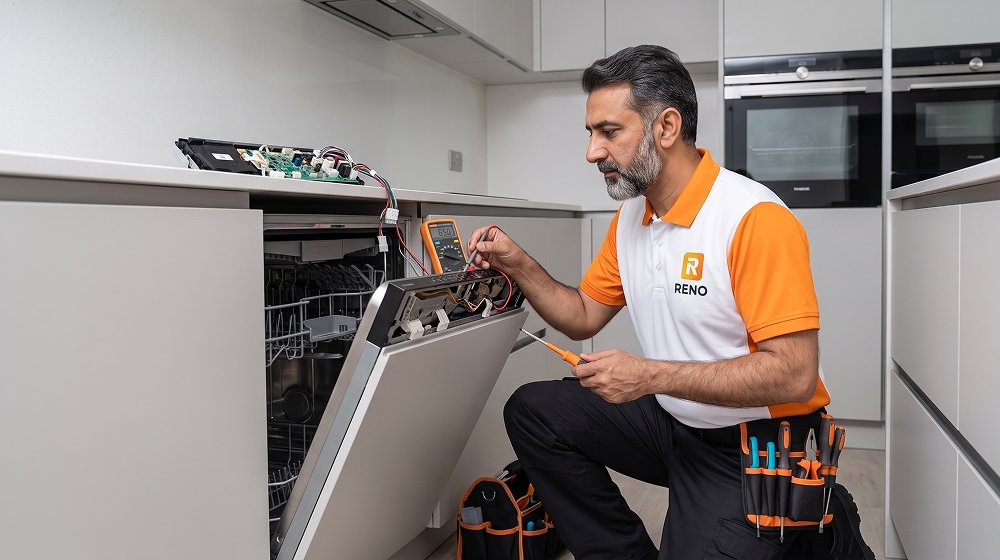
A dishwasher not turning on has either lost electrical supply or failed to receive a valid start signal. A blank display usually points toward the power path. Lit controls point toward the door latch, child lock, delayed start, or start command.
This article explains:
- The 7 main no-start causes in practical order
- Safe socket and Residual Current Device (RCD) checks
- Door and control settings
- Technician-only faults
- UAE electrical conditions
- Current Dubai repair costs
These checks help identify whether the fault needs a simple reset or professional dishwasher repair in Dubai. The aim is to rule out false faults first and avoid paying for the wrong repair.
Why is your dishwasher not turning on?
A tripped RCD or blown fuse is the likeliest of 7 common causes, followed by a dead socket or damaged cable and an unlatched door. You can check these 3 faults safely without removing panels or testing live electrical parts.
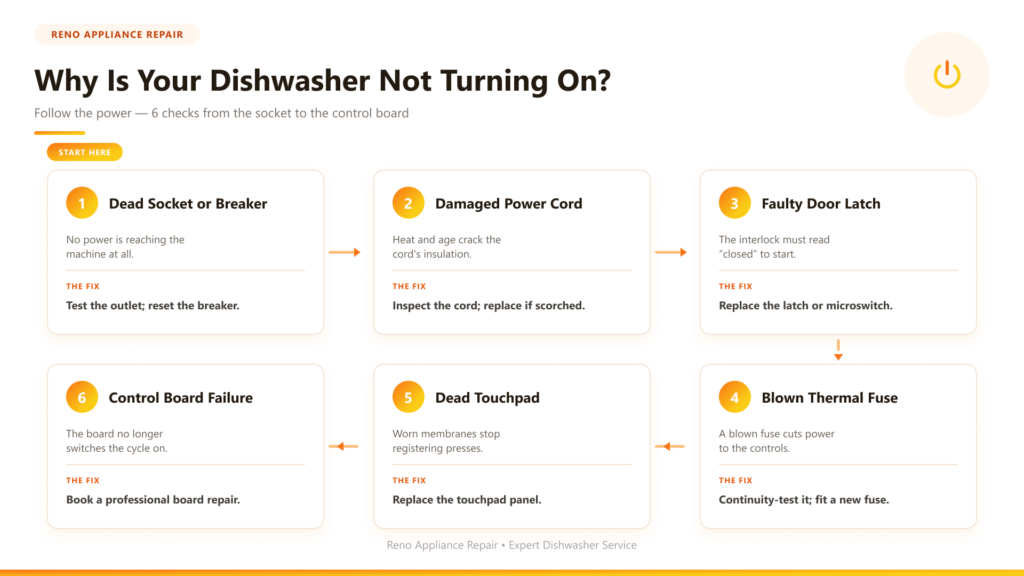
Child Lock, Delay Start, door-latch problems, and electrical faults are among the first checks. Bosch Home Appliances starts with the mains connection, socket, Residual Current Device (RCD), fuse, and door.
The table ranks diagnostic priority. It does not claim a Dubai failure percentage because no accredited UAE dataset reviewed for this article publishes one.
| Priority | Cause | Main clue | Owner check |
|---|---|---|---|
| 1 | Tripped RCD or blown fuse | Blank display and no sound | Reset once |
| 2 | Faulty socket or damaged cable | The test appliance fails, or damage appears | Test and inspect |
| 3 | Door latch not engaging | Lights appear, but Start fails | Clear door path |
| 4 | Active child lock | Lock icon or disabled keys | Release lock |
| 5 | Delayed start | Clock or hour value displayed | Cancel delay |
| 6 | Thermal fuse or on/off switch | Live socket, blank panel | Technician test |
| 7 | Board or wiring damage | Smell, moisture, flicker, or repeated trip | Isolate power |
What causes a no-power fault?
A no-power fault occurs when electricity cannot reach the dishwasher’s controls. Common causes include a tripped RCD or breaker, blown fuse, dead socket, loose plug, damaged power cable, failed thermal fuse or on/off switch, internal wiring damage, or a moisture-damaged control board.
A blank display with no sound usually indicates a true power-path fault. Lit controls suggest a no-start issue, such as an unlatched door, child lock, or delayed-start setting, rather than complete power loss.
How does a tripped RCD or blown fuse cut power to the machine?
A tripped RCD, circuit breaker, or fuse opens the supply path before power reaches the dishwasher. The display, indicator lamps, buttons, and pumps remain inactive.
Dubai Electricity and Water Authority (DEWA) sets Dubai’s nominal supply at 230/400 volts, 50 hertz, with a tolerance of ±10%. A domestic single-phase circuit therefore has a normal 207 to 253-volt range.
An RCD reacts to current leaking toward the earth. A breaker or fuse responds to overload or short-circuit current. The Dubai Building Code specifies 30-milliamp earth-leakage protection for dishwashers. Thirty milliamps equals 0.03 amperes.
Reset the device once. Leave it off when it trips again. A second trip points toward unresolved leakage, damaged insulation, wet wiring, or another electrical fault.
How does a faulty socket or damaged cable prevent start-up?
A failed socket, loose plug, crushed cable, or broken conductor blocks power before the dishwasher’s on/off switch. Built-in models often use a socket inside the adjacent sink cabinet.
Test the socket with another electrical product. GE Appliances identifies an adjacent cabinet or under-sink receptacle as a common connection point.
Inspect the only accessible cable. Look for cuts, flattening, melted insulation, discolored pins, corrosion, or moisture. Do not pull a fitted dishwasher forward to reach hidden wiring.
How does a door latch that is not engaging block the start signal?
A misaligned striker, obstructed rack, or failed latch switch can also leave the dishwasher door not locking even when the hinges and door seal remain intact.
An open or unlatched door prevents starting. A lower rack installed backwards can stop full closure.
Check pan handles, tall dishes, rack wheels, the door seal, and the latch striker. Close the door squarely. A click confirms mechanical movement, but not electrical continuity through the switch.
A lit panel with no response after firm closure narrows the fault toward latch alignment, the switch, its connector, or the control input.
How does an active child lock make the machine appear dead?
An active child lock disables control keys while the dishwasher still has power. The display may show a padlock, a key symbol, “CL,” or “LOC.”
Samsung Gulf instructs users to hold the relevant control for three seconds on supported models. The key may be Heated Dry, Sanitize, Control Lock, or a marked button pair.
Use the model manual rather than trying random combinations. Child lock is a control state, not proof of a failed control panel.
How does a delayed start setting hide a working machine?
Delayed start stores a cycle and postpones operation. The appliance has power, but the water valve and pumps remain inactive until the timer expires.
Samsung Gulf documents a 1 to 24-hour range in one-hour increments on supported models. Cancel or Cancel/Drain clears a delayed wash on many machines.
Look for a clock icon, “h,” or an hour value. Cancel the timer, select a fresh programme, press Start once, and close the door.
Child lock and delayed start form 2 of 7 categories in this guide, or 28.6%. That figure describes the checklist, not Dubai service-call frequency.
How does a failed thermal fuse or on/off switch cut power?
An intermittent switch, loose terminal, or overheating connection may first appear as a dishwasher stopping mid-cycle before the electrical path fails completely. The fuse protects the control board from overheating and must never be bypassed.
Protection layouts vary by model. A technician uses the appliance wiring diagram, checks continuity, and inspects heat-damaged connectors before replacing a fuse or switch.
How does a water-damaged control board stop the machine starting?
Water, detergent solution, or condensation can corrode board tracks and connectors. Moisture can also create leakage toward earth, causing resets or an RCD trip.
A failed board supply, damaged display connector, or corroded circuit track can leave the dishwasher control panel dead while the wall socket still has power.
A blank display does not prove board failure. The incoming supply, thermal protection, on/off switch, latch circuit, and wiring can create the same symptom.
Whirlpool’s technical service manual states that electrostatic discharge as low as 10 volts can weaken or damage a main control assembly. Internal electronic work therefore requires correct grounding and handling.
Switch off the circuit when moisture appears near the control housing, cable entry, or socket.
How do you diagnose a no-power fault step by step?
Follow the power path from the wall toward the control board. Each step removes one fault group without opening the machine.
- Test the socket with another appliance
Switch off the socket and unplug the dishwasher. Inspect the plug, then connect a small working appliance suited to the outlet.
A failed test points toward the socket, isolator, RCD, breaker, or building circuit. A successful test moves the diagnosis inside the dishwasher. Bosch Home Appliances recommends this socket test.
- Check the consumer unit for a tripped RCD
Find the labelled dishwasher, kitchen, socket, or appliance circuit. Move the tripped handle fully to Off, then back to On once.
Record when the RCD trips. An immediate trip suggests direct leakage or a short. A trip during heating shifts attention toward the heater, wet wiring, or combined circuit leakage.
Do not repeat the reset. The Dubai Building Code specifies 30 mA protection for this appliance class.
- Press the door firmly shut and listen for the latch
Push both racks inward. Remove anything touching the inner door, then close the door with even pressure.
Problems with the dishwasher door latch often involve striker alignment, a worn microswitch, loose wiring, or an obstruction near the door.
A click shows mechanical engagement. It does not prove that the microswitch changed state. Racks and pan handles are simple closure obstructions.
- Check the display for a child lock or delayed start indicator
Read every lit symbol before pressing more keys. A lock symbol identifies a blocked input. A clock or hour value identifies a stored timer.
Hold the specified lock control for the manual’s stated duration. Samsung uses three seconds on supported models. Cancel Delay Start, then start the programme again.
Samsung Gulf notes that holding Start for more than three seconds can cancel and drain on supported models.
- Confirm the main cable is undamaged at the cabinet entry
Inspect the visible cable where it enters the cabinet or appliance space. Check for crushing, sharp bends, heat marks, loose grommets, and water.
Stop when damage appears. Cable replacement, terminal work, and insulation testing belong to a qualified technician or electrician.
Which checks can you safely do yourself?
Five external checks stay within normal owner access. They require no panel removal, multimeter, or contact with live terminals.
- Test the socket with a suitable working appliance.
- Reset the RCD once after checking for water, heat, and visible damage.
- Close the door firmly after clearing racks, utensils, and sealing obstructions.
- Cancel delayed start using the timer or Cancel control.
- Hold the child lock key for the time stated in the manual.
Which of these faults needs a technician?
Professional home appliance repair becomes necessary when the fault involves the thermal fuse, on/off switch, control board, or internal wiring. These components expose mains electricity and require proper technical testing.
Faults in the dishwasher control board can affect incoming power, display operation, relays, programme selection, and the start command.
A technician traces voltage through the terminal block, fuse, switch, latch circuit, harness, and control-board supply. This sequence prevents an expensive board from replacing a cheaper failed connection.
Choose an electrician when the socket, fixed cable, consumer unit, or property circuit fails. Choose an appliance technician when a confirmed supply enters the dishwasher but disappears internally.
Repeated tripping, scorching, smoke, crackling, or water near wiring requires immediate isolation.
How much does it cost to fix a no-power fault in Dubai?
Dubai cost depends on brand, model, cabinet access, diagnosis time, part supply, and whether the fault sits in the appliance or building circuit.
A June 2026 Dubai repair-cost benchmark places diagnosis at AED 150 to AED 250. Minor labor sits near AED 150 to AED 350. Major electronic work reaches AED 700 to AED 1,000 or more.
An April 2026 Dubai electrical-cost guide places standard residential electrical labor near AED 129 to AED 150 per hour. Standard electrical work can reach AED 250 per hour, depending on the fault and technician.
| Cause or service | Dubai planning cost | Price date and basis |
|---|---|---|
| Child lock or delayed-start cancellation | AED 0 | Set 1 August 2026 |
| Diagnostic visit | AED 150 to AED 250 | Published 20 June 2026 |
| Socket or circuit diagnosis | AED 129 to AED 250 per hour | Published 28 April 2026 |
| Door-latch repair | AED 150 to AED 350 | Set 1 August 2026 |
| Thermal fuse or on/off switch | AED 250 to AED 500 | Set 1 August 2026 |
| Internal wiring repair | AED 250 to AED 650 | Set 1 August 2026 |
| Control-board diagnosis or repair | AED 300 to AED 1,000 or more | Set 1 August 2026 |
The component rows are planning ranges derived from published visit, labor, minor-repair, and major-electronic bands. They are not fixed quotations.
A written quote needs the dishwasher model, confirmed diagnosis, part number, Value Added Tax (VAT), cabinet-access charge, and repair warranty. Compare the dishwasher repair cost in Dubai before approving a control board.
Is your dishwasher off, or is it in delayed start or child lock?
A dishwasher is truly off when a confirmed live socket produces no display, sound, drain response, or button reaction. Delayed start and child lock normally leave a visual clue.
- Blank panel and dead socket: Investigate the property supply.
- Blank panel and live socket: Investigate the cable, fuse, switch, wiring, or board.
- Lit clock or hour value: Cancel delayed start.
- Lit lock symbol or disabled keys: Release child lock.
- Lit panel and no latch response: Inspect the door and latch circuit.
The 2 false faults represent 2 of 7 categories, or 28.6% of this diagnostic checklist. That percentage is not a Dubai call-out statistic.
A repair business can calculate its actual false-fault rate with this formula:
- Child-lock cases + delayed-start cases ÷ all confirmed no-start visits × 100
Publish the result only after reviewing confirmed service records. The service record must identify the final cause rather than the customer’s original symptom.
How does UAE electrical supply affect dishwasher electronics?
UAE mains electricity normally does not damage a dishwasher designed for a 220–240 V supply. Dubai Electricity and Water Authority specifies a nominal 230 V supply with a tolerance of ±10%, giving an expected operating range of approximately 207–253 V. Problems arise when voltage dips, electrical surges, poor earthing, or earth leakage interrupt the dishwasher’s electronic supply.
Why does a 220-240V supply with voltage dips damage control boards?
A normal UAE supply does not damage a dishwasher rated for 220 to 240 volts. DEWA specifies 230 volts with a ±10% tolerance, equal to 207 to 253 volts.
A voltage dip falls below the expected level for a short period. Voltage sags, dips, and short interruptions can disrupt connected equipment. A dishwasher control board may reset when its internal low-voltage supply drops out.
A blank panel alone does not prove voltage damage. The socket voltage, incoming connection, fuse, switch, latch circuit, and board supply require separate tests.
Why does a shared kitchen RCD trip when the dishwasher heats?
A shared RCD trips when combined leakage crosses its operating threshold. The Dubai Building Code lists 30 mA protection for dishwashers and several similar domestic appliances.
Heating can reveal weakened insulation. A dishwasher may start normally, then trip when the heater energizes. That symptom differs from a machine that remains completely dead before the cycle starts.
Record whether the trip occurs at power-on, fill, wash, heat, or drain. The cycle stage directs diagnosis toward different electrical components.
Why does a surge protector extend control board life?
A correctly selected surge-protective device limits short, high-voltage transients by diverting surge current toward the earth. It protects electronics from events outside the normal operating band.
Eaton states that surge protective devices divert surge current and identifies Type 1, Type 2, and Type 3 protection levels. Fixed protection requires correct coordination and earthing.
A surge protector does not correct low voltage, wet wiring, a loose neutral, or a failing control board. Use a qualified electrician for fixed surge protection. Do not connect a dishwasher through a multi-socket strip.
Which related dishwasher problems share the same cause?
A no-start symptom overlaps with door, control, and power-circuit faults. The symptom may change as the failed component deteriorates, but the diagnostic path still follows the same subsystem.
A latch fault can begin with difficult door closure and later block the start signal. A loose electrical connection may interrupt a running cycle before leaving the appliance completely dead.
Control-board damage can affect the display, programme selection, relays, or incoming low-voltage supply. The failed component determines whether the machine remains blank, starts intermittently, or stops after a specific cycle stage.
A dishwasher not turning on becomes easier to diagnose once the symptom is tied to one failed point. Confirm the external power path, remove the two false faults, then test the latch, fuse, switch, wiring, and control board.
Identify the fault before replacing parts
A dishwasher that does not turn on rarely needs an immediate control-board replacement. Start with the socket, RCD, door latch, delayed start, and child lock. These five checks require no panel removal and can separate a simple control setting from a genuine power fault.
A no-start fault shares causes with several common dishwasher problems, including interrupted cycles, dead controls, and doors that fail to lock. Linking the symptom to the failed component prevents unnecessary part replacement.
Stop troubleshooting when the RCD trips again, the cable shows damage, or moisture appears near electrical parts. Thermal fuses, internal wiring, switches, and control boards require proper testing. A clear diagnosis protects the appliance, reduces unnecessary costs, and makes dishwasher repair in Dubai easier to price accurately.
FAQs
Yes, a child lock, delayed start, or an open door latch can block the start command while the control panel still has power.
No, the click confirms mechanical engagement, but it does not confirm electrical continuity through the latch microswitch.
Heating can expose weakened heater insulation, causing earth leakage that crosses the dishwasher circuit’s 30 mA protection threshold.
Provide the model number, display condition, trip timing, error code, visible damage, and the socket, RCD, door, lock, and timer checks already completed.
Ahmed Al Mansoori
Ahmed Al Mansoori is a UAE-based home appliance repair specialist with over 12 years of hands-on experience in diagnosing and repairing washing machines, refrigerators, dishwashers, ovens, dryers, and other household appliances across Dubai and Abu Dhabi. He has worked with leading appliance brands and is known for delivering reliable repair solutions, preventive maintenance guidance, and same-day technical support for residential clients. Ahmed specializes in troubleshooting modern smart appliances and energy-efficient systems commonly used in UAE homes.
