
Dishwasher Not Filling With Water: Causes and Fixes
 August 1, 2026
17 min read
August 1, 2026
17 min read
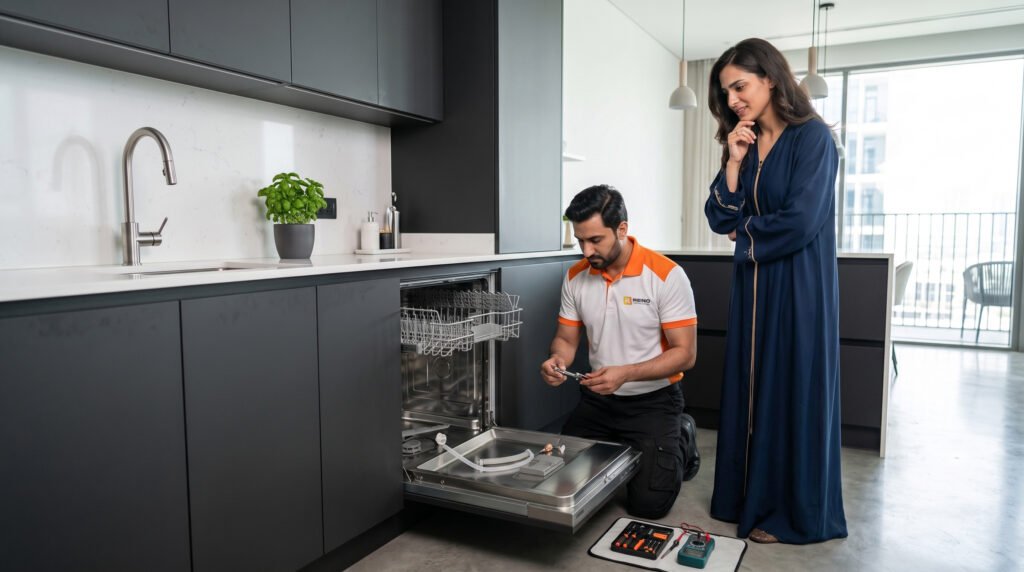
A partly closed supply valve is the likeliest of six water-intake faults, followed by a blocked inlet screen and low supply flow. You can check these three causes. Solenoid, AquaStop, flow-meter, and control-board faults require technical diagnosis.
A dishwasher not filling with water cannot begin effective washing because the tub receives no water or too little water. The appliance may drain first, hum, display a tap symbol, stop during filling, or complete a cycle with dirty dishes.
The fault does not always start at the dishwasher. An under-sink valve, restricted hose, blocked mesh screen, weak apartment supply, or building booster-pump problem can reduce water delivery.
One diagnosis deserves early attention. A dishwasher that will not fill may have already leaked into its lower base tray. The leak activates the anti-flood float, blocks new water intake, and can keep the drain pump running.
This guide helps you identify the failed point, complete safe checks, and understand the likely cost of dishwasher repair in Dubai.
Why is your dishwasher not filling with water?
A partly closed supply valve is the most likely cause, followed by a blocked inlet screen and inadequate water flow. You can check all three. A failed inlet valve, anti-flood trip, float fault, or electronic failure requires deeper diagnosis.
Bosch Home Appliances places the water valve, hose condition, tap flow, and inlet filter first in its no-water troubleshooting sequence. Bosch uses approximately 10 liters per minute as the practical tap-flow benchmark.
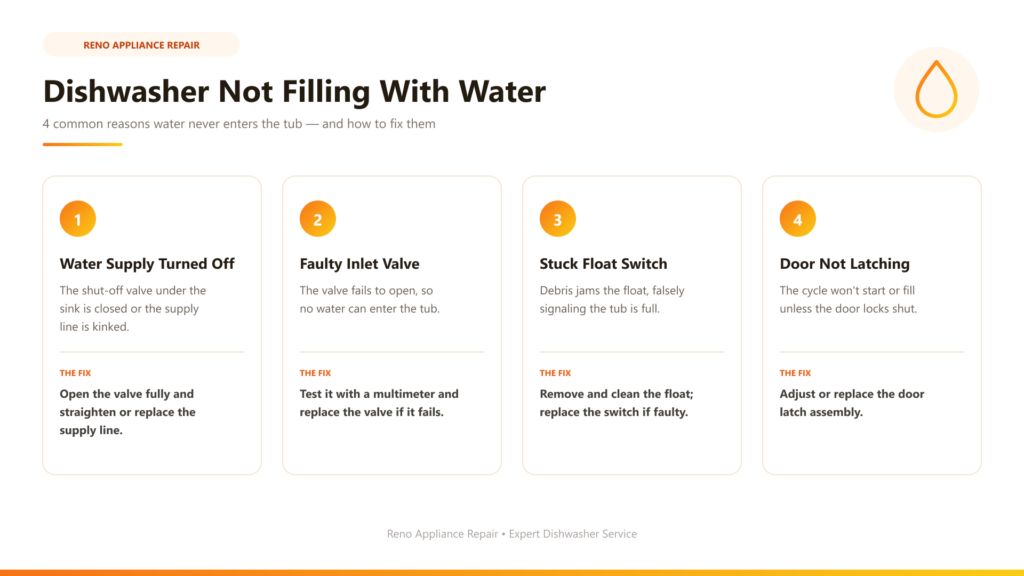
Some home appliance repair services recommend the 4 checks for a dishwasher not taking water:
- Confirm supply
- Inspect the hose
- Measure flow
- Clean the filter
The table below ranks checks by diagnostic priority. The ranking reflects manufacturer troubleshooting order, not a published failure-rate survey.
| Possible cause | Diagnostic likelihood | Main inspection point | Owner-fixable? |
|---|---|---|---|
| Closed or partly closed supply valve | Check first | Isolation valve under the sink | Yes |
| Blocked inlet screen | High priority | Hose or valve connection | Usually |
| Low tap flow or building pressure | High priority | Dishwasher supply outlet | Test only |
| Tripped anti-flood device | Medium priority | Base tray beneath the tub | Limited |
| Stuck float or float switch | Medium priority | Tub floor or base assembly | Basic inspection only |
| Failed inlet valve solenoid | Component-level fault | Lower inlet-valve assembly | No |
| Failed flow meter or control board | Component-level fault | Internal hydraulic or electronic system | No |
The order prevents unnecessary parts replacement. A new inlet valve cannot correct a closed stopcock, weak supply flow, or a blocked mesh screen.
What causes a water intake failure?
A dishwasher water-intake failure occurs when the external supply cannot deliver water, the inlet valve cannot open, or a sensor blocks the fill command. Six fault paths explain most no-fill symptoms.
How does a closed or partly closed supply valve stop the fill?
A closed supply valve blocks the dishwasher’s water path. A partly closed valve reduces flow and can make the appliance exceed its programmed fill period.
The isolation valve usually sits under the kitchen sink beside the dishwasher inlet hose. Cleaning, plumbing work, cabinet installation, or a tenant handover may leave the valve partly closed.
Confirm that the water-supply valve remains fully open when a dishwasher has no water.
Check the valve position:
- A lever handle normally aligns with the pipe when open.
- A wheel valve opens by turning anticlockwise.
- A seized, corroded, or leaking valve belongs to a plumber.
- A kinked hose can restrict flow even when the valve is open.
Do not force a stiff stopcock. A damaged spindle seal can turn a no-fill fault into an under-sink leak.
How does a blocked inlet screen restrict water entry?
A blocked inlet screen reduces water volume before water reaches the inlet valve. The fine mesh catches grit, pipe debris, rust particles, rubber fragments, and mineral deposits.
The filter may sit inside the hose connection, AquaStop coupling, or inlet-valve port. Its position varies by brand and model.
Close the tap, remove the supply hose, clean the filter under running water, use a small brush, reconnect the hose, and check for leakage.
A restricted screen can produce 5 clear symptoms:
- Water enters slowly.
- The cycle stops during filling.
- A tap symbol appears.
- Filling works intermittently.
- Wash performance drops because the tub receives too little water.
Clean the screen without piercing the mesh. Never remove it permanently. The screen protects the valve seat and internal waterways.
How does a failed inlet valve solenoid prevent filling?
A failed solenoid stops the inlet valve from opening after the control board sends the fill command.
The valve contains an electrical coil and a mechanical plunger. Energizing the coil creates a magnetic field that moves the plunger and opens the water passage.
Four faults can interrupt that action:
- A burned or open solenoid coil
- A seized internal plunger
- A blocked valve body
- A damaged wire or connector
A click at cycle start suggests that the valve receives a command. It does not prove that water passes through the valve.
No click can indicate a failed coil, broken wiring, open door switch, raised float, anti-flood lockout, or control-board fault. Electrical testing requires resistance and live-voltage measurements near water. A technician handles that stage.
How does a tripped anti-flood device cut the water supply?
A tripped anti-flood device blocks new water after leakage reaches the dishwasher’s lower base tray.
This fault changes the direction of diagnosis. A dishwasher not filling with water may actually be a leaking dishwasher protecting the kitchen from further water release.
A float rises when water collects in the tray. The float switch signals the control system to close the inlet path. Some machines also run the drain pump continuously.
Whirlpool Product Help explains that water in the drip tray can activate the float system and interrupt normal operation. Excess detergent foam can also push water into the tray.
Bosch describes its AquaStop design as a double-wall hose system that contains escaping water and activates a shut-off valve.
Drying the tray may clear the immediate signal. Drying does not repair the leak. Check these source areas:
- Inlet-hose unions
- Water inlet valve
- Pump housing
- Sump joints
- Internal hoses
- Door seal
- Excessive detergent foam
Repeatedly resetting the machine can hide the warning while the leak continues.
How does a stuck float switch tell the board the tub is already full?
A raised float tells the control board that the dishwasher already contains enough water. The board then withholds the fill command.
Some dishwashers place an overfill float inside the tub. Other models place the leak float below the tub in the base tray.
Check whether the accessible overfill float moves freely and remove debris that restricts its movement.
Food particles, detergent residue, a warped float, or a jammed microswitch can hold the float up. An accessible tub float usually moves vertically with little resistance.
Do not dismantle a sealed base system. Internal continuity testing requires access to electrical connectors and model-specific service data.
How does low building water pressure abort the fill stage?
Low delivered flow prevents the dishwasher from collecting its required water volume within the programmed fill period.
Bosch and Siemens UAE specify approximately 10 liters per minute from the fully opened tap as a practical flow check.
That benchmark converts into:
- 10 liters in 60 seconds
- 5 liters in 30 seconds
- 2.5 liters in 15 seconds
- 0.167 liters per second
Pressure requirements vary by dishwasher. A Miele installation specification lists a water connection range of 100 to 1,000 kilopascals (1 to 10 bar) for the referenced models. The same document lists a maximum inlet-water temperature of 60°C.
Another Miele installation requirement states that short programme cycles require at least 200 kilopascals, equal to 2 bar, for the cited commercial models.
Use the pressure range in your own dishwasher manual. Do not apply one model’s specification to every appliance.
How do you diagnose a water intake failure step by step?
Diagnose the water path in sequence. Check the supply valve, measure tap flow, inspect the inlet screen, look for water in the base tray, then assess the inlet-valve sound.
Disconnect electrical power before touching hoses, lower panels, wiring, or internal parts. Close the water valve before removing the inlet hose.
- Confirm the supply valve is fully open
Locate the dishwasher isolation valve under the sink. Open it fully and inspect the valve body, hose union, and cabinet floor for moisture.
Start a short cycle. Many dishwashers run the drain pump before filling, so a brief initial drain sound can be normal.
A drain pump that continues without filling points toward an anti-flood trip, stuck float, or control fault.
- Disconnect the inlet hose and check flow into a bucket
Switch off the dishwasher at the socket or breaker. Close the supply valve. Place towels and a measured bucket below the connection.
Remove the inlet hose, direct the valve outlet into the bucket, and open the valve carefully. Record the amount collected over 30 seconds.
Use this calculation:
- Collected liters × 2 = liters per minute
A 30-second result of 5 liters equals Bosch and Siemens’ 10-liter-per-minute benchmark.
Weak flow at the bare valve places the fault upstream of the dishwasher. Check the apartment valve, pressure regulator, tank supply, booster pump, or branch pipe.
- Inspect the inlet screen for scale and grit
Close the valve again. Inspect the mesh at the hose or appliance connection.
Rinse the screen under clean water. Use a soft brush for attached debris. Avoid needles, drill bits, and sharp metal tools.
Replace the filter if the mesh is torn, crushed, loose, or badly corroded. A damaged screen allows debris into the inlet valve.
- Check the base tray for water indicating an anti-flood trip
Inspect the lower tray only where the manufacturer provides safe access. Some models expose the area behind the toe-kick. Others require removal from the cabinet.
Look for:
- Standing water
- Detergent residue
- White mineral tracks
- Rust staining
- A raised safety float
- Moisture below the inlet valve
Treat any water as leak evidence. Do not describe the result as a simple reset problem.
- Listen for the inlet valve clicking at cycle start
Close the door and start a cycle. Listen after the initial drain period.
A click followed by flowing water supports normal valve operation. A click without flow points toward a blocked screen, closed supply, failed valve mechanism, AquaStop restriction, or low pressure.
No click requires electrical diagnosis. The missing command may involve the door latch, float switch, wiring, flow-control system, or control board.
Which checks can you safely do yourself?
Complete 5 supply-side checks. Stop when the repair exposes wiring, requires cabinet removal, involves a leaking valve, or reveals water returning to the base tray.
- Open the valve. Confirm that the isolation valve reaches its fully open position.
- Check flow. Measure water into a bucket and calculate liters per minute.
- Clean the screen. Rinse accessible mesh and brush away attached debris.
- Dry the base tray. Remove accessible water after isolating power, then identify the leak source.
- Restart the cycle. Reconnect the hose, check for leaks, and run one monitored test.
DIY versus technician decision box
DIY check: closed valve, kinked hose, accessible screen, measured tap flow, or removable tray water.
Technician diagnosis: failed solenoid, refilling base tray, internal leak, AquaStop failure, flow-meter fault, damaged wiring, or control-board fault.
A power reset does not clear a physical blockage or repair a leaking component. Perform a reset only after completing the supply checks.
Which of these faults needs a technician?
Four intake-system faults require electrical testing, internal access, or model-specific replacement work.
- Test the failed solenoid coil. The technician checks resistance, supply voltage, wiring, and valve movement.
- Diagnose the failed flow meter. A defective meter may stop sending volume pulses while water enters.
- Inspect the water-damaged control board. Moisture can corrode tracks, connectors, relays, and solder joints.
- Replace the AquaStop hose. The hose may contain a powered shut-off valve and internal conductors.
Some water-intake hoses contain electrical connections and cannot be shortened.
Technical help also makes sense for a dishwasher fixed under stone worktops or fitted cabinetry. Poor removal can damage flooring, cabinet edges, hoses, or the power cable.
How much does it cost to fix a water intake failure in Dubai?
Dishwasher water-intake repair in Dubai ranges from about AED 150 for diagnosis or minor labor to AED 1,000 or more for major component work, based on published June and July 2026 pricing. Brand, part availability, access, and warranty terms affect the quote.
The table provides planning figures. It does not replace an appliance-specific quotation.
| Water-intake fault | Dubai planning range | What the range may include |
|---|---|---|
| Diagnosis or call-out | AED 150 to AED 250+ | Inspection, fault identification, basic testing |
| Valve opening, screen cleaning, minor hose work | AED 150 to AED 350+ | Labor, cleaning, refitting, minor consumables |
| Water inlet valve replacement | AED 300 to AED 800+ | Part, labor, testing, brand variation |
| Locally advertised inlet-valve repair range | AED 150 to AED 280 | Provider-listed valve price and scope may vary |
| AquaStop or specialist inlet-hose replacement | AED 300 to AED 800+ | Hose assembly, valve unit, labor |
| Flow meter or sensor diagnosis and replacement | AED 300 to AED 800+ | Hydraulic sensor, access, testing |
| Control-board repair or replacement | AED 700 to AED 1,000+ | Board work, programming, parts, labor |
A Dubai repair provider listed AED 150 to AED 280 for inlet-valve work and AED 300 to AED 500 for control-board work when checked on 30 July 2026. The provider’s scope and part grade require confirmation before comparison.
Ask whether the price includes the call-out, original or compatible parts, Value Added Tax, cabinet removal, leak testing, and a written labor warranty. Compare the quote with the dishwasher’s age and replacement value before approving board-level work.
How do you check dishwasher water pressure in a Dubai apartment?
Check delivered flow with a measured bucket first. A pressure gauge measures static pressure, but the bucket test shows the volume available while water moves.
Use this 6-step method:
- Close the dishwasher supply valve.
- Disconnect the inlet hose.
- Place the outlet inside a measured bucket.
- Open the valve fully.
- Collect water for 30 seconds.
- Multiply the result by two.
5 liters in 30 seconds equals 10 liters per minute. 3 liters equals 6 liters per minute. 2 liters equals 4 liters per minute.
Repeat the test at two times if the dishwasher fails intermittently. A strong result during low-demand hours and a weak result during peak use indicates a building-side variation.
Give building maintenance four measurements:
- Liters per minute
- Test time
- Apartment floor
- Flow at a nearby kitchen tap
Those figures provide stronger evidence than saying the pressure “feels low.”
How does building water supply in the UAE affect dishwasher filling?
A UAE apartment’s tank, booster pump, pressure regulator, pipe layout, and floor level control the water delivered to the dishwasher branch.
Dubai Electricity and Water Authority (DEWA) supplies water to the property connection. The building’s internal plumbing then delivers that water to each apartment and appliance.
Normal flow at the kitchen mixer does not prove normal flow at the dishwasher valve. The appliance branch has its own stopcock, connector, filter, hose, and pressure losses.
How do rooftop tank systems change delivered pressure through the day?
Rooftop tanks create gravity pressure, while booster pumps raise or stabilize pressure across building floors.
Delivered flow can change when the tank level falls, the pump controls cycle, filters restrict supply, or several apartments draw water at once. The dishwasher may then miss its timed fill target.
The DEWA water-system specification uses duty- and standby-boosting pumps, with pump activation based on pressure drop and demand. This confirms the role of building booster systems in maintaining internal supply pressure.
Measure flow during the fault. Do not replace the inlet valve before confirming the building supply.
How does scale from hard water block the inlet screen faster?
Mineral deposits can narrow a wet inlet screen when dissolved calcium and magnesium leave scale on the mesh. Pipe grit and tank sediment can create the same restriction.
A Miele technical specification permits water hardness up to 6.5 millimoles per liter for the cited models. That limit equals roughly 650 milligrams per liter as calcium carbonate.
That specification is an appliance limit, not a claim that every Dubai property has the same hardness.
Inspect the material before naming the cause:
- White crust suggests mineral scale.
- Brown particles suggest corrosion or sediment.
- Black fragments may come from rubber components.
- Clear slime may indicate residue inside a neglected connector.
Photograph the screen before cleaning. The image can help a plumber trace recurring contamination.
Why do AquaStop hoses fail more often on high-pressure risers?
AquaStop hoses do not automatically fail on every high-pressure riser. Risk rises when pressure exceeds the appliance limit, surges occur, fittings carry strain, or the hose has aged.
The referenced Miele models accept 100 to 1,000 kilopascals, equal to 1 to 10 bar. Miele also warns that trapped air and pressure surges can damage dishwasher components.
Check 4 conditions:
- Pressure stays within the model rating.
- The hose has no tight bend.
- The fitting carries no sideways load.
- The outer casing has no crack, bulge, or corrosion.
A pressure-reducing valve belongs to the plumbing system. An appliance technician diagnoses the AquaStop unit.
Which related dishwasher problems share the same cause?
Four related faults connect through the same intake components. Follow the failed component instead of treating each symptom as a separate event.
- Dishwasher leaking and triggering anti-flood protection: Water leaking from the sump, hose, pump, or inlet valve can collect in the base tray and trigger dishwasher leaking water and anti-flood faults.
- Dishwasher cycle stopping at the fill stage: When the dishwasher cycle stops during filling, restricted water flow, a faulty inlet valve, or an absent flow-meter signal are common diagnostic areas.
- Dishwasher inlet-valve failure: A faulty coil may prevent the valve from opening, while internal blockage can restrict water flow, two key checks in dishwasher water inlet valve diagnosis.
- Dishwasher float-switch failure: A false full-tub signal from a stuck float can interrupt filling, placing the fault within dishwasher float-switch symptoms and testing.
Wash quality depends on water reaching the tub at the correct time and volume. Begin under the sink. Move through the inlet screen, base tray, float system, inlet valve, and electronic controls in that order.
Fix the water path before replacing dishwasher parts
A dishwasher that does not fill rarely needs immediate parts replacement. Start with the water path. Open the supply valve, measure the tap flow, inspect the inlet screen, and check the base tray before testing internal components.
The base tray deserves special attention. A no-fill dishwasher may already have leaked, raised the anti-flood float, and blocked further water intake. That link between leakage and filling failure changes the diagnosis completely.
Use the bucket result to separate an appliance fault from a building-supply problem. Five liters in 30 seconds equals 10 liters per minute, which matches the practical flow benchmark used in the article. A weak result at the bare supply valve places the restriction upstream of the dishwasher.
Stop the inspection when water returns to the base tray, the inlet valve requires electrical testing, or the AquaStop assembly shows damage. Those signs point to a failed component or an active leak, not a simple reset issue.
The most accurate repair follows one clear order: supply valve, water flow, inlet screen, anti-flood tray, float system, inlet valve, and electronic controls. Following this sequence helps trace common dishwasher problems to their actual source, reduces guesswork, protects the kitchen, and helps you approve only the repair the dishwasher actually needs.
FAQs
Yes, the drain pump can work normally while a closed valve, blocked screen, failed inlet valve, or anti-flood system prevents fresh water from entering.
Recurring blockage points to sediment, mineral deposits, pipe corrosion, tank debris, or a damaged hose releasing particles into the mesh screen.
No, a click confirms mechanical or electrical movement, but a blocked valve body or weak water supply can still prevent water from entering.
Yes, excess foam can enter the base tray, activate the anti-flood float, and stop the dishwasher from accepting more water.
Ahmed Al Mansoori
Ahmed Al Mansoori is a UAE-based home appliance repair specialist with over 12 years of hands-on experience in diagnosing and repairing washing machines, refrigerators, dishwashers, ovens, dryers, and other household appliances across Dubai and Abu Dhabi. He has worked with leading appliance brands and is known for delivering reliable repair solutions, preventive maintenance guidance, and same-day technical support for residential clients. Ahmed specializes in troubleshooting modern smart appliances and energy-efficient systems commonly used in UAE homes.
