
Dishwasher Parts and What Each One Does
 July 30, 2026
14 min read
July 30, 2026
14 min read
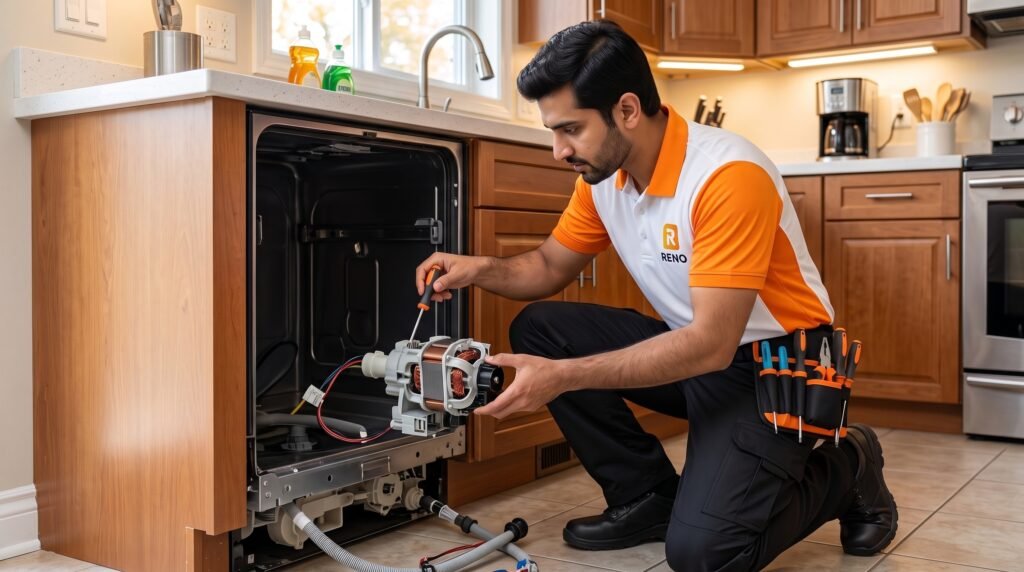
Dishwasher parts and what each one does become easier to understand when you follow the water path inside a dishwasher. Separate functional components admit, heat, circulate, drain, and contain water.
During dishwasher repair in Dubai, a no-drain complaint points toward different components than a no-heat complaint. The model number still controls part compatibility. A dishwasher can stop filling, leave dirty water behind, or run without heating. Each symptom points to a different component, not one universal fault.
Inside the cabinet, 12 main serviceable component groups manage water entry, circulation, heating, drainage, sealing, cycle control, and detergent release. That distinction matters before any dishwasher repair in a Dubai home. Replacing the wrong part wastes time, raises the repair cost, and can leave the original fault untouched.
This guide explains what each dishwasher part does and how each component supports the wash cycle. It covers:
- Inlet valves
- Hoses
- Pumps
- Heaters
- Spray arms
- Sensors
- Filters
- Door hardware
- Control boards
- Dispensers
It also compares built-in, freestanding, and countertop designs, then connects common symptoms with the parts worth checking first.
What are the main parts of a dishwasher?
A dishwasher has 12 main serviceable component groups within its cabinet: inlet plumbing, flood protection, circulation pump, heater, spray arms, temperature sensor, filter and sump, drain system, door seal, latch and hinge hardware, electronic controls, and detergent and rinse-aid dispenser.
These groups contain the individual dishwasher parts below. Manufacturers sometimes combine a heater with the wash pump, yet each function remains distinct.
- Inlet plumbing admits and filters supply water.
- Flood protection monitors unsafe water levels or base-tray leaks.
- The circulation pump pressurizes wash water.
- The heater raises water or drying temperature.
- Spray arms distribute water across the load.
- The temperature sensor reports heat conditions.
- The filter and sump collect water and debris.
- The drain system removes wastewater.
- The door seal contains water inside the tub.
- Latch and hinge hardware secure and balance the door.
- Electronic controls sequence each load.
- The dispenser releases detergent and rinse aid.
A Bosch owner manual labels 16 visible interior items. These include two spray arms, a three-part filter, detergent storage, and rinse-aid storage. Hidden parts add pumps, valves, sensors, wiring, and control modules.
Which parts control water entering the dishwasher?
The inlet system admits a measured charge of clean water and stops filling before the tub overflows. A fill fault can originate outside the machine. Check the tap, pressure, hose, and screen before blaming the valve.
Bosch UAE specifies 0.05 to 1 megapascal for one dishwasher installation range. That equals 0.5 to 10 bar. The same guidance requires at least 10 liters per minute.
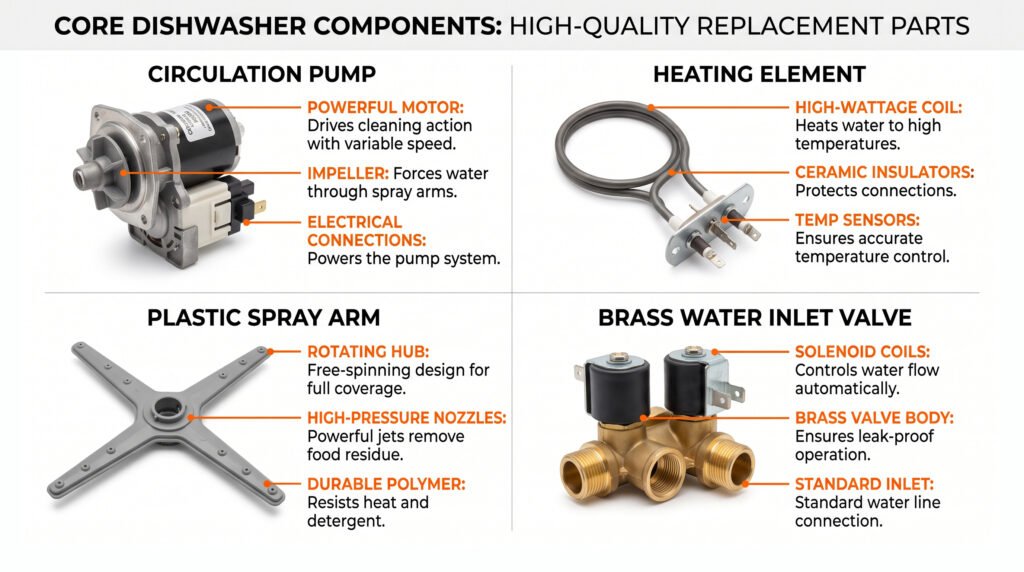
Water inlet valve
The water inlet valve opens and closes the household water path into the dishwasher.
The control board energizes the valve during each fill. A restricted valve can cause low water volume, weak spray pressure, long cycles, or a no-fill code. A valve that cannot close can admit water after the control stops requesting it.
Whirlpool identifies the inlet valve as the component that controls how much water enters during a cycle. Samsung documents one platform that expects about 237 flow-meter pulses per liter during filling. That figure shows how precisely some machines verify inlet volume.
Inlet hose and inlet screen
The inlet hose carries supply water, and the inlet screen traps particles before water reaches the valve.
A kink reduces flow without creating an electrical fault. A blocked screen produces the same visible result as a weak valve.
A technician therefore separates hydraulic restriction from valve failure before ordering dishwasher parts.
Replace a damaged hose with the model-approved type. Bosch UAE advises fitting a new supply hose when replacing the appliance. Its cited guidance limits warm inlet water to 60°C.
Float switch and anti-flood device
The float switch and anti-flood device interrupt filling or start drainage when water reaches an unsafe location.
Traditional tub floats rise with the water level. Base-tray systems detect leakage beneath the tub.
Whirlpool’s F8E4 guidance links drip-tray water with the float assembly and a protective drain response.
Samsung gives leakage detection priority over other listed errors on one dishwasher platform. The drain pump then runs while other electrical loads remain off.
Which parts circulate and heat the water?
The wash circuit reuses sump water, adds heat, and distributes pressurized jets through rotating arms.
Poor cleaning can therefore involve water volume, pump pressure, heat, blocked nozzles, or temperature feedback.
Circulation (wash) pump and motor
The circulation pump and motor pressurize sump water and drive that water through the spray system.
The motor turns an impeller that creates flow and pressure. Whirlpool lists the pump and motor as separate functional roles within one assembly.
A failing wash pump can produce humming, grinding, intermittent washing, or clean dishes on one rack only.
First exclude blocked filters and spray arms. Both restrictions can imitate pump weakness.
Heating element or flow-through heater
The heating element or flow-through heater raises wash-water temperature and supports heated drying on applicable models.
Exposed elements sit near the tub floor. Flow-through heaters warm water inside a hydraulic housing.
Whirlpool recommends incoming water near 49°C for its cited dishwashers.
A heating fault can leave grease, wet plastics, or a heater error. Samsung’s cited HE logic checks whether water reaches the required temperature within the programmed period.
Upper, lower and ceiling spray arms
The upper, lower and ceiling spray arms distribute pressurized water across different rack levels.
A typical dishwasher uses two rotating arms. Some designs add a third ceiling arm.
Water exits angled nozzles, and the reaction force turns the arm without a separate arm motor. Blocked jets reduce coverage. A utensil can also stop rotation.
Bosch warns that limescale and soil can block the nozzles and arm bearings. The manufacturer recommends checking the outlets under running water.
NTC temperature sensor
The negative temperature coefficient (NTC) sensor reports wash-water temperature to the control board.
An NTC sensor changes electrical resistance as temperature changes. The control board compares that signal with the selected programme and heater activity.
Bosch lists one NTC sensor at 10 kilohms at 25°C. Sensor values vary between dishwasher models.
A short or open circuit can produce a temperature-sensor error. Samsung labels that condition “tE” on one documented platform.
Which parts remove water and debris?
The debris and drain system protects the pumps, holds recirculated water, and sends used water to the household waste connection.
Filter assembly and sump
The filter assembly captures food debris, and the sump holds water for circulation and drainage.
Bosch describes a three-stage filter containing coarse, fine, and micro elements. The same manual tells users to check the filters after each wash. Residue can restrict water movement.
The sump sits below the filter. Glass, bones, labels, or seeds can pass into this area when a filter sits incorrectly. That debris can jam either pump.
Drain pump
The drain pump expels wastewater from the sump into the drain hose.
A small motor turns the drain impeller. Standing dirty water can indicate blockage, a loose pump cover, damaged wiring, or pump failure.
Bosch notes that large food remnants and glass fragments can block the wastewater pump. The manufacturer directs users to isolate power before accessing that area.
Drain hose and high loop
The drain hose carries wastewater to the sink waste, and the high loop limits dirty-water backflow.
A kink increases pump resistance. A low or incorrectly routed hose can allow sink water to return after the dishwasher drains.
GE specifies a minimum high-loop height of 32 inches above the floor for its cited installation arrangement.
Dubai installations vary by cabinet and siphon design. Follow the model manual and local plumbing arrangement rather than copying a universal hose height.
Which parts seal and secure the machine?
The door system contains pressurized spray, confirms safe closure, and controls the physical movement of the door.
Door seal (gasket)
The door seal closes the gap between the tub and door during operation.
Food, detergent residue, twisting, or hardened rubber can create a leakage path.
A blocked spray arm can direct unusual pressure toward the seal. A front leak does not automatically prove gasket failure.
Checking arm rotation before replacing the upper seal.
Door latch and interlock switch
The door latch secures the door, and the interlock switch confirms closure before the cycle starts.
Whirlpool explains that the latch operates a safety switch. That switch tells the dishwasher that the door has closed.
A misaligned rack, loose strike, or defective switch can therefore create a no-start complaint.
Do not bypass the interlock. The switch forms part of the appliance’s operating safety chain.
Door springs and hinge cables
The door springs and hinge cables counterbalance the door’s weight during opening and closing.
A broken cable often lets one side fall faster. A weak spring makes the full door drop.
An overtightened system can pull the door upward. Integrated furniture panels also change the load placed on the hinges.
European Union Ecodesign rules require 10-year availability for door hinges and seals after a model leaves the market. That rule measures parts availability, not guaranteed lifespan.
Which parts control the cycle?
The electronic and dosing components select the programme, process sensor inputs, switch electrical loads, and release chemicals at scheduled points.
Control board (PCB)
The printed circuit board (PCB) controls washing, heating, draining, and drying functions.
The board receives signals from the latch, NTC sensor, flood device, and user interface. It then switches valves, pumps, heaters, and dispensers.
GE describes one main control board as managing the washing, draining, and drying cycles.
A board fault can imitate several failed parts. Check supply voltage, connectors, sensors, and output loads before replacing the PCB.
Touch panel and display module
The touch panel accepts cycle commands, and the display module reports status, time, settings, and fault codes.
Some models combine the interface and control board. Samsung Gulf lists running indication, delay time, and codes among the display’s functions.
Moisture, a stuck key, or a broken ribbon cable can create erratic input. A blank panel can also originate from the latch, mains supply, or main board.
Detergent and rinse aid dispenser
The detergent and rinse-aid dispenser stores each chemical and releases it at the programmed stage.
The detergent door opens for the main wash. The rinse-aid chamber meters a smaller final-rinse dose.
Whirlpool confirms timed release for both products.
Caked detergent can block the lid. A failed solenoid, wax motor, spring, or control signal can leave the tablet trapped after the cycle.
Which dishwasher parts fail most often?
Repair records report symptoms more reliably than confirmed failed components. Use symptom frequency to rank the first component groups worth testing.
Do not use a reported symptom alone to declare a part defective.
Archimede recorded 224,554 dishwasher interventions between July 2019 and March 2026.
No-drain complaints represented 12.4%. No-fill complaints accounted for 10.0%, while water leaks represented 8.6%.
The service-life figures below provide practical inspection windows. Manufacturers do not rate these ranges as guaranteed part lifespans.
The ranges combine the reported repair pattern with a 10-year consumer benchmark. The United States Department of Energy assumes a 15.2-year average dishwasher life in its analysis.
| Order | Reported fault | Share of interventions | Parts tested first | Service life (planning range) |
|---|---|---|---|---|
| 1 | Will not start | 15.0% | Latch, interlock, touch panel, PCB | 5–10 years |
| 2 | Error code | 14.3% | Sensor, PCB, pump, heater, flood device | 5–12 years |
| 3 | Will not drain | 12.4% | Filter, drain pump, hose | 6–10 years |
| 4 | Will not fill | 10.0% | Inlet hose, screen, valve, float switch | 6–10 years |
| 5 | Water leak | 8.6% | Door seal, hose, pump seal, anti-flood device | 5–12 years |
| 6 | Poor washing | 3.6% | Filter, spray arms, wash pump, heater | 7–12 years |
Condition matters more than age. Sand can stop a new inlet screen, while a clean pump can outlast the appliance.
Which parts differ between built-in, freestanding and countertop models?
Built-in, freestanding, and countertop dishwashers share the same hydraulic functions. Installation changes hose design, cabinet access, capacity, and component packaging.
How does cabinet integration change part access?
Cabinet integration restricts access to side panels, hoses, hinges, and the machine base.
A built-in model connects permanently beneath a worktop. Repair access often requires removal of fixing screws, a plinth, or a furniture panel.
A freestanding machine exposes more cabinet surfaces. A technician can usually pull the appliance forward with less dismantling.
Countertop models compress the pump, heater, sump, and controls into a smaller enclosure. Many use a faucet connector rather than permanent inlet plumbing.
Whirlpool distinguishes built-in units by permanent plumbing. The company describes portable models as faucet-connected appliances.
Which parts are shared across all three types?
All three types use an inlet path, wash pump, spray system, filter, drain path, door seal, controls, and detergent dispenser.
The architecture changes more than the function. A compact model may combine the wash pump and heater.
A built-in model may hide top controls beneath the counter. A freestanding model may place the same controls on the front.
Bosch UAE also requires integrated appliances used as freestanding units to receive anti-tip securing. That detail affects access and safe reassembly during repair
Which part does each dishwasher symptom point to?
A symptom identifies a test path, not a confirmed replacement.
Check simple restrictions before electrical parts. Then match the model number before ordering any dishwasher component.
| Dishwasher symptom | First component checks |
|---|---|
| No water enters | Tap, inlet hose, screen, inlet valve |
| Machine overfills | Float, float switch, inlet valve |
| Weak cleaning on every rack | Filter, circulation pump, heater |
| One rack stays dirty | Matching spray arm and feed tube |
| Water stays cold | Heater, NTC sensor, PCB output |
| A temperature error appears | NTC wiring and sensor resistance |
| Dirty water remains | Filter, drain pump, drain hose |
| Water returns after draining | Drain hose routing and high loop |
| Water leaks at the door | Spray arms, seal, latch alignment |
| Cycle will not start | Latch, interlock, interface, PCB |
| Buttons or display fail | Touch panel, cable, control board |
| Tablet remains trapped | Dispenser lid, actuator, loading clearance |
Start with the component that performs the missing action. The earlier cycle explains what happens; this component guide identifies what performs it.
That connection ties dishwasher parts and functions to each fault state.
Dishwasher parts and what each one does provide a repair map, but the model number provides the replacement decision. Isolate electricity and water before internal access.
Use trained service support for live voltage, heater, pump or control board diagnosis.
Match the failed function before replacing the part
A dishwasher fault becomes easier to trace when you start with the missing function. No water points toward the inlet path. Cold water shifts attention to the heater, temperature sensor, or control output. Standing wastewater directs the inspection toward the filter, drain pump, and hose.
The visible symptom still does not confirm the failed component. A blocked screen can resemble a defective inlet valve. A jammed spray arm can resemble a weak circulation pump. Even a door leak can start with poor spray-arm movement rather than a damaged gasket.
Use the component’s job as the starting point, then check restrictions, connections, and installation before ordering a replacement. Match every dishwasher part to the model number, since dimensions, wiring, resistance values, and control logic can differ between similar machines.
A good repair does more than replace a part. It identifies why that part could no longer perform its function.
FAQs
Yes, restricted water flow, failed sensors, damaged wiring, and control-board faults can produce similar symptoms, so the function needs testing before replacement.
One rack can remain dirty when its spray arm, nozzle openings, or water-feed connection becomes blocked while the main circulation pump still operates.
No, an error code identifies a fault circuit or operating condition, but the sensor, wiring, connected component, or control board can cause that condition.
A new dishwasher can develop these problems when the inlet hose kinks, the screen blocks, the drain hose sits incorrectly, or cabinet installation restricts the plumbing.
Ahmed Al Mansoori
Ahmed Al Mansoori is a UAE-based home appliance repair specialist with over 12 years of hands-on experience in diagnosing and repairing washing machines, refrigerators, dishwashers, ovens, dryers, and other household appliances across Dubai and Abu Dhabi. He has worked with leading appliance brands and is known for delivering reliable repair solutions, preventive maintenance guidance, and same-day technical support for residential clients. Ahmed specializes in troubleshooting modern smart appliances and energy-efficient systems commonly used in UAE homes.
