
White Film and Limescale Residue on Dishes: Causes and Fixes
 August 4, 2026
15 min read
August 4, 2026
15 min read
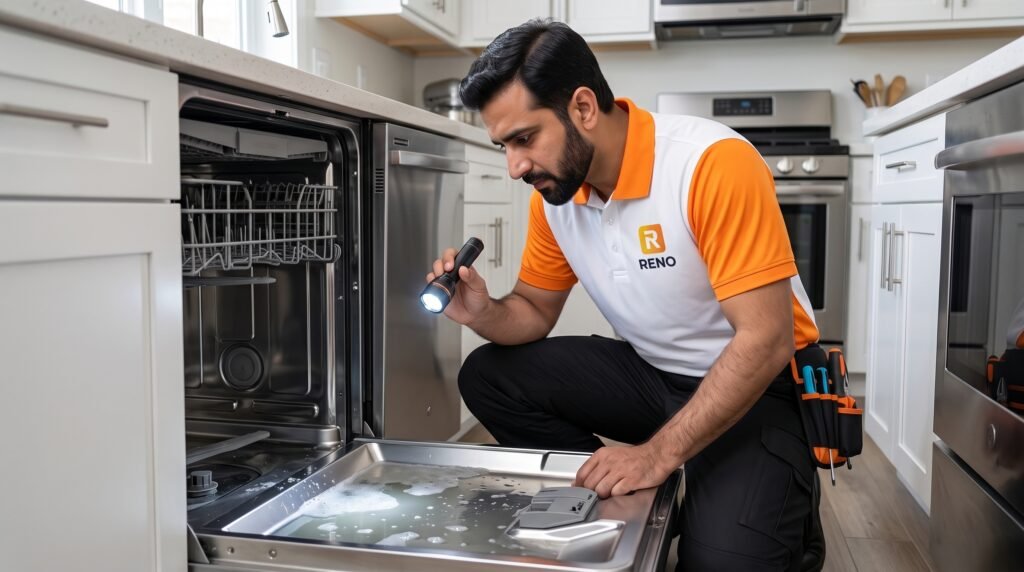
A dishwasher can complete a full cycle and still leave glasses cloudy, plates chalky, and cutlery covered in white residue. In Dubai homes, hard water is often the main cause. An empty salt reservoir, incorrect hardness setting, low rinse aid, excess detergent, or internal limescale can create a similar result.
The first task is identifying whether the white film is removable. A simple vinegar test can separate mineral deposits from permanent glass etching. That distinction matters because adding more detergent can make etched glassware worse.
This guide explains:
- The 6 main causes of white film on dishes
- The checks that are safe to complete at home
- The faults that require a dishwasher technician
It also covers Dubai water hardness settings, internal inspection points, descaling steps, and likely repair costs in AED.
When setting changes and descaling do not stop the residue, professional dishwasher repair in Dubai can diagnose softener, heating, circulation, or internal scale faults.
Why is your dishwasher leaving white film on dishes?
Hard water is the likeliest cause, followed by low rinse aid and excess detergent. You can correct these three causes by refilling salt, adjusting settings, or reducing detergent after testing whether the white film is removable.
Hardness comes mainly from dissolved calcium and magnesium. The United States Geological Survey classifies water above 180 milligrams per liter as calcium carbonate as very hard. Water between 121 and 180 milligrams per liter is hard.
The table ranks causes by practical diagnostic likelihood in a Dubai dishwasher. It does not represent a published fault-rate survey.
| Diagnostic rank | Likely cause | Typical appearance | Fastest confirmation | Owner-fixable? |
|---|---|---|---|---|
| 1 | Hard water, missing salt, or a low hardness setting | Chalky film across glasses, cutlery, and the tub | Vinegar removes the deposit | Yes |
| 2 | Low or empty rinse aid | Spots, droplets, or patchy white marks | Check the rinse-aid indicator | Yes |
| 3 | Excess or unsuitable detergent | Milky glass, powder, or rough cloudiness | Reduce the measured dose for three loads | Usually |
| 4 | Low temperature or poor detergent release | Grainy powder and unfinished tablet material | Inspect the dispenser after a cycle | Sometimes |
| 5 | Scale inside the dishwasher | The film returns after every temporary cleaning | Inspect spray jets, filter, sump, and element | Partly |
| 6 | Permanent glass etching | Cloudiness stays after vinegar cleaning | Compare with a hand-washed glass | No |
A removable chalky film usually identifies mineral or detergent residue. A permanent dull surface points towards etching, scratches, or silica-related glass damage.
White residue can overlap with common dishwasher problems when weak circulation, low heat, or poor rinsing leaves detergent and minerals on the load.
What causes white residue?
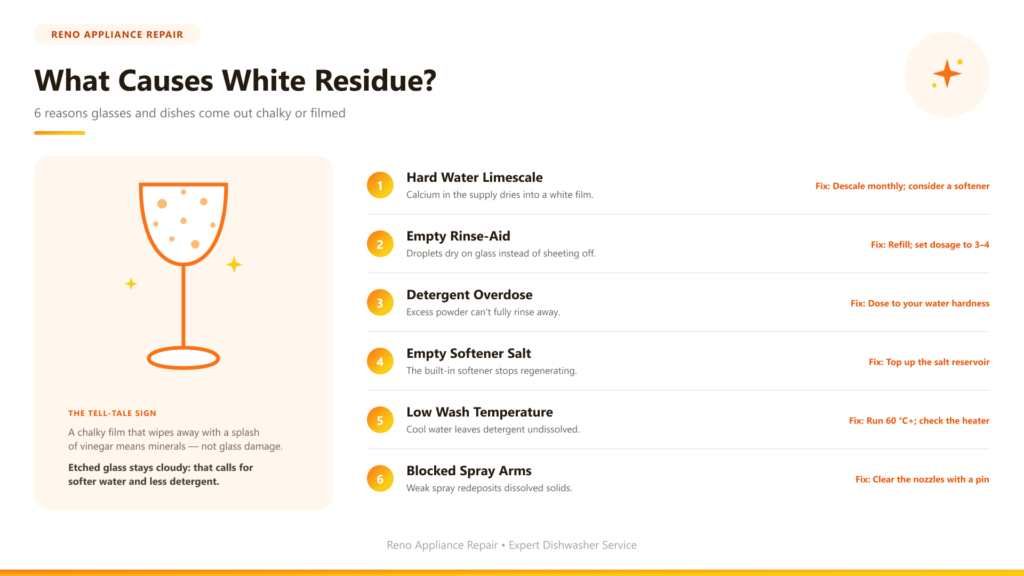
White residue forms when minerals, detergent, or rinse water remain on a surface after drying. The location and texture of the mark help identify the failed process.
Correct use of salt and rinse aid addresses two different processes: the softener reduces hardness minerals, while rinse aid helps water drain from surfaces.
How does missing dishwasher salt leave calcium deposits?
Dishwasher salt regenerates the appliance’s internal ion-exchange softener. The softener removes hardness minerals before heated washwater reaches your dishes.
An empty salt reservoir stops effective regeneration. Calcium and magnesium then remain in the water and dry as white residue on dishes, glasses, steel walls, and spray arms. Dishwasher salt supports the internal softener and reduces hardness-related marks.
Use only special dishwasher salt. Detergent must never enter the salt reservoir because detergent damages the softening system.
How does an incorrect water hardness setting under-soften the water?
The hardness setting controls how frequently the dishwasher regenerates its softener. A low setting uses too little salt for the incoming mineral load.
Bosch models with H00 to H07 controls divide hardness into eight settings. H00 covers 0 to 1.1 millimoles per liter, while H07 covers 5.5 to 8.9 millimoles per liter. Other brands use degrees of German hardness, grains per gallon, or numbered levels.
Match the setting to a measured sample from the kitchen tap. Do not copy a neighbor’s setting because separate buildings may use different tanks, pipes, filters, or softeners.
How does low or empty rinse aid leave drying spots?
Rinse aid lowers water’s surface tension during the final rinse. Water forms a thin sheet and drains instead of remaining as mineral-rich droplets.
Rinse aid reduces filming, water spots, and incomplete drying. Increase the dispenser level when clear droplets dry into pale circles. Reduce it when glassware develops blue or rainbow-colored streaks.
A dishwasher not drying properly may leave mineral-rich droplets on glassware, especially when rinse aid is low or the final rinse is too cool.
Rinse aid cannot correct an empty salt reservoir or a failed softener. It limits droplet marks but does not remove calcium and magnesium from the incoming water.
How does overdosed detergent etch glassware permanently?
Excess detergent creates highly alkaline wash conditions. The risk rises when the dishwasher receives softened water, lightly soiled loads, or prolonged hot cycles.
GE Appliances identifies excess detergent in soft water as a cause of glass etching. Electrolux describes etching as surface damage that resembles film but cannot be wiped away.
Reduce powder or gel in measured stages. A fixed tablet offers less dose control, especially during small loads. Replace etched glasses only after the vinegar test confirms that no removable deposit remains.
How does overdosed detergent etch glassware permanently?
Excess detergent can attack glass in soft water, lightly soiled loads, or long hot programmes. The alkaline wash removes surface material and leaves fine pits.
Too much detergent in soft water is a common cause of permanent milky discoloration. Cut detergent by half after a household softener is installed. Whirlpool also links etching with soft water, high detergent concentration, and heat.
Etching cannot be cleaned away. Reduce detergent and select a glass programme to protect undamaged items.
Fixed-dose tablets give limited control during small or lightly soiled loads. Measured powder or gel provides clearer evidence during diagnosis.
How does the scale in the machine redeposit on every load?
Limescale can collect on the heater, sump, filter housing, tubes, and spray-arm holes. Heated water loosens particles and returns them to the load.
Food, grease, undissolved detergent, and water minerals accumulate inside dishwashers. Bosch recommends a dedicated descaler on an empty machine using the longest, hottest cycle.
Siemens UAE advises a programme of at least 65°C for its machine-cleaning procedure. Siemens also recommends annual descaling in hard or very hard water.
Film that returns after salt, rinse aid, and detergent corrections points toward internal deposits or a failed softener.
A dishwasher not cleaning dishes may share the same blocked jets, weak circulation, or undissolved detergent that allow white residue to remain.
How do you diagnose white residue step by step?
Start with one affected glass. A controlled test gives clearer evidence than changing several settings at once.
- Distinguish removable film from permanent etching with a vinegar test
Apply a small amount of white vinegar to one cloudy area. Leave it for five minutes, rub gently with a soft cloth, then rinse and dry the glass.
The deposit is mineral film if the treated patch becomes clear. The glass is probably etched if the surface remains cloudy, rough, or pitted. Whirlpool and KitchenAid both use vinegar removal as the main distinction between filming and etching.
Do not pour concentrated vinegar into the salt reservoir, rinse-aid chamber, or detergent dispenser. Use a manufacturer-approved descaler for the machine itself.
- Check the salt reservoir and the hardness setting
Remove the lower rack and locate the round salt cap beside the filter assembly. Open the cap only when the manual confirms that your model has an internal softener.
Check for a salt warning light, loose cap, salt bridge, or spilled granules. Refill the reservoir immediately before a wash programme and close the cap firmly.
- Check the rinse aid level and dial position
Open the rinse-aid compartment beside the detergent cup. Fill it to the marked maximum level and wipe away spills.
Use the middle dispenser setting as a controlled starting point. Raise the dose by one level when water spots remain. Lower it by one level when colored streaks appear.
- Compare a glass washed by hand with one from the machine
Wash one matching glass by hand with the same tap water. Dry it immediately with a lint-free cloth.
A clear hand-washed glass and a cloudy machine-washed glass point towards dishwasher settings, detergent chemistry, heat, or internal scale. Cloudiness on both glasses points towards the water supply or pre-existing surface damage.
- Inspect the heating element and spray jets for scale
Disconnect power before touching removable internal parts. Inspect the lower spray arm holes, filter rim, sump opening, exposed heater, and stainless-steel wall.
White crust around several inspection points confirms a machine-wide mineral problem. Clear removable spray-arm blockages according to the manual. Leave wiring, heater terminals, pumps, and hidden sump parts untouched. Regularly check for blocked spray nozzles and filter residue.
Scale on the heating element can reduce heat transfer and contribute to undissolved detergent, longer programmes, or recurring mineral deposits.
Which checks can you safely do yourself?
Complete these 5 checks in order. Run one normal load after each change so you can identify the correction that worked.
- Refill salt. Use special dishwasher salt and tighten the reservoir cap.
- Set the hardness level. Match the control setting to a tap-water hardness test.
- Refill rinse aid. Start near the middle dose and adjust one level at a time.
- Reduce the detergent dose. Use a measurable powder or gel for test loads.
- Run a descale cycle. Use an approved product and the programme stated in the manual.
DIY versus technician decision box
Continue with DIY checks when vinegar removes the film, the dishwasher heats normally, and no error code appears.
Book a technician when residue returns after descaling, water stays cold, the machine trips the power, or the softener setting has no effect.
Which of these faults needs a technician?
A technician is appropriate when the failed process sits behind a sealed panel or requires electrical testing.
Professional home appliance repair is appropriate when testing requires access to wiring, pumps, sensors, or sealed internal components.
Professional work includes:
- Descaling the sump and element when heavy deposits remain below the filter housing.
- Testing or replacing the softener resin unit when salt consumption stops or hardness remains unchanged.
- Diagnosing the heating circuit when detergent stays undissolved and dishes remain cold.
- Checking the circulation pump when weak pressure prevents complete rinsing.
- Testing sensors and wiring when an error code accompanies poor heating or water flow.
Do not scrape an element with metal tools. Do not open the base tray or electrical enclosure. Scale can hide heater corrosion, seal leaks, and damage wiring.
How much does it cost to fix white residue in Dubai?
Dubai prices vary by brand, built-in cabinet access, part availability, and warranty. The table gives planning ranges checked on 3 August 2026, not fixed quotations.
| Cause or repair scope | Typical action | Planning cost in AED | Price date |
|---|---|---|---|
| Wrong hardness or rinse-aid setting | Change control settings | AED 0 | 3 August 2026 |
| Salt, rinse aid, or descaling consumables | Owner purchase | AED 19 to AED 75 | 3 August 2026 |
| Diagnostic visit | Test heating, flow, and softener operation | AED 100 to AED 250 | 3 August 2026 |
| Filter and spray-arm service | Clean blockages and removable scale | AED 150 to AED 350 | 3 August 2026 |
| Full professional descaling | Clean sump, internal channels, and exposed components | AED 200 to AED 350 | 3 August 2026 |
| Softener or related water-control component | Diagnose and replace the failed assembly | AED 300 to AED 800 | 3 August 2026 |
| Heating circuit repair | Test or replace heater-related components | AED 350 to AED 1,000 | 3 August 2026 |
The dishwasher repair cost in Dubai depends on the failed component, brand, built-in cabinet access, part availability, and warranty coverage.
A June 2026 Dubai market guide reports AED 150 to AED 250 for diagnosis and AED 700 to AED 1,000 or more for major heating, motor, or control faults.
Another local guide lists AED 150 to AED 300 for a full-service clean and AED 180 to AED 400 for heating-element replacement.
A 2-kilogram dishwasher salt listing showed AED 28.61 when checked for this article. Retail prices and promotions change, so the consumables figure remains a planning range.
Confirm diagnosis, parts, labor, cabinet work, testing, and warranty before approval.
Is it limescale or is it permanent glass etching?
Limescale sits on the glass surface and reacts with vinegar. Etching changes the glass surface and remains after cleaning.
| Feature | Limescale or residue | Permanent etching |
|---|---|---|
| Vinegar result | Film softens or disappears | Cloudiness remains |
| Surface feel | Chalky or powdery | Dull, rough, or finely pitted |
| Distribution | Also appears on cutlery or tub walls | Often strongest on glassware |
| Main causes | Hardness, low salt, weak rinsing | Excess detergent, soft water, heat |
| Recovery | Usually removable | Irreversible |
Do not keep increasing detergent when dishes look cloudy. Whirlpool and GE Appliances use the vinegar response as the practical dividing test. Do not increase detergent until the residue type is clear.
Hard-water film and glass etching require opposite corrections. Mineral film can indicate inadequate softening. Etching can indicate water that is too soft for the detergent dose.
How hard is Dubai’s water and what setting does your dishwasher need?
Dubai-area names do not determine one dependable dishwasher setting. Your measured kitchen-tap hardness determines the setting because building tanks, internal pipes, filters, and private softeners affect delivered water.
What is the typical hardness of Dubai mains water?
Published Dubai water guides commonly report about 150 to 250 milligrams per liter as calcium carbonate. That range crosses the USGS’s hard and very-hard classifications. Property-level measurements can fall outside it, so treat the figure as a testing range rather than a guaranteed DEWA value.
For Bosch-style controls, 150 to 250 milligrams per liter equals about 1.5 to 2.5 millimoles per liter. That measurement generally maps to H02, H03, or H04. Check the conversion table in your exact manual.
Because hard water in Dubai can vary by building, test the kitchen-tap supply before selecting a hardness setting.
How do building storage tanks change delivered hardness?
Storage tanks do not provide a predictable hardness increase. However, tank sediment, internal scaling, stagnant sections, and building plumbing can change the water reaching your kitchen.
Dubai Municipality requires water tanks to be emptied, cleaned, and disinfected at least twice yearly. The guidance also calls for monthly internal inspection and six-month laboratory testing.
Ask building management for the latest tank-cleaning certificate when several taps show residue, sediment, unusual color, or odor. Test the dishwasher feed at the kitchen tap rather than relying on a citywide estimate.
Which hardness setting matches each Dubai area?
Use this table as a starting framework. The H values apply only to Bosch-style H00 to H07 controls.
| Dubai area or property pattern | Provisional starting band | Final setting method |
|---|---|---|
| Dubai Marina, Jumeirah Beach Residence, Downtown Dubai, Business Bay | H02 to H04 | Test the water after the building tank |
| Deira, Bur Dubai, Al Barsha, Jumeirah Village Circle | H02 to H04 | Test at the kitchen tap because building age varies |
| Jumeirah, Umm Suqeim, Dubai Hills, Arabian Ranches | H02 to H04 | Test after the villa or community storage system |
| Properties with a whole-home softener | H00 to H02 may apply | Test after the softener, not before it |
| Any property above 290 mg/L | H05 or higher may apply | Match the exact manual conversion table |
For a measured result of 160 milligrams per liter, start near H02. A result near 200 milligrams per liter maps near H03. A result near 240 milligrams per liter maps near H04 on the cited Bosch scale.
Which related dishwasher problems share the same cause?
White residue connects with other dishwasher symptoms through the same water, heat, drainage, and circulation systems.
- Bad odour comes from biological deposits in the filter or sump, while white film comes from mineral or chemical deposits.
- Poor cleaning shares blocked spray jets, weak circulation, and undissolved detergent.
- Wet dishes share low rinse aid, weak heating, and poor final-rinse drainage.
- Long cycles can share the heater scale or a heating-circuit fault.
- Noisy circulation can share scale or debris around the pump and sump.
- Recurring spots can share an incorrect hardness setting or a failed softener.
Odour and white residue belong to the same symptom class: unwanted deposits inside the dishwasher. One deposit is mainly biological. The other is mainly mineral. Inspect the failed component before treating either symptom as a detergent problem alone.
Clear the residue by fixing the cause
White film is a symptom, not a single dishwasher fault. Test one cloudy glass with vinegar before changing detergent, salt, or rinse aid. A clear patch confirms removable mineral residue. Cloudiness that remains points towards permanent glass etching.
For removable residue, follow a controlled sequence. Refill dishwasher salt, match the hardness setting to kitchen-tap water, adjust rinse aid, reduce detergent, and run an approved descale cycle. Changing one factor per load makes the result easier to measure.
Dubai homes also require property-level water testing. Building tanks, internal plumbing, filters, and central softeners can change the water that reaches the dishwasher. An area name cannot provide an accurate hardness setting.
Book a technician when the dishwasher stays cold, leaves undissolved detergent, trips the electrical supply, or develops white residue again after descaling. At that stage, the fault may sit inside the softener, sump, heating circuit, or circulation system.
FAQs
Yes, many household filters improve taste or remove sediment without reducing calcium and magnesium hardness.
The hardness setting may remain too low, the salt cap may leak, or the internal softener may not regenerate correctly.
No, rinse aid reduces drying spots but does not remove hardness minerals or dissolve established limescale.
No, white powder can also come from a blocked dispenser, low wash temperature, weak spray pressure, or an undissolved tablet.