
Dishwasher Not Heating Water: Causes and Fixes
 August 1, 2026
14 min read
August 1, 2026
14 min read
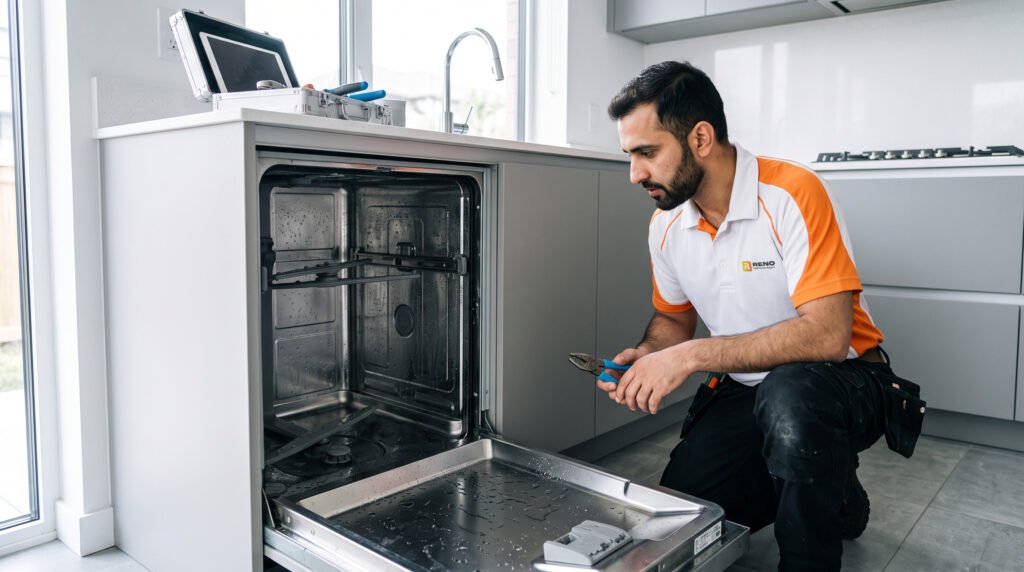
A failed heating element is the likeliest of six common causes when a dishwasher completes its cycle but keeps the water cold. Limescale and a faulty temperature sensor rank next. You can correct programme selection and approved descaling without opening the appliance.
Cold wash water affects detergent performance, grease removal, sanitizing temperatures, and heat-assisted drying. A dishwasher may still fill, spray, and drain normally, which can hide the heating fault until dishes come out greasy or wet.
The diagnosis starts with the selected programme. It then follows the heating circuit through the element, temperature sensor, flow-through heater, wiring, relay, and control board.
This guide explains why dishwasher water is not hot, how each heating-circuit fault develops, and which checks remain safe for an owner. It also covers error codes, element testing, dishwasher salt, descaling intervals, technician-only repairs, and dated repair costs in AED.
Why is your dishwasher not heating water?
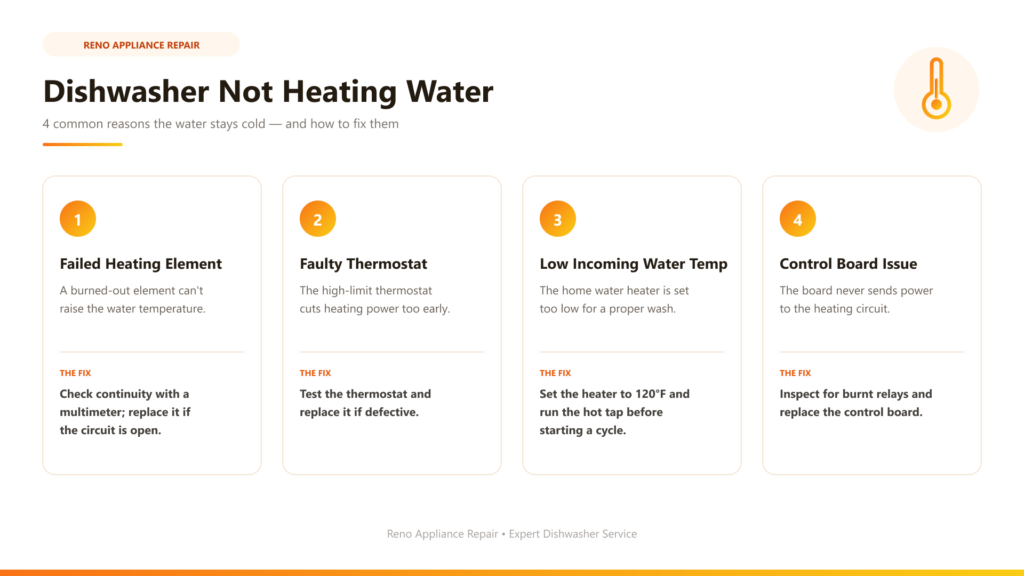
A failed heating element ranks first, followed by limescale insulation and an inaccurate negative temperature coefficient sensor. You can correct programme selection and approved descaling. A technician tests the element, sensor, wiring, relay, flow-through heater, and control board.
This cause order applies when the dishwasher fills, circulates water, and drains normally. A fill fault, weak circulation pump, or blocked filter creates a different fault path.
Dishwasher manufacturers do not publish comparable percentages for these six failures. The table therefore gives a diagnostic order based on component function, symptoms, and manufacturer service procedures.
| Likelihood order | Cause | Evidence that raises likelihood | Owner-fixable? |
|---|---|---|---|
| 1 | Failed heating element | Two heated programmes finish with cold water | No |
| 2 | Limescale-coated element | White crust, mineral film, or slow heating | Descaling only |
| 3 | Faulty NTC sensor | Erratic temperature or a heat-related error code | No |
| 4 | Failed flow-through heater | Water circulates normally but remains cold | No |
| 5 | Control board relay fault | Element and wiring pass tests but receive no power | No |
| 6 | Eco, quick, or rinse programme | Published cycle temperature is lower than expected | Yes |
The table helps you avoid replacing parts before checking the programme and scale condition.
What causes a heating failure?
A dishwasher heating failure starts when the circuit cannot create heat, transfer heat, measure temperature, or switch heater power correctly.
How does a failed heating element stop water heating?
A failed heating element breaks the electrical path that converts current into heat. The circulation pump may continue spraying cold water through both racks.
A Whirlpool technical service manual identifies the heater, harness, relay, and control board as one connected circuit. Its example dishwasher specifies approximately 14 ohms across a working element.
That figure does not apply to every dishwasher. Element resistance changes with voltage, heater wattage, and component design.
An element can also leak current to earth after becoming hot. A basic continuity test may appear normal while the appliance trips a residual-current device during the heating stage.
How does limescale coating insulate the heating element?
Limescale forms a low-conductivity layer between the hot element and the wash water. The element becomes hotter while the water warms more slowly.
A Politecnico di Torino heating study modeled a 2-kilowatt heater with 10 liters of circulating water. A 2-millimeter calcium carbonate layer reduced the final water temperature by 5°C after 480 seconds.
The same scale layer raised element temperature by about 44°C. A 1-millimeter layer added approximately 30 seconds to the time required to reach 60°C.
The model does not predict one dishwasher’s service life. It shows the physical mechanism that increases thermal stress on a scale-coated element.
How does a faulty NTC sensor report the wrong temperature?
A negative temperature coefficient sensor reduces electrical resistance as water temperature rises. The control board converts that resistance into a temperature reading.
The Whirlpool service data lists approximately 10 kilo-ohms at 25°C and 3 kilo-ohms at 60°C for one thermistor.
A sensor outside its specified range can report hot water when the water remains cold. The board may stop the heater early, extend the cycle, or store an error code.
Use the resistance table for the exact appliance model. Sensor specifications differ between brands and product series.
How does a failed flow-through heater cut heating on modern models?
A flow-through heater warms recirculating water inside a compact heater or heat-pump assembly. The spray arms can still receive water when only the heating section fails.
Bosch dishwasher error guidance assigns E6001 to an internal heat-pump heater fault on supported models. Bosch uses E2120 for a zeolite-chamber heater fault.
Integrated assemblies may contain the circulation pump, heater, seals, and electronic connections. Replacement therefore requires model-specific disassembly and leak testing.
A flow-through heater usually costs more to replace than a separate exposed element because the technician replaces a larger assembly.
How does a control board relay failure disable the heater?
The heater relay switches electrical power after the control board confirms water level, circulation, and temperature conditions. Burned relay contacts can leave a working element without power.
The Whirlpool heater circuit places the relay in series with the element. Its procedure checks heater resistance and wiring before control-board replacement.
Bosch identifies E02 and E03 as control-board relay faults on supported dishwashers. Bosch identifies E04 as a heater-electronics fault detected during self-testing.
Error definitions remain model-specific. Do not apply one brand’s code table to another machine.
How does an eco or quick programme limit the maximum temperature?
An eco or quick programme can make a dishwasher feel cooler without indicating heater failure. Each cycle follows a different temperature, duration, water-use, and drying profile.
A Bosch programme table lists Intensive at 70°C, Auto at 55°C to 65°C, Eco at 50°C, Gentle at 40°C, and Quick at 45°C for the covered models.
The same table gives 140 minutes for Eco and 30 minutes for Quick. Its pre-rinse programme uses 0.10 kilowatt-hours and contains no heated cleaning stage.
Read the programme table for your model before testing components.
How do you diagnose a heating failure step by step?
Diagnose the fault in this order: programme, heat evidence, error reporting, scale inspection, and electrical testing.
- Confirm the selected programme’s target temperature
Read the appliance manual and locate the exact programme table. Confirm that the selected cycle includes a heated main wash.
Run the same intensive programme twice with similar loading. A dishwasher cold water only complaint may start after someone selects Eco, Glass, Quick, or Rinse.
Some dishwashers retain the last programme after power-off. Check the control panel before each test.
- Feel the door and interior at the end of the main wash
Feel the outer door near the end of a heated cycle. Door insulation makes this a screening check rather than a temperature measurement.
Open the door carefully after the pump stops. Warm humid air, heated stainless steel, and hot crockery support normal heating.
Cold steel and no warm vapor after two intensive cycles support a heating-circuit fault. These symptoms do not identify the failed component.
- Test the heating element for continuity with the machine isolated
Continuity testing identifies an electrically open element. It does not confirm that the control board supplies power during operation.
Disconnect the plug or isolate the dedicated breaker. Remove one heater lead before measuring resistance, then compare the reading with the service sheet.
The Whirlpool example measures approximately 14 ohms. A different element design produces a different value.
- Check for an error code reporting the heating circuit
Record the full error code before resetting the dishwasher. Photograph the display or count each flash group.
Bosch examples include E04 for heater electronics and E6001 for an internal heat-pump heater fault. E02 and E03 identify relay faults on supported models.
Check the manual for the complete model number. Two product ranges from the same brand may use different code definitions.
- Inspect the element for scale build-up
Remove the lower rack and filter. Inspect the sump under bright light.
Look for chalky deposits, rough white crust, or a mineral ring around the heater area. Some machines expose the element inside the tub. Newer designs may hide it beneath the sump.
Labelled photo of the inspection point
Add an original image with the 4 labels. These labels include Dishwasher heating element inspection point, sump, salt reservoir, and heater terminals. The Whirlpool component-access diagram shows element retainers inside the cabinet and heater terminals beneath the tub.
Which checks can you safely do yourself?
Four non-invasive checks separate an incorrect programme from a probable heating-circuit fault.
- Check the programme. Confirm its published temperature and heating stages.
- Feel for heat at cycle end. Check the door, dishes, and humid air carefully.
- Run an intensive cycle. Select the hottest manufacturer-approved programme.
- Record any error code. Note the full code and cycle stage.
DIY versus technician decision box
DIY checks: Programme selection, manual review, heat observation, error-code recording, salt refill, and approved descaling.
Technician work: Continuity testing, insulation testing, NTC measurement, wiring repair, relay diagnosis, and flow-through heater replacement.
Stop using the dishwasher after a breaker trip, burning smell, damaged cable, or water leak. Disconnect the power and close the water valve.
Which of these faults needs a technician?
Element continuity testing, NTC replacement, board relay repair, and flow-through heater replacement require trained electrical diagnosis. These tasks expose mains wiring, control electronics, seals, and pressurized circulation parts.
The Whirlpool manual labels its electrical procedures for service technicians. It reserves diagnostic voltage measurements for authorized personnel.
A technician answers 4 separate questions:
- Does the element match the specified resistance?
- Does the element leak current to earth?
- Does the NTC resistance track water temperature?
- Does the control board energize the heater circuit?
This order prevents unnecessary parts replacement. A working relay cannot heat through an open element. A working element cannot operate without controlled electrical output.
How much does it cost to fix a heating failure in Dubai?
Dishwasher heating repairs in Dubai start near AED 150 for diagnosis and can exceed AED 1,000 for an integrated heater or control-board fault. These planning ranges were set on 31 July 2026.
The figures combine a local Dubai repair benchmark with UAE parts listings. They are comparison ranges rather than regulated tariffs.
| Fault or repair scope | Dubai planning cost | Price date and basis |
|---|---|---|
| Diagnosis or call-out | AED 150 to AED 250 | 31 July 2026, local service range |
| Approved descaling and test cycle | AED 150 to AED 350 | 31 July 2026, minor labor range |
| NTC sensor, connector, or minor wiring repair | AED 300 to AED 600 | 31 July 2026, parts and labor |
| Separate heating element replacement | AED 350 to AED 650 | 31 July 2026, element plus fitting |
| Integrated flow-through heater or heat pump | AED 700 to AED 1,000+ | 31 July 2026, assembly and access |
| Control relay repair or board replacement | AED 300 to AED 1,000+ | 31 July 2026, repair versus replacement |
Brand, model, cabinet access, parts availability, warranty status, and value-added tax change the final quote.
Check the dishwasher repair cost in Dubai before approving an element, heater-pump, or control-board replacement. Book dishwasher repair in Dubai when electrical testing or sealed-component access is required.
Ask the provider to list diagnosis, labor, parts, cabinetry access, tax, and the post-repair test cycle separately.
How do you test a dishwasher heating element safely?
Test a dishwasher heating element only after full electrical isolation and model-specific terminal identification. An authorized technician handles live-voltage measurements.
- Disconnect the appliance plug or isolate the dedicated breaker.
- Prevent accidental reconnection while the panels remain open.
- Close the water valve and remove standing water.
- Locate the heater terminals through the service sheet.
- Disconnect one lead to remove parallel circuit paths.
- Measure resistance across both terminals.
- Compare the reading with the model specification.
- Inspect terminals, seals, and wiring for heat damage.
- Refit every panel before restoring power.
An open reading supports a broken element. Normal resistance does not exclude insulation leakage, damaged wiring, relay failure, or an inaccurate NTC sensor.
Do not conduct live heater-voltage testing yourself. Incorrect testing can cause electrical shock, electronic damage, or water leakage.
Why do heating elements fail earlier in Dubai than in soft-water regions?
Heating elements experience more thermal stress when the kitchen-tap water contains higher calcium and magnesium levels and the softener remains incorrectly set.
The Dubai location alone does not establish one fixed hardness value. Building tanks, internal plumbing, source blending, and maintenance affect the water reaching the dishwasher.
Dubai Municipality advises cleaning and disinfecting domestic water tanks and plumbing systems at least every 6 months. Tap-level testing therefore gives more useful appliance data than a citywide assumption.
No accredited public dataset states that the Dubai scale removes a fixed number of years from element life. A defensible assessment uses measured hardness, visible deposits, salt settings, and repair history.
How does calcium scale build on the element surface?
Heating shifts dissolved calcium bicarbonate toward solid calcium carbonate. The deposit attaches to the hottest surfaces inside the hydraulic circuit.
The United States Geological Survey classifies 0 to 60 milligrams per liter as soft water. It classifies 61 to 120 as moderately hard, 121 to 180 as hard, and more than 180 as very hard.
Test the water at the dishwasher supply. A total dissolved solids meter does not measure hardness specifically because sodium and other dissolved ions also affect conductivity.
How does dishwasher salt reduce scale on the element?
Dishwasher salt regenerates the built-in ion-exchange softener. The resin captures calcium and magnesium before heated water reaches scale-forming surfaces.
A Miele dishwasher manual requires softening above 0.9 millimoles per liter, equal to 5 German degrees. Its integrated softener accepts settings up to 12.6 millimoles per liter.
The same manual quantifies one regeneration event at 4.4 liters of water, 0.015 kilowatt-hours, and approximately three minutes for the specified settings.
Salt reduces new mineral loading after correct setup. Salt does not remove a thick scale layer already attached to the heater.
How often should a Dubai household descale a dishwasher?
Descale according to measured tap hardness, visible deposits, and manufacturer instructions. No single interval fits every Dubai property.
Bosch maintenance guidance advises descaling several times yearly where hard-water deposits occur. Siemens UAE advises annual descaling in hard or very hard water.
Use the measured hardness to set an inspection schedule:
- Soft, 0 to 60 mg/L: Descale when deposits appear or the manual specifies it.
- Moderately hard, 61 to 120 mg/L: Inspect the tub and heater area every six months.
- Hard, 121 to 180 mg/L: Maintain dishwasher salt and plan an annual descale.
- Very hard, above 180 mg/L: Inspect several times yearly and follow the stricter model guidance.
Never mix dishwasher descaler with chlorine cleaner. Use a product approved for the appliance model.
Which related dishwasher problems share the same cause?
Heating-circuit faults appear under several symptoms because hot water supports detergent action and heat-assisted drying.
- Poor cleaning: Cold water leaves grease, starch, and detergent residue behind. Use the dishwasher not cleaning dishes guide to separate heater, spray, filter, and detergent faults.
- Not drying: A failed heater or NTC sensor can remove the heated rinse and leave crockery wet. Check the dishwasher not drying guide before replacing drying components.
- White film: Calcium deposits can coat glassware and the heater surface. Salt, rinse-aid, detergent, or water-hardness settings can leave cloudy residue, a common fault pattern in the white film on dishes.
- Heating element fault: An open heating element breaks the heating circuit even when the circulation pump operates normally.
- Hard water: Incorrect softener settings allow scale to return. Dishwasher salt dosage and descaling intervals may need adjustment because hard water in Dubai contains elevated mineral concentrations.
A dishwasher not heating water often appears first as wet dishes or poor cleaning. The failed heating component carries the symptom into the related drying, cleaning, scale, and repair-cost nodes.
When cold water signals a heating-circuit fault
A dishwasher that fills, sprays, and drains with cold water needs a structured diagnosis, not immediate parts replacement. Start with the programme temperature, test an intensive cycle, record error codes, and inspect the visible scale. These checks separate a simple setting issue from a failed heating element, NTC sensor, flow-through heater, or control relay.
Stop after the owner-safe checks. Electrical resistance tests, live circuit diagnosis, and sealed heater replacement require professional equipment and model-specific service data. Incorrect testing can damage the control board, create a leak, or expose live electrical parts.
In Dubai, the final decision also depends on the scale of exposure and repair cost. Compare the written estimate with the appliance’s age, condition, and replacement value. Professional home appliance repair makes sense when accurate testing identifies one repairable component and the total cost remains proportionate to the dishwasher’s remaining service life.
FAQs
Yes, a dishwasher can fill, circulate, and drain normally while a failed heating-circuit component keeps the wash water cold.
Intensive programmes use higher target temperatures, while Eco cycles reduce energy use through lower heat levels and longer wash times.
A reset may clear a temporary control error, but it cannot repair an open element, damaged NTC sensor, failed relay, or defective heater assembly.
White residue can indicate mineral scale, which coats dishes and can insulate the heating element when the water-softener setting is incorrect.
Ahmed Al Mansoori
Ahmed Al Mansoori is a UAE-based home appliance repair specialist with over 12 years of hands-on experience in diagnosing and repairing washing machines, refrigerators, dishwashers, ovens, dryers, and other household appliances across Dubai and Abu Dhabi. He has worked with leading appliance brands and is known for delivering reliable repair solutions, preventive maintenance guidance, and same-day technical support for residential clients. Ahmed specializes in troubleshooting modern smart appliances and energy-efficient systems commonly used in UAE homes.
