
Dishwasher Not Drying Dishes: Causes and Fixes
 August 1, 2026
14 min read
August 1, 2026
14 min read
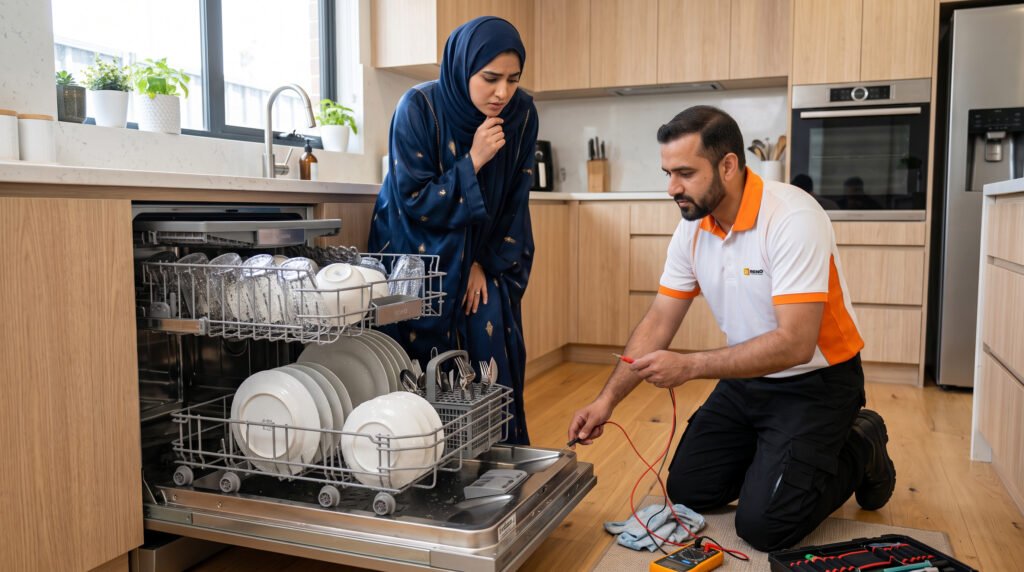
A dishwasher not drying dishes usually has a rinse aid, programme, loading, heating, airflow, or temperature-control problem. The correct diagnosis starts by identifying whether the appliance uses heat drying, condenser drying, fan-assisted drying, automatic door opening, or zeolite drying.
Wet glasses, damp plates, and water-filled plastic containers can make a completed wash cycle feel unfinished. A dishwasher not drying dishes may have a simple rinse aid or loading issue. It may also indicate a failed heater, drying fan, vent flap, temperature sensor, or control relay.
This guide helps you separate normal water retention from a failed drying component. It also shows which checks are safe in a Dubai home, when a technician is required, and what current repair benchmarks look like in AED.
The practical steps also clarify when basic home appliance repair is enough and when professional dishwasher repair in Dubai becomes the safer option.
Why is your dishwasher not drying dishes?
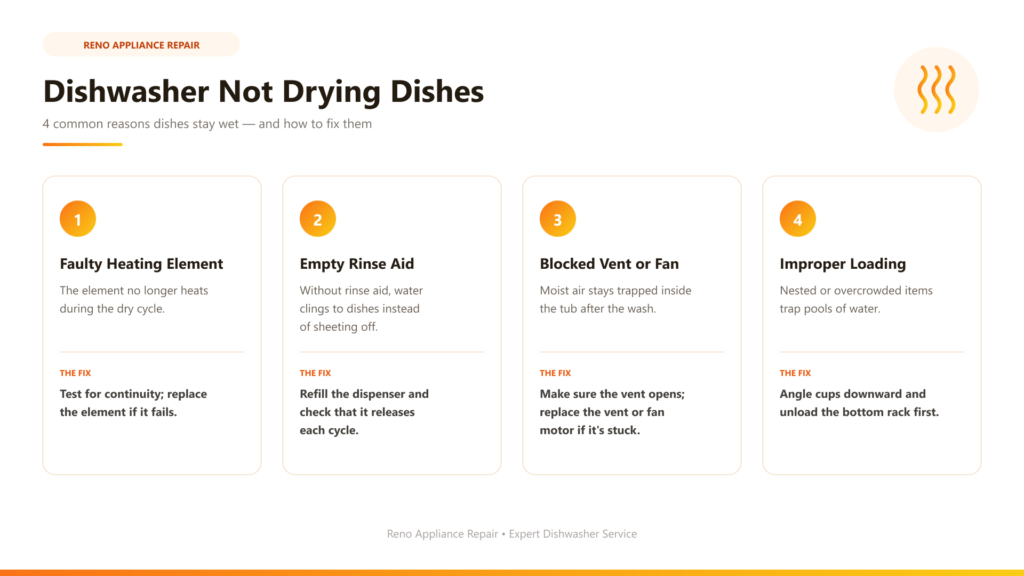
Low rinse aid is the likeliest of six common causes, followed by low-heat-retention plastic items and an interrupted drying stage. You can fix those three. Failed heaters, fans, vent actuators, NTC sensors, and control-board relays require technician testing and repair.
This is a practical troubleshooting order, not a published failure-rate dataset.
The table connects each symptom with the first useful decision.
| Likelihood order | Cause | Strongest clue | Owner action |
| 1 | Low or empty rinse aid | Droplets remain on glass, steel, and ceramic | Refill and adjust the dose |
| 2 | Plastic tableware | Glass dries, but plastic tubs and lids stay wet | Re-angle and secure plastics |
| 3 | Drying stage interrupted | The door opens before the end signal | Let the programme finish |
| 4 | Failed heating element | A confirmed heat-dry cycle finishes cold | Book electrical testing |
| 5 | Failed fan or vent flap | The tub is hot, but humid air remains trapped | Book airflow testing |
| 6 | Faulty NTC sensor or relay | Heating becomes weak, erratic, or stops early | Book sensor and board testing |
Rinse aid helps water drain from dishes after the final rinse. Plastic dries poorly because it retains less heat.
Material and temperature patterns provide more evidence than wetness alone.
What causes a drying failure?
A drying failure starts when water stays attached to the load, the load stores too little heat, the dishwasher produces insufficient heat, or humid air cannot leave its designed route.
How does missing or low rinse aid leave water on dishes?
Rinse aid lowers water’s surface tension, so final-rinse water sheets off instead of forming droplets. This action is part of effective condensation drying.
Check the dispenser when glass, steel, and ceramic all remain wet or spotted. According to Whirlpool, a 150-milliliter dispenser lasts about one to three months under typical conditions.
Fill the reservoir and raise the dial by one level. Too little rinse aid leaves more water for every drying system to remove.
How does a failed heating element stop heat drying?
A failed heating element removes the added heat used for evaporation in a heat-dry dishwasher. The tub should feel warm and may contain steam after a confirmed heated-dry test.
A cold tub after the correct programme supports a heater-circuit fault. The failed point can be the element, wiring, thermostat, safety cut-out, sensor, or control relay, so the symptom does not identify one part by itself. This is a diagnostic inference based on the linked heater and temperature-control system.
An Electrolux technical manual documents a 2,100-watt heating element, a 45-minute heating timeout, and a 70°C maximum on one platform. Those figures are model-specific, which is why technicians use the service sheet for the exact dishwasher.
How does a failed drying fan or vent flap trap moisture?
A drying fan moves humid air through a condensation tube, vent, or moisture chamber. A failed motor, blocked duct, or jammed flap leaves hot moisture inside the tub.
GE documents a 10-watt fan in selected concealed-vent dishwashers. The fan can continue for 30 minutes to four hours after the clean light appears, depending on the selected programme. Condensed moisture drains back into the tub.
Generally, home appliance repair services use a fan to direct steam into a zeolite chamber, where the mineral absorbs moisture and generates heat. Hot dishes with trapped steam therefore point more strongly toward airflow than lost heat.
How does a faulty NTC sensor end the dry stage early?
A Negative Temperature Coefficient sensor, or NTC sensor, sends water-temperature data to the control board.
The Electrolux technical manual lists a monitored NTC range of 209,200 ohms at -5°C to 5,300 ohms at 80°C. The control records an alarm when resistance falls outside that model-specific range.
A drifting sensor may remain inside the alarm window while reporting an inaccurate temperature. A technician therefore compares resistance with actual temperature rather than replacing the heater from the wet-dish symptom alone. This is a diagnostic inference from the manufacturer’s resistance-based control design.
How does plastic tableware retain water in any dishwasher?
Plastic retains less heat than glass, ceramic, and metal, so less stored energy remains available for evaporation. Plastic is harder to dry.
Recessed lids, cup bases, and container rims also collect water. Place plastic on the upper rack, secure light items, and angle every concave surface downward.
Dry plates beside wet plastic usually indicate material and loading behavior. Wet glass, cutlery, ceramic, racks, and tub walls indicate a broader dishwasher drying failure.
How does opening the door too early interrupt condenser drying?
Opening the door before programme completion interrupts active functions and releases heat too early. Miele states that opening the door during operation interrupts the programme.
Wait for the end signal. Silence can occur between stages and does not confirm completion.
After completion, follow the manual. Some models remain closed for condensation drying. Others open automatically to release humid air at a controlled point. Miele and Bosch document automatic opening as an end-of-cycle drying feature.
How do you diagnose a drying failure step by step?
Diagnose a dishwasher leaving water on dishes by changing one variable per cycle. Record the programme, rinse aid setting, load materials, end temperature, and visible moisture pattern.
- Check the rinse aid reservoir and dial setting
Open the dishwasher door fully and inspect the rinse aid indicator beside the detergent compartment. The indicator should be checked with the door level.
Refill the reservoir, wipe away spills, and record the current dose. A Miele operating manual lists an approximate 110-milliliter reservoir on the referenced model and warns that spilled rinse aid can create excess foam.
- Identify whether the machine uses heat drying or condenser drying
Find the model number on the door edge and read the drying section in the manual. Look for terms such as Heated Dry, condensation, PureDry, Fan Dry, AutoOpen, openDoor, CrystalDry, PerfectDry, or Zeolith.
PureDry is a closed system that uses no outside air and no exposed drying element. A fan-assisted mineral system converts absorbed moisture into heat.
Name the technology before choosing the component test. A heater test has little diagnostic value when the dishwasher uses a closed condensation system without an exposed drying element.
- Feel the interior for residual heat at cycle end
Wait for the completion signal and let visible steam subside. Open the door carefully, then assess tub warmth without touching a heater.
A heat-dry test should leave the interior warm and may produce steam. A cool tub supports a heater, thermostat, NTC, wiring, or relay fault.
Strong heat shifts the diagnosis towards rinse aid, loading, plastic, fan, or vent performance.
- Run an intensive programme and compare the result
Run the same mixed load on an intensive programme with the strongest drying option. Keep the loading and rinse aid setting unchanged.
A Heavy cycle adds more heat than a Normal cycle. Quick or 30-minute programmes may leave dishes incompletely dry.
A clear improvement confirms that the drying system can work. No change across glass, ceramic, and steel supports component testing.
- Check the vent flap opens at the dry stage
Inspect the visible vent cover for grease, scale, or an item blocking airflow. Listen for the expected fan or actuator during the dry stage identified in the manual.
ActiveVent closes during washing and opens after washing and rinsing for convection drying. Opening the door can interrupt continued fan operation on selected models.
Do not remove the inner door panel for this check. A hot tub, no expected airflow, and a uniformly wet load form a useful technician brief.
Labelled photo placement
Add an original photo of the fully open dishwasher door.
Label:
- A: Rinse aid cap
- B: Rinse aid dosage dial
- C: Visible drying vent
- D: Model and serial-number plate
Dishwasher rinse aid reservoir, dosage dial, drying vent, and model plate inspection points.
Which checks can you safely do yourself?
Complete these 4 checks without removing a panel:
- Refill rinse aid. Fill the reservoir to the marked limit.
- Raise the dial. Increase the dose by one setting when wetting or spots remain.
- Select an intensive programme. Choose enhanced drying instead of Quick or 30 Minute.
- Leave the door shut until cool. Wait for programme completion unless the manual specifies automatic opening.
DIY vs technician decision box
DIY: Low rinse aid, wet plastic only, water pooled on cup bases, flipped light containers, or a low-heat programme.
Technician: Cold tub after confirmed heat drying, repeated breaker trips, burning smell, error codes, a silent fan, a jammed vent actuator, or unstable heating.
Disconnect power when the breaker trips or an electrical smell appears.
Which of these faults needs a technician?
Four drying-system faults require resistance, voltage, insulation, or control-signal testing:
- Failed heating element: Test resistance, earth leakage, terminals, wiring, and the heat relay.
- Failed fan motor: Test impeller movement, winding resistance, electrical supply, and airflow.
- Failed NTC sensor: Compare measured resistance with actual temperature and the model chart.
- Control board dry-stage relay: Confirm heater, sensor, and wiring results before replacing the board.
The heater, NTC sensor, wiring, and electronic control are generally inside one monitored temperature system. That system design explains why a wet load cannot identify the failed electrical part without measurements.
Ask the technician to write the failed component, measured value, labor charge, part price, and warranty on the quote. This gives you comparable repair scopes instead of symptom-based estimates.
How much does it cost to fix a drying failure in Dubai?
A dishwasher drying repair in Dubai commonly starts at AED 150 for diagnosis and can exceed AED 1,000 for heating, motor, or control-board work. Generally, Dubai cost guides list AED 150 to AED 250 for diagnosis and about AED 700 to AED 1,000 or more for motor, heating, or control-board faults.
The table separates diagnosis from component repair.
| Cause or service | Dubai range set 31 July 2026 | Quote detail |
|---|---|---|
| Diagnostic visit | AED 150 to AED 250 | Fee waived or charged separately |
| Heating element or thermostat | AED 250 to AED 550 | Part, labor, electrical test |
| NTC sensor or wiring | AED 250 to AED 500 | Sensor value and harness |
| Drying fan or vent actuator | AED 250 to AED 650 | Motor, flap, duct, labor |
| Control relay or board | AED 400 to AED 900 | Board repair or replacement |
The heating-element and control-board ranges combine published Dubai provider figures. The NTC range uses a published 2026 thermistor price and the wider Dubai sensor benchmark.
A public price page verifies an advertised benchmark, but it cannot verify your exact repair. Compare itemized quotes through the Dubai dishwasher repair cost guide before approving a premium part.
Does your dishwasher use heat drying or condenser drying?
Your dishwasher uses heat drying when a heater directly raises the drying temperature. It uses condenser drying when final-rinse heat moves moisture from hot dishes onto a cooler tub.
The comparison identifies the system before the fix.
| Technology | Process | Normal pattern | Fault clue |
|---|---|---|---|
| Heat drying | Heater supports evaporation | Tub and hard items finish warm | The entire load finishes cold |
| Closed condenser drying | Moisture condenses on cooler tub walls | Glass dries better than plastic | All materials remain wet despite heat |
| Fan-assisted drying | A fan moves humid air through a route | Airflow removes moisture | Hot tub with trapped steam |
| Automatic door opening | The door opens after completion | Humid air leaves at the set point | The door stays closed when enabled |
| Zeolite drying | Minerals absorb moisture and release heat | Improved plastic drying | Fan, sensor, chamber, or control fault |
Bosch documents condensation against a cooler stainless tub. Siemens documents fan-assisted Zeolith drying, while Miele documents automatic door opening after selected programmes.
This split prevents a search for a drying element in a machine that does not use one.
How does UAE indoor humidity affect condenser drying?
UAE indoor humidity affects vented and automatic-opening drying more than a sealed condensation system.
The Dubai Statistics Center recorded a 2025 mean daily maximum relative humidity of 62% in July, 75% in August, and 76% in September. The corresponding mean daily minimums were 24%, 24%, and 30%.
Humid room air accepts less additional water vapor, so evaporation slows after the dishwasher exchanges air with the kitchen.
Why does air-conditioned kitchen air improve condenser drying?
Air conditioning removes moisture from indoor air and controls temperature. Drier room air improves evaporation after a fan, vent, or automatic door releases humid air.
Dubai Municipality recommends 20% to 60% relative humidity and 22.5°C to 25.5°C dry-bulb temperature for acceptable indoor conditions during 95% of the year.
Room conditions have less influence on a closed system. PureDry does not pull outside air into the dishwasher.
Why do humid closed kitchens leave plastics wet?
Humid closed kitchens provide less evaporation capacity after the door opens. Plastic adds another limit because it stores less heat than glass or ceramic.
Wet plastics beside dry plates usually indicate material and room conditions. A completely wet load indicates rinse aid, programme, heat, airflow, or sensor performance.
Angle plastics and let the completed machine vent according to its manual. Opening the door during operation interrupts many models.
How does the rinse aid dose interact with water hardness?
Harder water leaves more calcium and magnesium residue. Rinse aid helps water sheet off before droplets dry into spots. Match the dose to water conditions and raise it one level when wetting persists.
No single dose fits every Dubai building. Tanks, plumbing, filters, and softeners can alter point-of-use water. Dubai regulations set supply-quality parameters, but an on-site hardness test gives the value relevant to your dishwasher.
Set the softener and rinse aid from the measured hardness and the model manual. Too little leaves droplets and spotting. Excess rinse aid can leave film.
Which related dishwasher problems share the same cause?
Drying faults overlap with heating, spotting, dosing, and drainage because one subsystem can affect several cycle stages.
- When wash water remains cold, the heating element, temperature sensor, thermostat, and wiring become key diagnostic areas.
- White deposits caused by calcium and magnesium also build up and form a key diagnostic area.
- Little or no heat during the drying stage places the heating element, wiring, and relay among the main checks.
- Insufficient rinse aid and salt can reduce drying quality and increase hard-water deposits.
Water left inside the tub can become water left on dishes. A dry result starts with the correct technology diagnosis. Identify the system, change one owner-controlled variable, then test a component when the symptom remains.
Dry dishes start with the right diagnosis
Wet dishes do not always mean the dishwasher has a failed part. Low rinse aid, poorly angled plastic items, or the wrong programme can create the same symptom as a heater, fan, sensor, or control-board fault.
Start by identifying the drying system. Then change one safe setting at a time and compare the next load. A warm tub with wet plastic points towards loading or drying conditions. A cold tub after a confirmed heat-dry cycle points towards an electrical fault.
This method separates routine common dishwasher problems from faults that require professional testing. It also prevents unnecessary part replacement. Book dishwasher repair in Dubai when the machine trips the breaker, produces a burning smell, displays repeated error codes, or finishes every heat-dry cycle cold.
A dry result starts with a simple rule:
Identify the drying technology, correct the owner-controlled conditions, and test the suspected component only when the symptom remains.
FAQs
Yes, overcrowding blocks airflow and traps water between items, even when the drying system works correctly.
The lower rack often holds heavier glass, ceramic, and metal items that retain more heat than lightweight plastic.
Yes, a failed heater or temperature sensor can reduce both wash-water temperature and drying performance.
Yes, repair testing is justified when glass, ceramic, cutlery, racks, and tub walls remain wet after rinse aid and programme checks.
Ahmed Al Mansoori
Ahmed Al Mansoori is a UAE-based home appliance repair specialist with over 12 years of hands-on experience in diagnosing and repairing washing machines, refrigerators, dishwashers, ovens, dryers, and other household appliances across Dubai and Abu Dhabi. He has worked with leading appliance brands and is known for delivering reliable repair solutions, preventive maintenance guidance, and same-day technical support for residential clients. Ahmed specializes in troubleshooting modern smart appliances and energy-efficient systems commonly used in UAE homes.
