
How a Dishwasher Works: Cycle Stages, Water Path and Components
 July 30, 2026
16 min read
July 30, 2026
16 min read

A dishwasher may fill, pause, spray and drain, yet still leave dishes dirty, cold or wet. The fault becomes easier to trace once the normal cycle is clear. A dishwasher completes five controlled stages: fill, wash, drain, rinse and dry. Each stage depends on a specific water path, sensor reading and component response.
This guide explains what happens inside a dishwasher during each stage. It follows water through the inlet valve, sump, circulation pump, heater, spray arms and drain system.
It also covers:
- Cycle timing
- Programme temperatures
- Water use
- Electricity consumption
- Sensors that control each transition
Dubai-specific factors, including inlet temperature, building water pressure, hardness and electrical supply, provide the final reference for locating a dishwasher fault.
How does a dishwasher work?
A dishwasher completes these stages, including fill, wash, drain, rinse and dry. On one EN 60436-tested model, programmes run for 70 to 235 minutes and use 9.5 to 15.0 liters, depending on programme selection.
The machine does not fill its entire cabinet. It admits a measured water charge into the sump below the filter. The circulation pump repeatedly sends that water through the spray arms.
Detergent enters during the main wash. Fresh water replaces the dirty wash water during rinsing. Heat, airflow or condensation then removes moisture.
Modern dishwashers take longer because efficient programmes reduce heating power and water use. Manufacturer guidance places a complete cycle between 1.5 and 4 hours. Soil sensors, inlet temperature and drying options alter that figure.
What are the five stages of a dishwasher cycle?
The 5 dishwasher cycle stages are the following:
- Fill
- Main wash
- Drain
- Rinse
- Dry
Some programmes repeat the fill and drain actions between pre-rinse, wash and final-rinse sections.
The control board does not allocate one universal time to every stage. It waits for water volume, temperature, and soil conditions. That explains why the displayed remaining time can change during operation.
The following stage timing table uses published manufacturer programme data and service checkpoints. The figures describe specific machines, not every dishwasher.
| Dishwasher cycle stage | Estimated timing or operating benchmark | Expected interpretation |
|---|---|---|
| Fill | A service test admits 3 litres; one control reports a fill fault after 4 minutes | Water reaches the sump before circulation starts |
| Main wash | A diagnostic heater starts 10 seconds after the wash pump and heats to 57°C | Pump operation comes before controlled heating |
| Drain | One service test runs the drain pump for 30 seconds; another model cancels and drains in about 1 minute | Short drain periods separate water batches |
| Rinse | Express 65°C completes the whole sequence in 70 minutes | Short programmes compress washing and rinsing |
| Dry | One 2026 cycle guide adds 52 minutes for heated drying | Drying can form a large part of total runtime |
The service figures confirm sequence rather than normal cycle duration. They show which component activates first and how the control checks each result.
How does the fill stage admit and measure water?
The fill stage opens the inlet valve and admits a measured water charge into the sump.
Water passes through the household isolation tap, supply hose and inlet screen. Models with leak protection add an electrically controlled safety valve to the hose assembly.
A flow meter can measure incoming volume. A pressure sensor or level switch may confirm the resulting sump level. One manufacturer service manual specifies approximately 3.8 liters per fill and 3.8 liters within 36 seconds during a supply test.
The float switch provides overfill protection. Rising water lifts the float and changes the switch state. The control then closes the inlet valve or activates the drain pump.
Check these conditions when the dishwasher does not fill:
- Open the isolation tap fully.
- Straighten the inlet hose.
- Clean the inlet screen.
- Check the float for free movement.
- Confirm that water reaches the valve.
One tested European model requires at least 10 liters per minute at the open tap. A restricted building supply can therefore interrupt the fill stage before washing begins.
How does the main wash stage heat and circulate water?
The main wash stage heats detergent water and circulates it through rotating spray arms.
The circulation pump draws water from the sump. It pushes that water through internal channels feeding the lower, middle and upper spray arms.
Angled spray holes create reaction force. The arms rotate while jets strike exposed dish surfaces. One service specification records lower-arm rotation at 20 to 40 revolutions per minute and upper-arm rotation at 15 to 40 revolutions per minute.
Water then falls back into the sump. The filter catches larger food particles before the pump recirculates the same water.
This closed circulation loop explains how a full-size dishwasher can clean a loaded cabinet with about 10 liters. The machine reuses each wash charge rather than sending fresh water continuously.
Three conditions reduce washing force:
- A blocked filter restricts pump intake.
- Food deposits obstruct spray holes.
- Large dishes stop the arms from rotating.
Heating occurs during circulation. A service sequence shows the wash pump starting first, followed by heater activation after 10 seconds. That order protects the heater from operating without water movement.
How does the drain stage expel waste water?
The drain stage uses a separate pump to move wastewater from the sump into the household drain.
Dirty water first passes through the filter outlet. The drain-pump impeller then pushes it through a non-return valve and drain hose.
The non-return valve limits wastewater flowing back after the pump stops. Correct hose routing also prevents water from the sink connection returning to the dishwasher.
A drain fault can occur at 6 points:
- Filter outlet
- Pump chamber
- Drain impeller
- Non-return valve
- Drain hose
- Sink trap or waste connection
One quick-reference guide links a blocked wastewater pump with error E:61-02. The same document instructs users to remove food remains or foreign objects from the impeller chamber.
Standing water does not automatically prove pump failure. A glass fragment, blocked hose or plugged sink connection creates the same symptom. Test the complete wastewater route before replacing the pump.
How does the rinse stage apply rinse aid?
The rinse stage replaces detergent water with fresh water and releases rinse aid during the final hot rinse.
Many programmes include an intermediate rinse and a final rinse. Each rinse requires another fill, circulation period and drain.
The rinse-aid dispenser meters a small dose into the final water charge. One manufacturer states that its dispenser releases about 3 milliliters per cycle. A full reservoir on selected machines holds roughly 150 to 175 milliliters.
Rinse aid contains surfactants. These substances reduce the surface tension of water. So water forms a thin sheet instead of separate droplets.
That action produces 2 effects:
- Less water remains on glass, ceramic and steel.
- Fewer mineral spots form as the dishes dry.
Too little rinse aid can leave droplets and cloudy marks. Too much can produce streaks or a blue film.
Persistent detergent residue can also indicate incomplete drainage before the rinse. Review common dishwasher problems when rinse water remains cloudy or foamy.
How does the dry stage remove moisture?
The dry stage removes moisture through condensation, a resistive heater, forced airflow, automatic door opening or a moisture-absorbing mineral.
Condensation drying relies on retained heat. Water evaporates from hot dishes and condenses on the cooler stainless-steel tub.
Heated-dry systems use a resistive element near the tub base. One current cycle guide adds 52 minutes when the heat-dry option operates.
Fan-assisted systems move humid air through a vent. Auto-opening systems release steam after the final rinse.
Mineral drying systems absorb moisture and release stored heat. A documented zeolite design directs warm, dry air back into the cabinet during the drying phase.
Plastic usually remains wetter than ceramic or metal. Plastic stores less heat. Hence, surface water evaporates more slowly.
Use the dishwasher, not drying dishes, when the final rinse feels hot, but moisture remains excessive.
Where does water travel inside a dishwasher?
Dishwasher water follows 3 connected routes:
- The inlet path
- Circulation loop
- Drain path
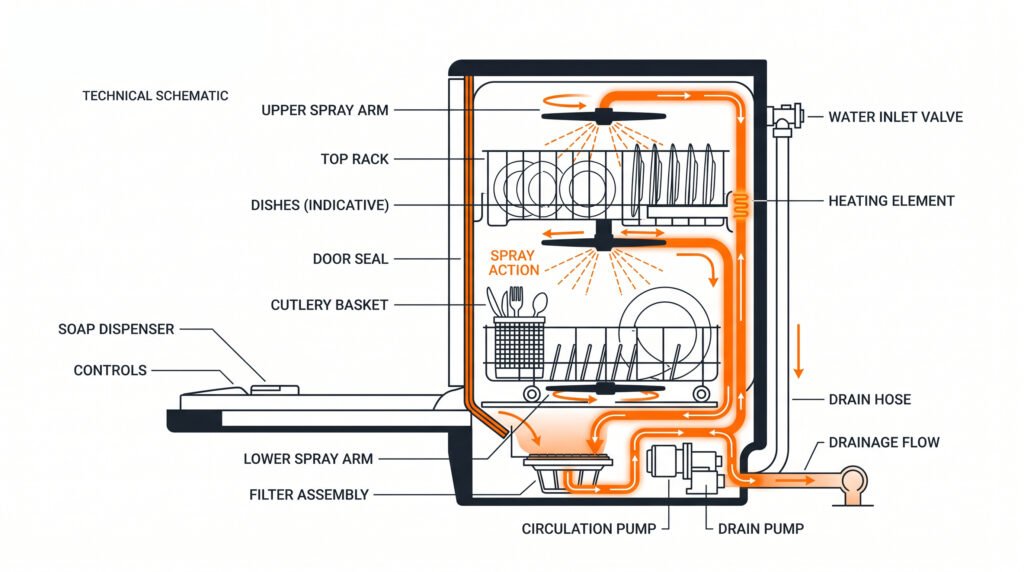
The normal dishwasher water path runs in this order:
- Building supply → isolation tap → inlet hose → inlet valve → sump → circulation pump → heater → spray arms → filter → sump → drain pump → drain hose → waste connection
The detergent dispenser joins the circulation route during the main wash. The rinse-aid dispenser joins it during the final rinse.
Which components sit on the inlet side?
The inlet side contains the tap, supply hose, inlet screen, safety valve, fill valve, flow meter and water-level controls.
The inlet valve forms the electrical gate between the home supply and the appliance. The control board energizes its solenoid whenever the programme requests water.
The flow meter converts water movement into electrical pulses. A pressure switch or level sensor confirms that water has collected in the sump.
A service manual shows why these signals matter. Its control reports an inlet fault when the flow meter fails to confirm a correct fill within 4 minutes. The diagnostic checks include supply, valve, meter, pressure switch and control board.
Which components sit on the circulation side?
The circulation side contains the sump, filter, wash pump, heater, water channels and spray arms.
The sump forms the lowest collection point. The filter protects the wash pump while permitting water to return.
The pump creates flow and pressure. The spray arms convert that pressure into rotating jets.
The heater raises water temperature during circulation. A concealed flow-through heater warms moving water inside a chamber, while a tub element transfers heat directly near the sump. Documented flow-through designs can heat water to 71°C.
It is necessary to understand dishwasher parts and their functions for individual component locations and electrical roles.
Which components sit on the drain side?
The drain side contains the filter outlet, pump chamber, impeller, non-return valve, hose and household waste connection.
The drain pump operates for short periods. It does not create the spray pressure used during washing.
A restriction near the filter can mimic a weak pump. A blockage at the sink trap can produce the same standing-water result.
Check the route in sequence. Replacing the pump before checking the hose can leave the original fault unchanged.
How does a dishwasher heat its water?
A dishwasher heats water with a resistive tub element or a flow-through heater inside the circulation system.
A visible resistive element sits near the tub floor. It can heat wash water and support heated drying.
A flow-through heater warms water while the wash pump moves it through a sealed chamber. This design keeps the heating surface away from exposed plastic items.
Programme temperature describes the intended wash condition. It does not always represent the hottest point in the complete cycle.
The following table uses declared programme data from an EN 60436-tested dishwasher.
| Programme | Main wash temperature | Cycle time | Load condition |
|---|---|---|---|
| Glass | 40°C | 1 hour 45 to 50 minutes | Light soil and sensitive glassware |
| Auto | 45°C to 65°C | 1 hour 45 to 2 hours 45 minutes | Mixed soil measured by sensors |
| Eco | 50°C | 3 hours 55 minutes | Normal soil with lower energy use |
| Express | 65°C | 1 hour 10 minutes | Light or fresh soil requiring speed |
| Intensive | 70°C | 2 hours 30 to 35 minutes | Dried or baked-on food |
The control reads a negative temperature coefficient (NTC) sensor while heating. The sensor resistance decreases as temperature rises. The board stops or changes heating when the target is reached.
How does a dishwasher know when to move to the next stage?
The control board advances after sensors confirm the required water level, temperature, soil condition and safety state.
Five devices provide the main feedback:
- NTC sensor: Measures water temperature through changing resistance.
- Turbidity sensor: Measures suspended soil through an optical light path.
- Flow meter: Counts incoming water.
- Float switch: Detects an unsafe water level or base leak.
- Control board: Compares sensor data with programme rules.
A turbidity sensor sends light through the wash water and measures clarity. The result can change water quantity, temperature, wash time and number of fills.
When a system reuses cleaner rinse water, it can save 3 to 6 liters when the sensor detects low soil.
The timer can therefore pause or change. A longer stage can represent normal sensor control rather than a fault.
How much water and electricity does one cycle use?
One dishwasher cycle can use about 9 to 15 liters and 0.7 to 1.5 kilowatt-hours, but exact figures depend on the tested model and programme.
The table below uses laboratory measurements for one model under European Standard EN 60436. It provides measured liters and kilowatt-hours.
| Programme | Duration | Electricity per cycle | Water per cycle |
|---|---|---|---|
| Glass 40°C | 1:45 to 1:50 | 0.720 to 0.750 kWh | 11.1 to 13.7 litres |
| Eco 50°C | 3:55 | 0.900 kWh | 9.5 litres |
| Intensive 70°C | 2:30 to 2:35 | 1.130 to 1.200 kWh | 10.5 to 13.3 litres |
| Express 65°C | 1:10 | 1.250 kWh | 10.2 litres |
| Machine Care | 2:25 | 1.350 kWh | 15.0 litres |
Eco uses 0.350 kilowatt-hours less than Express in this model. That equals a 28 percent reduction per cycle, despite Eco running 165 minutes longer.
The difference comes mainly from slower heating. Express uses more electrical input to reduce waiting time.
Current ENERGY STAR criteria limit a qualifying standard dishwasher to 240 kilowatt-hours per year and 3.2 US gallons per cycle. The water limit equals about 12.1 liters, based on 215 annual test cycles.
The European Commission reports that an efficient dishwasher can use about 9 liters for 15 place settings. Hand washing the same quantity can use around 20 liters.
Why does the same cycle behave differently in Dubai?
The same cycle behaves differently in Dubai because inlet temperature, water hardness, building pressure and electrical supply affect filling and heating.
Dubai Electricity and Water Authority (DEWA) produces desalinated water for the city. That water can pass through a building tank, booster pump and internal pipes before reaching your kitchen.
Four local conditions matter:
- Inlet temperature: Warm supply water shortens heater pauses. Cooler water extends them.
- Tap flow: A restricted tank outlet or inlet screen slows every fill.
- Water hardness: Building storage and plumbing can change conditions at the kitchen tap.
- Electrical supply: The heater requires stable voltage under load.
Test hardness at the dishwasher connection. Do not select a salt setting from a city-wide assumption. One appliance provides eight hardness settings covering 0 to 8.9 millimoles per liter.
DEWA technical regulations identify 230/400 volts and 50 hertz as rated network values. Regional dishwasher guidance specifies a 220 to 240-volt grounded connection at 50 or 60 hertz.
Low water pressure can delay filling. A loose socket, damaged connection or voltage drop can interrupt heating. These conditions justify checking the home supply before replacing internal components.
Which parts of the cycle fail most often?
Fill, drainage and heating systems form the main cycle-interruption groups used during dishwasher fault diagnosis.
This is a diagnostic grouping, not a universal failure-rate ranking. Each group stops the programme from confirming its next condition.
Which stage does a fill fault interrupt?
A fill fault interrupts the cycle before useful wash circulation starts.
Common causes include a closed tap, kinked hose, blocked screen, failed inlet valve, defective flow meter or raised float switch.
Listen after the initial drain. Water entry indicates that the valve opened. Silence or repeated short attempts point back toward the inlet route.
Which stage does a drain fault interrupt?
A drain fault interrupts the change between dirty water and the next fresh fill.
The machine may stop with water above the filter. Some models continue, but contaminated water then weakens the next rinse.
Check the filter and pump chamber first. Then inspect the non-return valve, hose and sink connection.
Which stage does a heating fault interrupt?
A heating fault interrupts temperature confirmation during the main wash or final rinse.
Possible causes include the element, flow-through heater, NTC sensor, control relay or wiring.
One technical control reports a heater fault when water fails to reach the required value within 90 minutes. Its diagnostic sequence directs the technician toward the heater, thermistor and control.
Cold dishes alone do not identify the failed component. The circuit requires both heat production and accurate temperature feedback.
How do you use the cycle to locate a dishwasher fault?
Locate a dishwasher fault by identifying the last normal stage and checking the next required component or water path.
The stage-to-symptom map below turns the dishwasher cycle into a practical diagnostic sequence.
| Last normal event | First abnormal symptom | Primary checks |
|---|---|---|
| Programme starts | No water enters | Tap, hose, screen, valve, flow meter and float |
| Fill completes | Little or no spray action | Filter, circulation pump and spray arms |
| Wash starts | Water remains cold | Heater, NTC sensor, relay and wiring |
| Washing is complete | Water remains in the sump | Impeller, non-return valve, hose and waste trap |
| Final rinse completes | Dishes remain wet | Rinse aid, heater, fan, vent or door opener |
Record the sound, temperature and water level when behavior changes. That evidence narrows the fault before a component is removed.
A dishwasher completes five stages through one controlled water path. The fill establishes water volume. The wash pump creates spray pressure. The drain pump removes waste. Rinsing prepares the load for drying.
Those same cycle stages provide the normal-operation baseline for dishwasher repair in Dubai.
A clear cycle makes dishwasher faults easier to trace
A dishwasher does not clean through one continuous action. It completes a controlled sequence of filling, washing, draining, rinsing and drying. Each stage depends on a specific component, water path and sensor response.
That sequence gives every fault a starting point. No water points toward the inlet side. Weak spray points toward circulation. Standing water points toward drainage. Cold dishes point toward heating or temperature sensing. Wet dishes after a hot rinse shift attention to the drying system.
The most useful clue is the last stage that worked normally. Record the sound, water level and temperature at that point. Then inspect the next required component instead of replacing parts based on the final symptom alone.
This method matters in Dubai homes because building water pressure, inlet temperature, hardness settings and electrical supply can change how the same programme behaves. A longer cycle does not always indicate failure. A stopped stage, missing sound or incorrect water condition provides stronger evidence.
Once the dishwasher cycle becomes clear, the appliance stops looking like a sealed box. It becomes a connected system with a measurable sequence. That normal-operation baseline supports faster fault location and more accurate dishwasher repair decisions.
FAQs
A dishwasher can sound normal while a blocked filter, obstructed spray arm or low fill volume reduces the pressure reaching the dishes.
An Eco cycle heats water more gradually and extends washing time to reduce energy use, while an Express cycle uses more power to shorten the programme.
Plastic stores less heat than ceramic, glass or metal, so water evaporates more slowly from its surface.
Identify the last stage that operated normally, then inspect the component or water path required for the next stage.
Ahmed Al Mansoori
Ahmed Al Mansoori is a UAE-based home appliance repair specialist with over 12 years of hands-on experience in diagnosing and repairing washing machines, refrigerators, dishwashers, ovens, dryers, and other household appliances across Dubai and Abu Dhabi. He has worked with leading appliance brands and is known for delivering reliable repair solutions, preventive maintenance guidance, and same-day technical support for residential clients. Ahmed specializes in troubleshooting modern smart appliances and energy-efficient systems commonly used in UAE homes.
