
Washing Machine Door Seal (Gasket) Replacement
 July 23, 2026
12 min read
July 23, 2026
12 min read
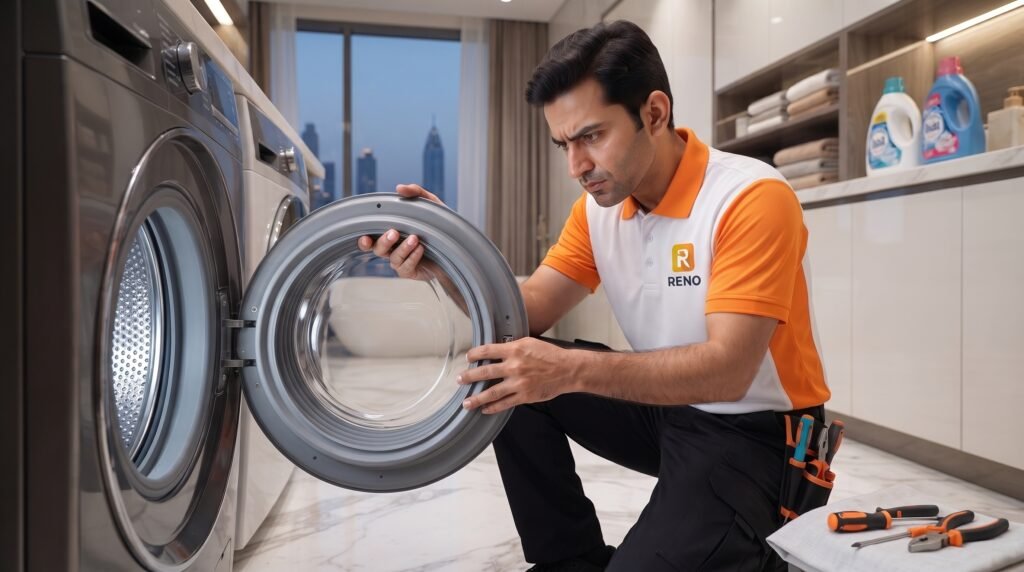
A small tear in a washing machine door seal can leave water on the floor, mold inside the drum, and clothes with a musty smell. Yet a front-door leak does not always mean the gasket needs replacement. Detergent buildup, trapped fabric, loose clamps, or hard-water residue can create similar symptoms.
This guide explains how to identify a damaged washing machine door gasket, what causes the rubber seal to fail, and whether you can replace it yourself. You will also learn how Reno technicians complete washing machine door seal replacement, what the repair costs in Dubai, and when replacing the entire machine makes better financial sense.
A clear diagnosis helps you avoid paying for the wrong repair and prevents a minor leak from damaging the washer or surrounding floor.
What are the signs of a damaged door seal?
A damaged washing machine door seal causes six common signs. These include a front-door leak, visible tear, twisted lip, recurring mould, trapped debris, or uneven door closure.
Check the washer during filling and slow tumbling. Bosch identifies trapped clothing, detergent residue, and excessive foam as faults that can imitate gasket failure.
Check the washing machine rubber seal in this order:
- Inspect the outer lip for cuts, cracks, stretched rubber, and loose sections.
- Pull the lower fold forward and remove coins, hair, lint, screws, or fabric.
- Check the door glass where it presses against the washing machine door gasket.
- Watch the first leak point during a short rinse.
- Smell the empty drum and clean laundry for persistent musty odor.
- Compare the full circumference for twisting or uneven seating.
A clean gasket that still leaks through a cut needs replacement. A dirty but intact gasket may only need cleaning. Electrolux advises cleaning hair, dirt, lint, and trapped clothing before arranging service for a front-door leak.
Does black mould mean the gasket needs replacement?
Black mould does not prove that the rubber has failed. Replace the washing machine rubber seal when mould sits inside cracked, porous, permanently stained, or deformed material.
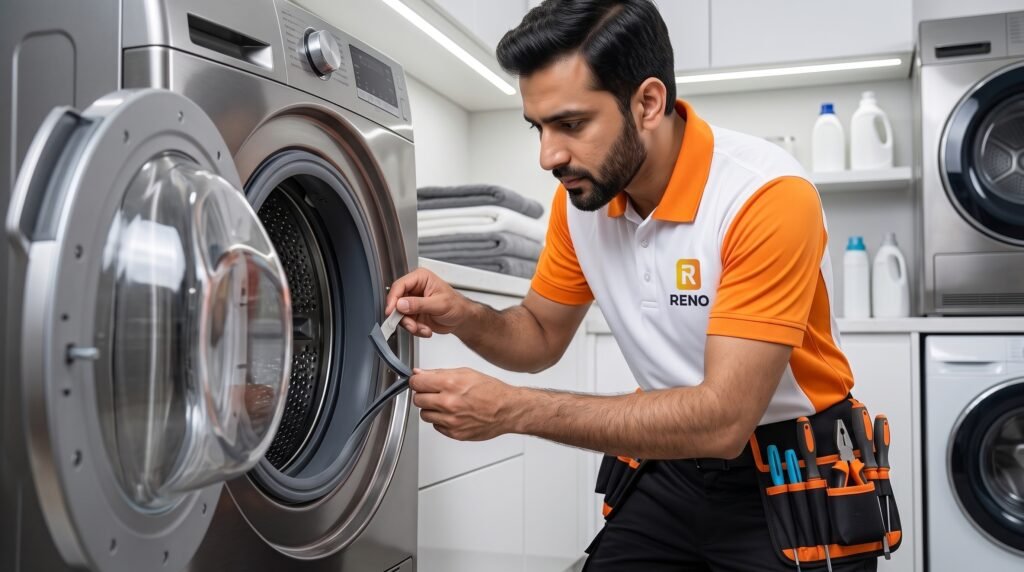
A 2023 Scientific Reports study sampled 50 shared-building washing machines. Fungi appeared in 41 machines (82%). The inner rubber seal had the highest contamination share at 37.5%. The outer seal reached 36.1%, while detergent drawers reached 26.2%.
Researchers recovered 122 fungal isolates across 17 genera. Moulds represented 80.3%, and yeasts represented 19.7%. Aspergillus accounted for 27.7%. These figures describe sampled communal machines, not every household washer.
Cleaning remains suitable when the gasket stays flexible and holds its original shape. Replacement becomes the practical option when staining sits inside a tear or the seal no longer contacts the glass evenly.
Is every front-door puddle a gasket leak?
No. Hair, lint, clothing, detergent foam, and an unlatched door can break the temporary contact between the door glass and seal.
Clean the contact area first. Run a controlled rinse test afterward. Persistent water escaping through the same cut confirms physical gasket damage.
Is moisture on the door always a leak?
Small water droplets on the inner glass after a wash can represent normal residual moisture. Water running across the gasket or collecting below the machine indicates a sealing, detergent, door-alignment, hose, or drainage fault.
Observe the washer during a short rinse. Note the exact point where water first appears. A puddle near the door does not prove that the door seal caused it.
What causes a washing machine door seal to fail?
Door gasket failure comes from mechanical cuts, overloading, trapped garments, detergent residue, retained moisture, harsh cleaners, oily textiles, mineral deposits, and incorrect installation.
Which objects can tear a front-load washer door seal?
Zips, metal buttons, bra wires, keys, screws, and sharp clothing fittings can catch the gasket during loading or unloading. Laundry trapped between the rubber and glass can pull the seal as the drum turns.
Overloading increases this risk because garments press against the door area. Manufacturer guidance identifies metal fittings, trapped laundry, and excessive loads as direct causes of door-seal damage.
Empty pockets before washing. Close zips and place wired garments inside a suitable laundry bag. Check the lower gasket fold after every load.
How does detergent buildup affect the gasket?
Excess detergent produces foam and sticky residue around the gasket, dispenser, glass, and air paths. The residue traps lint and water, which can interrupt the contact between the gasket and door.
Manufacturer troubleshooting guidance links excessive detergent and blocked residue paths with front-door leakage. High-efficiency front-load washers require the detergent type and dosage stated in the model manual.
More detergent does not create a cleaner wash. Excess foam can escape around the door even when the gasket has no tear.
Why does mould develop inside the door gasket?
Mould develops when moisture remains inside a closed washer. The thick folds of a front-load washer door seal can retain water, detergent, lint, and fabric soil after the cycle.
Leave the door and detergent drawer open after washing when the location remains safe for children. Wipe the gasket folds with a soft cloth. Manufacturer guidance recommends weekly gasket cleaning and monthly tub-cleaning cycles for many front-load models.
Use the cleaner specified in the appliance manual. Abrasive cleaners can attack the rubber. Some manufacturers also warn that vinegar or undiluted bleach can damage rubber components.
Does hard-water residue damage the gasket in Dubai?
Hard-water residue adds scale and detergent deposits, but visible white marks do not confirm a failed seal.
The World Health Organization (WHO) classifies water with less than 60 milligrams per liter of calcium carbonate as ‘soft’. It classifies 60 to 120 as moderately hard, 120 to 180 as hard, and above 180 as very hard.
The WHO links hardness above about 200 milligrams per liter with scale in pipework and tanks. DEWA’s 2021 report listed calcium hardness at 30 to 65 milligrams per liter, averaging 42. Test your building outlet before changing detergent dosage.
That distinction matters in Dubai. A white deposit may come from detergent, building plumbing, a storage tank, or a cleaning product rather than DEWA supply hardness alone.
Measure the tap water before using a descaler. Follow the washer manual because concentrated acids, abrasive pads, and unsuitable chemicals can attack rubber. Bosch specifically warns that abrasive cleaners can damage the seal.
Can you replace a washing machine door seal yourself?
You can complete washing machine gasket replacement yourself when the model permits user repair. You also need experience with electrical isolation, drainage, spring clamps, hoses, and panel removal.
Most front-load designs use 2 retainers:
- One at the cabinet
- One at the tub
Some seals also connect to the dispenser, drainage, or washer-dryer ducts.
AEG states that internal bellows-seal work requires specific skills. Its procedure includes panel removal, door-lock access, hose disconnection, two retaining rings, and reference-mark alignment.
Book a technician when:
- The washer remains under warranty.
- The front panel requires full removal.
- The seal connects to several hoses or ducts.
- Spring clamps require specialist tools.
- Previous leakage reached electrical parts.
- The machine has door-lock or alignment damage.
Incorrect fitting can twist the seal, block its drain holes, loosen a hose, or leave part of the retaining ring outside its groove.
How do you identify the correct replacement gasket?
Record the full model number, serial number, and production code before purchasing a washer door gasket. Match the manufacturer’s part number rather than relying on drum capacity or visible diameter.
Door seals can differ in these six areas:
- Diameter and depth
- Outer lip profile
- Inner flange shape
- Drain-hole position
- Hose-port arrangement
- Retaining-clamp groove
A gasket for one 8-kilogram washer may not fit another 8-kilogram model. Parts suppliers and manufacturers use model checkers because visual similarity does not confirm compatibility.
European Union Ecodesign rules require manufacturers to make door seals and several other washer parts available for 10 years. UAE availability still depends on the brand, distributor, model age, and imported stock.
When does the repair require a technician?
Book a technician when the repair requires front-panel removal, door-lock disconnection, counterweight access, hose removal, or washer-dryer ductwork. Seek service during the warranty period unless the manufacturer permits user replacement.
Professional installation also makes sense when previous leakage reached wiring, the door hinge sits unevenly, or the retaining band is corroded.
How is a washing machine door seal replaced?
A technician replaces a washer door seal through isolation, drainage, clamp removal, alignment, reassembly, and leak testing.
A standard washing machine door seal replacement follows 9 stages:
- Record the appliance model and gasket part numbers.
- Disconnect the plug and close the water valves.
- Drain residual water through the emergency hose or pump filter.
- Photograph ports, clamps, arrows, and reference marks.
- Release the outer retaining ring and cabinet lip.
- Remove required panels, the door lock connection, and attached hoses.
- Release the inner ring and clean the tub flange.
- Align the new gasket, drain holes, ports, and retaining rings.
- Test filling, tumbling, draining, and spinning for leaks.
AEG’s service sequence requires correct reference-mark alignment and a fully seated tub snap ring. The installer also reconnects the dispenser pocket and outer cabinet ring.
Run the first test empty. Check the door during filling and tumbling, then inspect below the cabinet during draining and spinning.
Water appears only during draining points toward the filter, drain pump, or hose. Water crossing a known tear during tumbling confirms the washer door seal as the leak source.
How much does door seal replacement cost in Dubai?
Washing machine door seal replacement in Dubai commonly requires an estimated AED 250 to AED 650 for diagnosis, parts, fitting, and testing. Premium or scarce gaskets can push the total above this range.
The estimate combines current UAE parts listings and published service prices. It does not represent a regulated tariff. The table explains the main cost components.
| Cost item | Published UAE amount | Main price factor |
|---|---|---|
| Inspection or call-out | AED 49 to AED 150 | Location and provider |
| Common replacement gasket | AED 40 to AED 245 | Model and compatibility |
| Scarce genuine gasket | Up to about AED 519 | Brand and import cost |
| Published seal-repair range | AED 150 to AED 500 | Labour access and included parts |
| Estimated installed budget | AED 250 to AED 650 | Parts, labor, diagnosis, and testing |
UAE parts references list common door seals around AED 40 to AED 150, while a model-specific gasket listing reaches AED 245. Some genuine imported parts cost about AED 519.
Published Dubai service menus show inspection charges between AED 49 and AED 150. Another local repair guide lists door seal replacement between AED 150 and AED 500.
Ask whether the quotation includes:
- The exact replacement gasket
- Inner and outer retaining clamps
- Technician labour
- Inspection charges
- Hose reconnection
- Leak testing
- Repair warranty
A low advertised leak-repair price may cover cleaning or diagnosis rather than complete washing machine rubber seal replacement.
Is it worth replacing the door seal or the machine?
Replacing the door seal usually makes financial sense when the washer runs normally and the gasket remains the only failed component. Compare replacements when bearing noise, corrosion, electrical faults, or repeated leaks accompany the damaged seal.
Use this calculation:
- Repair ratio = total installed repair quote ÷ current price of a comparable washer × 100
The following thresholds provide a practical decision framework:
- Below 30%: Repair presents a strong financial case.
- Between 30 and 50%: Compare age, condition, warranty, and previous faults.
- Above 50%: Compare a new machine before approving the repair.
These percentages act as screening points, not fixed engineering rules. A premium washer with a scarce gasket differs from a basic washer with several existing faults.
The United States Department of Energy used an average residential clothes washer lifetime of 13.4 years in its 2024 standards analysis. Actual service life varies with usage, maintenance, loading, water conditions, and component quality.
Choose washing machine door seal replacement when the appliance:
- Completes full cycles
- Spins without bearing noise
- Drains at the normal rate
- Shows no control-board fault
- Has no serious cabinet corrosion
- Uses an available model-matched gasket
Compare a new washer when the machine has several expensive faults or the correct gasket no longer exists. A torn seal on a three-year-old washer presents a different case than a gasket leak on a twelve-year-old machine with noisy bearings.
Washing machine door seal replacement remains a targeted component repair. Diagnose the water source first, match the exact gasket, and compare the complete quotation against the washer’s condition.
Repair the seal only after confirming the leak
A damaged door gasket does not always mean the washing machine has reached the end of its useful life. A model-matched seal can restore normal operation when the drum, pump, motor, bearings, and control system remain in good condition.
The decision starts with diagnosis. Clean an intact gasket, replace torn or distorted rubber, and investigate another component when water appears away from the door. In Dubai, compare the full repair quote with the price and condition of the washer rather than judging the gasket cost alone.
A correct washing machine door seal replacement protects the floor, limits moisture inside the cabinet, and prevents a minor split from becoming a larger leak. Check the part number, confirm what the quotation includes, and test the appliance through filling, tumbling, draining, and spinning before closing the repair.
FAQs
A patch offers no dependable long-term repair because detergent, heat, water pressure, and drum movement can reopen the damaged area.
A new gasket can leak when the rubber sits twisted, a retaining clamp remains loose, a drain hole is misaligned, or an attached hose was not secured.
Provide the full model number, serial number, clear gasket photos, leak location, and the cycle stage when water first appears.
Stop using the washer when the gasket pulls away from the cabinet or allows water to escape, because the leak can reach flooring and internal electrical parts.
Ahmed Al Mansoori
Ahmed Al Mansoori is a UAE-based home appliance repair specialist with over 12 years of hands-on experience in diagnosing and repairing washing machines, refrigerators, dishwashers, ovens, dryers, and other household appliances across Dubai and Abu Dhabi. He has worked with leading appliance brands and is known for delivering reliable repair solutions, preventive maintenance guidance, and same-day technical support for residential clients. Ahmed specializes in troubleshooting modern smart appliances and energy-efficient systems commonly used in UAE homes.
