
Why Your Dishwasher Smells Bad and How to Fix It
 August 3, 2026
16 min read
August 3, 2026
16 min read
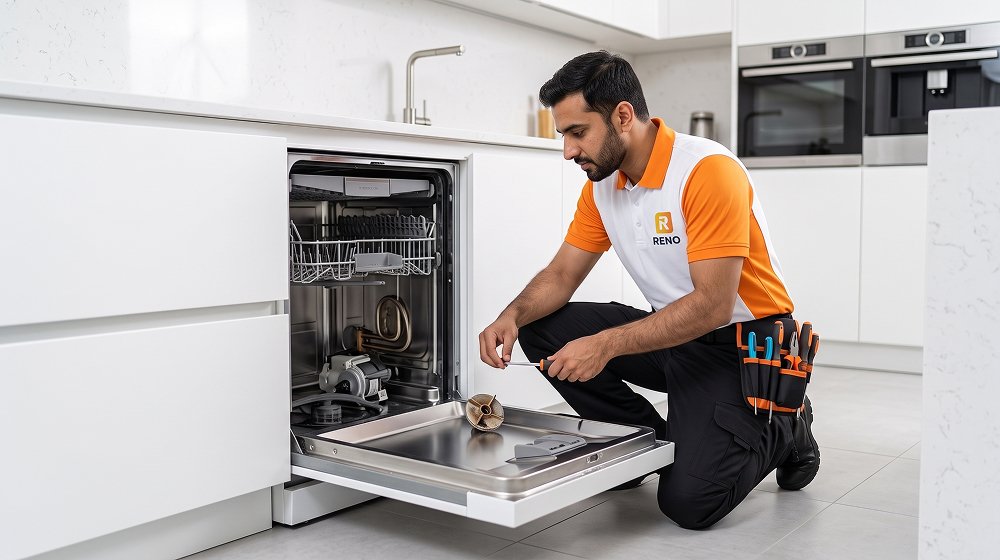
A dishwasher that smells bad is not always dirty. A stale or musty odour usually starts inside the filter, sump, or door seal. A sewage smell points elsewhere, often to the drain hose, sink waste connection, or shared drainage stack. Cleaning can remove a hygiene odour. It cannot correct wastewater backflow or a faulty plumbing connection.
A different smell changes the diagnosis. A musty dishwasher points toward biofilm around the door seal. A dishwasher that smells like sewage points toward the drain hose, sink waste connection or shared drainage stack.
That distinction saves time. You can remove internal hygiene deposits yourself. Cleaning cannot correct wastewater backflow or a faulty plumbing connection.
When cleaning does not remove the odour, professional dishwasher repair in Dubai can diagnose pump, hose, electrical, or wastewater-connection faults.
This guide separates hygiene faults from drainage faults by smell type.
It covers:
- 6 common odour sources
- Step-by-step diagnosis
- Safe checks
- Technician-only repairs
- Current repair costs in Dubai
It also explains why standing water, cool wash programmes, grease deposits, poor hose routing, and warm conditions can make dishwasher odour return.
Why is your dishwasher smelling bad?
A dirty filter and sump are the likeliest cause, followed by door-seal biofilm and standing water. You can clean the filter, sump and seal yourself. Persistent water, drain-hose backflow or a sewage smell requires a technician or plumber for diagnosis.
Check the smell before adding another cleaning product. Stale and musty odours usually originate inside the tub. Drain-like odours usually enter through the wastewater path.
What causes dishwasher odour?
Six fault states explain most dishwasher odours:
- Retained food
- Seal biofilm
- Standing wastewater
- Backflow
- Repeated cool washing
- Grease inside the drain hose
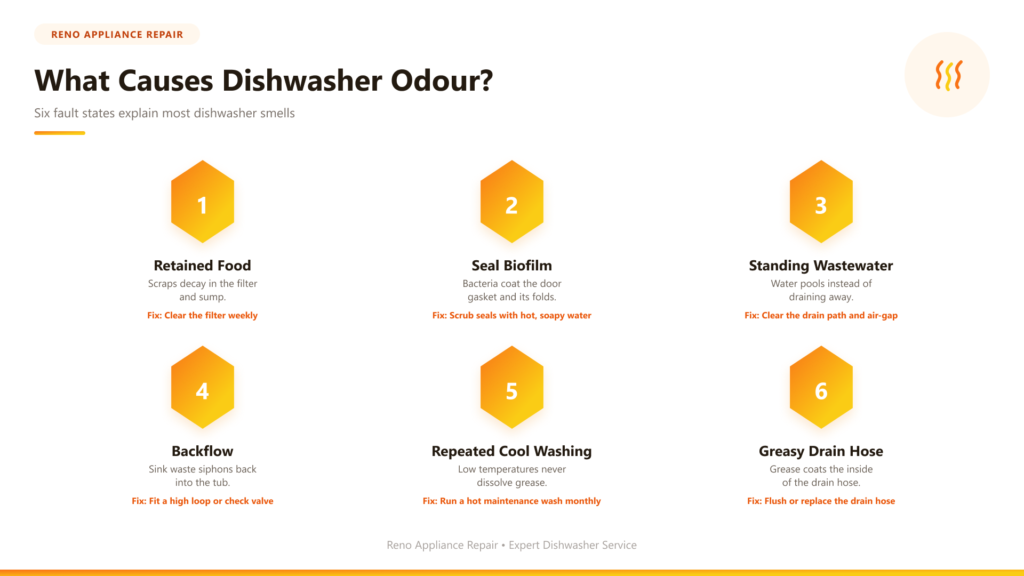
The following cause-likelihood table ranks diagnostic priority. It does not represent measured Dubai prevalence because no published local dataset assigns percentages to household dishwasher odour faults.
| Diagnostic likelihood | Odour source | Observed smell | Confirming sign | Owner action |
|---|---|---|---|---|
| Highest | Dirty filter and sump | Stale, sour or fishy | Removed filter smells stronger than the tub | Clean filter and accessible sump |
| High | Door-seal biofilm | Musty, damp or earthy | Slippery residue inside seal folds | Clean and dry the seal |
| High | Standing wastewater | Foul or swamp-like | Excess water remains after draining | Clear visible debris |
| Conditional | Low hose or missing air break | Sewage or drains | Smell matches the sink waste | Request plumbing correction |
| Moderate | Repeated low-temperature cycles | Recurring mustiness | Greasy film remains after washing | Run an approved hot cycle |
| Moderate | Grease inside the drain hose | Persistent rancid odour | Clean tub smells again after draining | Arrange hose cleaning or replacement |
Bosch Customer Service places blocked filters and insufficient maintenance washing among its main odour checks.
GE Appliances separately identifies dirty water returning through an incorrectly routed drain hose.
How does a dirty filter and sump generate a stale smell?
A dirty filter retains food proteins, starch, cooking fat and paper labels. The sump below the filter collects smaller particles before water enters the circulation and drain system.
Food remains wet between cycles. Microbial breakdown then releases volatile compounds that create a stale dishwasher smell. A blocked filter also restricts wastewater movement, leaving more residue inside the machine.
Regular dishwasher filter cleaning removes trapped food before moisture and microbial activity turn it into a recurring stale odour.
Samsung Gulf recommends cleaning applicable removable filters every 2 to 4 weeks, depending on use. Samsung links clogged filters with odour, standing water, poor cleaning and abnormal pump noise.
Remove the filter and smell it separately. A much stronger odour confirms that the hygiene fault sits near the filter or sump.
How does biofilm in the door seal produce a musty smell?
Biofilm is a thin layer of microorganisms held within moisture and organic residue. Dishwasher seals support biofilm because their folds receive splashes but little direct spray pressure.
A 2018 Applied and Environmental Microbiology study examined rubber-seal biofilms from 24 household dishwashers. Researchers sequenced 21 samples and identified 309 bacterial and 194 fungal operational taxonomic units. Candida appeared in 100% of the sampled dishwashers.
The study recorded wash environments ranging between 20°C and 74°C and pH values between 6.5 and 12. Biofilm still persisted on protected rubber surfaces. That finding explains why a musty dishwasher can smell despite regular wash cycles.
Inspect the door seal folds for slippery residue, dark specks, or concentrated musty odour, then clean them using the method approved for your model.
A 2026 Brazilian Journal of Microbiology study tested another 22 dishwashers. Rubber seals were the most frequently colonized inspection point.
Wipe the side folds, bottom corners and lower door channel. Replace the gasket when rubber has split, hardened or stopped sealing.
How does standing water from poor drainage turn foul?
Standing wastewater becomes foul when food residue remains after the drain phase. The retained water repeatedly warms during later cycles, then cools inside an enclosed sump.
A few millimeters of clean water can remain in some models by design. A large pool above the filter area is different. A large amount after a cycle indicates a drainage problem.
Run a short programme and inspect the base immediately afterward. Persistent water points toward one of four components:
- A blocked filter
- A kinked drain hose
- A restricted sink waste branch
- A weak or obstructed drain pump
Water that returns after the machine empties points more strongly toward backflow. Water that never leaves points toward an appliance blockage or pump fault.
When a dishwasher not draining complaint includes water above the filter area, first separate an internal blockage from sink-side wastewater returning after the pump stops.
How does a drain hose without an air break admit sewer gas?
A low dishwasher drain hose creates a direct path between the appliance and the sink waste branch. Dirty sink water can travel backward during a blockage or pressure change.
An air gap creates physical separation between the dishwasher hose and household drain. An air break uses an open discharge arrangement. A high loop raises and secures the hose beneath the worktop where the manufacturer permits that method.
A correctly elevated drain hose helps prevent contaminated sink water and drain air from travelling back toward the appliance.
Whirlpool Product Help specifies a minimum loop height of 20 inches (50.8 centimeters) for applicable Whirlpool installations. Whirlpool requires an air gap when the hose sits below that level. Other manufacturers specify different layouts.
Dirty water entering a dishwasher without an air gap or high loop is an installation fault. Cleaning the tub cannot change hose elevation or stop wastewater backflow.
How does running only low-temperature programmes allow bacteria to survive?
Low-temperature programmes reduce heat exposure and can leave grease on filters, plastic surfaces and seal folds. Temperature works with detergent chemistry and cycle duration. Heat alone does not clean a blocked component.
A Journal of Applied Microbiology study tested temperatures of 45°C, 50°C, 55°C, 60°C, 65°C and 75°C. Test cycles lasted between 5 and 90 minutes. Microbial reduction increased with temperature, with clearer improvement at 60°C or above during short cycles.
The study also notes that the NSF/ANSI 184 sanitation certification uses a 5-log microbial reduction and a 65°C final rinse. That standard applies to certified sanitizing programmes, not every domestic cycle.
Bosch Customer Service recommends a maintenance wash every 4 to 6 months and a programme of at least 65°C for its stated procedure. Follow your model manual rather than applying one temperature to every dishwasher.
How does grease in the drain hose bore produce a persistent odour?
Grease adheres to the corrugated inner wall of a dishwasher drain hose. Fine food particles stick to that layer and remain outside the reach of normal spray arms.
Each drain phase wets the deposits again. The smell then returns after filter cleaning because the source sits between the pump outlet and sink connection.
Suspect the hose when three conditions appear together:
- The filter and seal smell clean.
- The odour becomes stronger during draining.
- The connected sink drains slowly or gurgles.
A hardened, inaccessible or internally coated hose often needs replacement. Pouring chemicals into the dishwasher can damage seals and expose the technician to drain cleaner.
How do you diagnose dishwasher odour step by step?
Diagnose the odour before dismantling anything. Start inside the tub, then follow the wastewater route toward the sink.
Disconnect electrical power before touching fixed pump covers, wiring or the heating element. Unplug the appliance or switch off its circuit before relevant maintenance.
- Identify the smell type (stale, musty, sewage, or burning)
A stale smell indicates wet food near the filter. A musty smell indicates biofilm around rubber or plastic. A sewage smell indicates drain air or contaminated backflow when it matches the sink waste.
A burning smell follows a different fault path. Plastic may fall against an exposed heater. Plastic or food can melt on the heating element and create smoke or odour.
Switch off the circuit when the burning odour persists, wiring smells hot or smoke appears.
- Remove and smell the filter stack separately
Remove the lower rack and unlock the filter according to the model manual. Wear gloves because filters can hold broken glass.
Rinse each filter under running water. Use a soft brush for mesh openings. Do not use wire tools or abrasive pads.
Inspect the open filter housing for bones, labels and glass. Stop when a screw-secured pump cover blocks access.
- Inspect and wipe the full door seal channel
Inspect both vertical sides, the top corners and the lower lip. Run a white cloth through each fold.
Grey, pink, brown or greasy residue confirms surface deposits. Odour concentrated on the cloth supports a seal-biofilm diagnosis.
Clean with the manufacturer-approved method. Never combine chlorine bleach with ammonia because the mixture releases toxic gases.
- Check for standing water in the sump after a cycle
Check the sump directly after a completed cycle. Photograph the water level before starting another test.
Run a drain or cancel command. A falling level confirms that the pump can move some water. No movement suggests blockage or pump failure.
Water that disappears and later returns supports sink-side backflow. That pattern shifts diagnosis toward the hose route or waste branch.
- Check the drain hose for a high loop or air break
Inspect the visible hose beneath the sink. Look for a secure rise, sharp kink, deep sag or low connection.
Do not disconnect the hose while the sink contains water. Do not pull a built-in dishwasher from cabinetry without isolating power and water.
Compare the routing with the appliance installation manual. A hose can appear high while still sitting below the manufacturer’s required connection point.
Which checks can you safely do yourself?
Four owner checks cover removable hygiene parts and the visible hose route. Stop when access requires tools, cabinet removal or plumbing disconnection.
Learning how to clean a dishwasher safely starts with removable parts, approved products, and the maintenance instructions in the appliance manual.
- Remove the filter. Rinse every removable section and clear accessible debris.
- Scrub the seal channel. Clean each fold, then dry the rubber.
- Run a hot empty cycle. Select the maintenance programme stated in the manual.
- Check the hose loop. Confirm that the visible hose rises securely without sagging.
Do not run the dishwasher without its filters. Filter design varies by model and requires correct reassembly.
DIY versus technician decision box
- DIY: Removable filter debris, accessible sump residue, seal deposits, approved maintenance washing and a loose visible hose support.
- Technician or plumber: Returning wastewater, pump humming, fixed sump covers, hose replacement, waste re-routing, and burning odour or sewage smell affecting several drains.
Which of these faults needs a technician?
Common faults that require technical access include:
- Sump strip-down
- Drain hose replacement
- Waste connection re-routing
- Internal pump cleaning
Professional home appliance repair is appropriate when diagnosis requires electrical testing, pump access, cabinet removal, or replacement of fixed internal parts.
A sump strip-down exposes the drain pump, non-return valve, impeller and seals. Incorrect reassembly can create a leak beneath the appliance.
Drain-hose replacement requires the correct diameter, length, clamps and elevation. A longer universal hose can create low points that trap greasy water.
Waste re-routing requires a plumber when the hose connects below the trap, enters an unsuitable fitting or lacks an approved separation method. Contact building maintenance when several drains smell or gurgle.
Pump cleaning requires a technician when debris sits behind a fixed guard. Humming without drainage can indicate a jammed impeller, while silence may indicate an electrical or motor fault.
How much does it cost to fix a dishwasher odour in Dubai?
Dishwasher odour repair in Dubai ranges from a basic diagnosis to pump or shared-drain work. The table provides planning figures, not fixed quotations.
Every range below carries a price date of 3 August 2026. Published June 2026 Dubai benchmarks place dishwasher diagnosis around AED 150 to AED 250 and minor blockage work around AED 150 to AED 350.
| Cause and repair scope | Planning cost | Confirm before approval |
|---|---|---|
| Diagnosis or appliance call-out | AED 150 to AED 250 | Fee deduction, testing and travel |
| Filter, accessible sump or minor blockage cleaning | AED 150 to AED 350 | Cleaning, refitting and drain test |
| Drain-hose cleaning or minor hose correction | AED 150 to AED 350 | Cabinet access, clamps and leak test |
| Drain-pump or deeper sump repair | AED 300 to AED 800 | Part number, labour and warranty |
| Accessible kitchen drain clearing | AED 150 to AED 300 | Trap cleaning and flow testing |
| Machine clearing for grease blockage | AED 300 to AED 800 | Equipment, waste removal and retest |
| Repeated or shared-line blockage investigation | AED 500 to AED 1,200 | Camera inspection and building escalation |
Published Dubai drain benchmarks place simple clearing at AED 150 to AED 300, machine grease work at AED 300 to AED 800, and repeated multi-drain investigation at AED 500 to AED 1,200.
Confirm value-added tax, parts, cabinet access, testing and warranty before approving work.
Why does your dishwasher smell like sewage or drains?
A dishwasher smells like sewage when drain air or dirty wastewater reaches the appliance through its discharge path. The fault sits outside normal tub cleaning when the odour matches the sink or returns immediately after cleaning.
A true sewage smell points toward one of four conditions:
- A drain hose sits too low.
- The connection lacks an approved air break or high loop.
- The sink branch contains grease or stagnant waste.
- A shared stack has a venting or blockage problem.
A dishwasher that smells of eggs does not prove one exact cause. Decomposing food proteins can smell sulphurous. Hydrogen sulfide also smells like rotten eggs and forms during bacterial breakdown of organic matter.
The Agency for Toxic Substances and Disease Registry reports that people can detect hydrogen sulfide between 0.0005 and 0.3 parts per million. Smell alone cannot measure its concentration.
Report a strong odour affecting several drains to building management. Leave the area and seek urgent assistance when occupants experience irritation, dizziness or breathing difficulty.
How do Dubai plumbing connections cause dishwasher odours?
Dubai apartments often connect the dishwasher, kitchen sink and building waste stack through a compact under-sink branch. A fault in that branch can carry drain odour into the appliance.
According to the Dubai Municipality, the Dubai Building Code sets minimum health and safety requirements for building design. The appliance manual still controls the model-specific hose layout.
Why does a direct waste connection without an air break admit gas?
A direct low connection leaves no protective rise or open separation between the dishwasher and household drain. Pressure changes can then move drain air or wastewater toward the machine.
The connection belongs on the protected side of the sink trap and at the approved elevation. Exact arrangements vary across dishwasher brands.
Request plumbing correction when the smell follows sink discharge. Repeated cleaning cannot alter the waste route.
Why does a shared kitchen waste stack push odour into the machine?
A shared stack carries wastewater and air from several apartments. Fast discharge creates pressure changes inside the pipe.
A sound vent system balances that pressure and protects water seals inside traps. A partial blockage or venting fault can produce gurgling, slow drainage and odour across several fixtures.
The failed component may sit outside your apartment. Report these signs together:
- Two or more drains smell.
- The sink gurgles when another fixture empties.
- Water rises inside the sink or dishwasher.
- Neighboring units report the same fault.
An appliance technician can test the dishwasher. Building management or a plumber must investigate the shared line.
How does high ambient temperature accelerate biofilm growth?
Warm conditions increase odour development when moisture and food residue remain available. Dubai’s climate makes wet filters, idle hoses and closed-door seals dry more slowly inside warm cabinets.
The World Meteorological Organization lists Dubai’s mean daily maximum temperatures of 38.8°C in June, 40.6°C in July and 40.4°C in August. These are outdoor climate values, not dishwasher temperatures.
The practical link is indirect. Warm under-sink spaces increase the value of drying, rinsing delayed loads and removing food deposits promptly.
Leave the door slightly open after use only when the manual permits it. Keep children away from an open appliance.
Which related dishwasher problems share the same cause?
Dishwasher odour shares the sump and drain path with poor cleaning, standing water, gurgling and abnormal pump noise.
- Poor cleaning follows restricted circulation through a dirty filter.
- Standing water follows a blocked hose, waste branch or drain pump.
- Gurgling follows restricted drainage or pressure movement.
- Grinding follows hard debris near the pump impeller.
- Leaking follows damaged seals, hoses or incorrect reassembly.
Samsung Gulf links clogged filters to these symptoms, including foul odour, poor drainage, weak cleaning, and abnormal noise. That relationship carries the failed component forward rather than treating each symptom as a separate problem.
Use the smell type to keep diagnosis focused. Clean stale and musty sources inside the tub. Trace sewage odour through the hose, sink branch, trap and shared stack.
That is the key distinction. A hygiene odour responds to cleaning. A plumbing odour remains until the drainage fault is corrected.
How do you stop dishwasher odour from returning?
A bad dishwasher smell stops returning when the repair matches the odour source. Clean the filter, sump, and seal when the smell is stale or musty. Trace the drain hose, sink branch, and shared waste stack when the smell resembles sewage.
That difference matters. A hygiene fault responds to cleaning. A drainage fault remains until backflow, poor hose routing, trapped grease, or a shared plumbing problem is corrected.
Use the smell as the first diagnostic clue. Then check each component in order. This approach avoids repeated cleaning, unnecessary parts, and repair costs that do not address the failed component.
FAQs
The odour may remain in the sump, door seal, drain hose, standing water, or sink waste connection.
No, a hot cycle removes internal residue but cannot correct wastewater backflow or a faulty drain connection.
Sink discharge can push drain air or contaminated water toward the dishwasher through a low or poorly routed hose.
Contact building management when several drains smell, the sink gurgles, water backs up, or neighboring apartments report the same fault.
Ahmed Al Mansoori
Ahmed Al Mansoori is a UAE-based home appliance repair specialist with over 12 years of hands-on experience in diagnosing and repairing washing machines, refrigerators, dishwashers, ovens, dryers, and other household appliances across Dubai and Abu Dhabi. He has worked with leading appliance brands and is known for delivering reliable repair solutions, preventive maintenance guidance, and same-day technical support for residential clients. Ahmed specializes in troubleshooting modern smart appliances and energy-efficient systems commonly used in UAE homes.
