
Dishwasher Making a Loud Noise: Causes and Fixes
 August 3, 2026
15 min read
August 3, 2026
15 min read
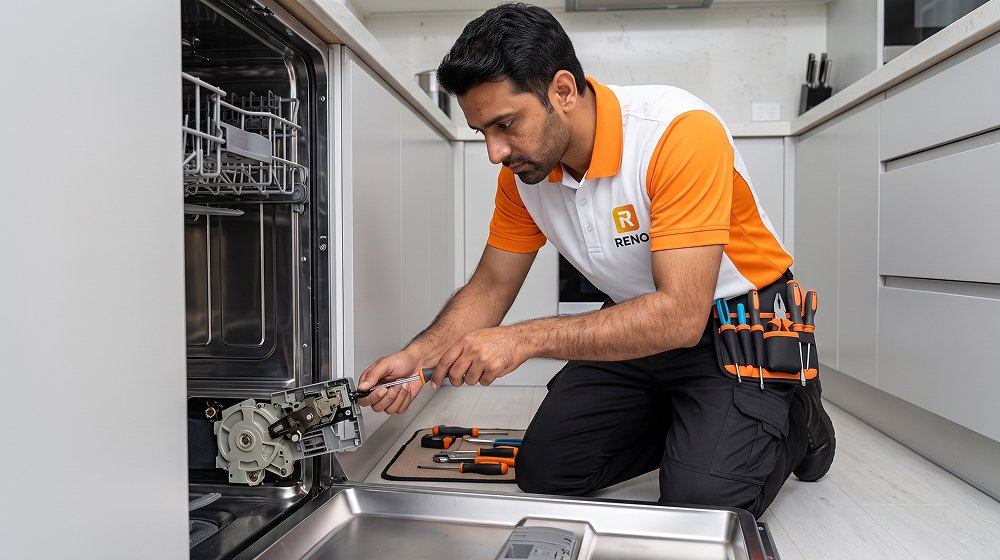
A dishwasher making a loud noise can turn a normal wash cycle into a warning sign. Grinding, humming, rattling, knocking, or gurgling often points to a specific fault inside the pump, sump, spray arm, filter, or mounting system.
Ignoring the noise can lead to poor drainage, weak cleaning, damaged pump parts, or a more expensive repair. The timing of the sound matters. A knock during washing suggests spray-arm contact, while grinding during draining points toward the sump or drain pump.
This article explains:
- What are the main causes of abnormal dishwasher noise?
- How to match each sound with the cycle stage?
- Which checks are safe to complete at home?
It also identifies faults beyond safe DIY checks, urgent symptoms, and the point at which dishwasher repair in Dubai may be the appropriate next step.
Why is your dishwasher making a loud noise?
A foreign object in the sump is the likeliest of 6 causes to check, followed by spray-arm contact and a blocked filter. You can clear debris, reload dishes, and clean the filter; pump and bearing faults require a qualified technician.
The useful clue is cycle timing. A wash-stage knock points toward the spray arm. A drain-stage grind points toward the sump, impeller, or drain pump. Whirlpool Product Help separates normal dishwasher sounds by fill, wash, drain, and drying stage.
A dishwasher’s label gives a baseline, not a fault diagnosis. The European Union dishwasher label uses 4 airborne-noise classes:
- A) below 39 dB(A)
- B) from 39 to below 45
- C) from 45 to below 51
- D) at 51 dB(A) or higher
The test uses the eco programme at rated capacity.
Decibels use a logarithmic scale. A 10 dB increase represents ten times the sound power, according to the US Centers for Disease Control and Prevention. A new dishwasher’s loud noise can therefore feel substantial even when the measured rise looks small.
The table ranks the first checks for a dishwasher making noise. It does not claim measured failure percentages because no public Dubai dataset reports cause-by-cause incidence.
| Diagnostic order | Likely cause | Noise pattern | Cycle stage | First action |
|---|---|---|---|---|
| 1 | Foreign object in sump | Grinding or crunching | Drain, sometimes wash | Inspect accessible sump |
| 2 | Spray arm striking a dish | Rhythmic knocking | Wash | Reload and spin arms |
| 3 | Blocked or loose filter | Gurgling, rattling, suction | Wash or drain | Clean and refit filter |
| 4 | Unlevel mounting | Cabinet buzz or vibration | Wash or drain | Check level and support |
| 5 | Worn drain-pump impeller | Rattle or harsh hum | Drain | Arrange pump diagnosis |
| 6 | Worn circulation-pump bearing | Continuous whine or drone | Wash | Arrange motor diagnosis |
Check the impeller for very loud grinding or buzzing. Spray-arm obstruction causes rhythmic thumping.
What causes abnormal noise?
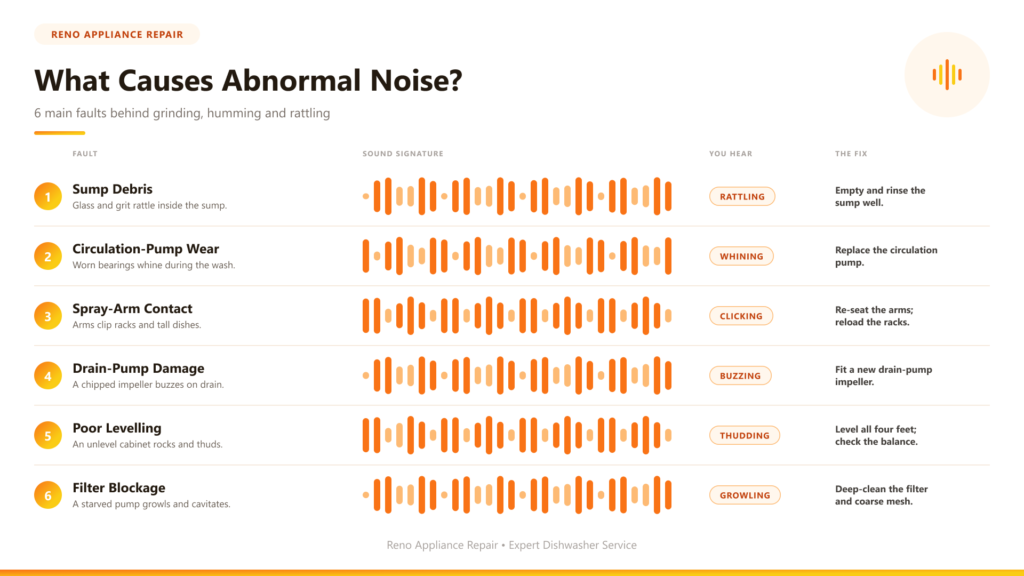
6 main faults cause abnormal dishwasher noise:
- Sump debris
- Circulation-pump wear
- Spray-arm contact
- Drain-pump damage
- Poor levelling
- Filter blockage
The sound and cycle stage identify the likely component. Grinding usually points to the sump or pump, rhythmic knocking points to a spray arm, and a continuous wash-stage whine points to the circulation pump.
The cycle stage narrows the diagnosis before any parts are removed. A noise during filling relates mainly to the inlet valve or household pipework. A noise during washing relates to loading, spray-arm movement, or the circulation system. A noise during draining relates to the filter, sump, impeller, drain hose, or drain pump. GE Appliances separates normal and abnormal dishwasher sounds by operating stage.
Noise can overlap with common dishwasher problems such as poor drainage, weak washing, and water left in the tub. Match the sound with the cycle stage before replacing a component.
How does a foreign object in the sump cause grinding?
A glass chip, fruit stone, bone fragment, label, or hard food particle can reach the sump. The impeller can then strike or drag the object, creating a dishwasher grinding noise during draining. Samsung Support links loud grinding with material caught near the drain-pump impeller.
Bosch UAE instructs users to remove the lower basket, lower spray arm, and filter before checking an accessible pump area. Bosch also specifies gloves because hidden glass can cut your hand.
Stop repeated testing when grinding remains after debris removal. A clear sump with the same sound requires pump and impeller diagnosis. Consider service when loud grinding returns every cycle and the pump opening is inaccessible or clear.
How does a worn circulation pump bearing cause a continuous whine?
A worn circulation-pump bearing is suspected when a new, rough whine remains present throughout the wash stage. The wash pump operates while water moves through the rotating spray system.
A low wash-motor whine can be normal. Ordinary wash-pump whine is among normal operating sounds. Treat a new, louder, or uneven tone as the reason for inspection.
Sound alone cannot confirm bearing wear. A technician checks the pump, motor, water movement, electrical load, and leakage before replacing parts. GE Appliances recommends service when basic noise checks do not resolve an abnormal sound.
How does a spray arm striking a dish cause rhythmic knocking?
The spray arms can cause rhythmic knocking when one of them hits the same item on each rotation. Tall plates, pan handles, loose utensils, and light plastic lids can enter the rotation path.
Rack items extending into the wash-arm path can cause thumping. Rearrange the load so each arm rotates freely.
Hand-spin every accessible arm before closing the door. A quiet cycle after reloading confirms a loading fault rather than a pump fault. Free spray-arm rotation also supports effective wash performance.
How does a worn drain pump impeller cause a rattle at drain?
A worn or damaged drain pump impeller creates a rattle, scrape, or harsh dishwasher humming sound while wastewater leaves the tub. Debris can produce a similar sound.
It is recommended to check the impeller when drain grinding or buzzing becomes very loud. LG Support links squealing or grinding with a possible pump problem.
Arrange repair when the pump area looks clear and the rattle returns during every drain. Owners must seek service when loud pump noise persists after accessible debris checks.
How does an unlevel machine cause vibration against the cabinet?
An unlevel dishwasher transfers normal motor movement into the worktop, side panels, brackets, or toe-kick. The surrounding cabinet then amplifies the vibration.
Provide support from the feet and rear wheels, plus a square position inside the cabinet. Excessive noise, weak drainage, poor cleaning, and door problems are associated with poor levelling.
Press each upper front corner. Rocking points toward uneven support. Stop if adjustment requires appliance removal or hose movement.
How does a blocked filter cause a gurgling or sucking noise?
A blocked filter restricts water flow and traps food, grease, labels, or glass. The pump then draws water through a smaller opening, creating gurgling, suction, or a strained hum.
A loose or clogged filter can rattle and make gulping sounds. Owners are advised to keep the outlet filter clean.
Persistent gurgling after cleaning points toward the drain hose, sink connection, pump chamber, or building drain. Drain-pipe restrictions cause slow sink drainage and gulping.
How do you diagnose abnormal noise step by step?
First, identify when the noise occurs: during filling, washing, draining, or drying. The cycle stage narrows the fault to a smaller group of components.
- Listen during filling. Banging or vibrating pipes may indicate water hammer, household pipework movement, or an inlet-valve problem.
- Check the wash stage. Rhythmic knocking usually means a spray arm is hitting a plate, utensil, or pan handle. A continuous loud whine may point to the circulation pump.
- Check the drain stage. Grinding, rattling, or harsh humming can indicate debris in the sump, a loose filter, impeller damage, or drain-pump wear.
- Switch off the power. Remove the lower rack and clean the filter. Inspect the accessible sump while wearing cut-resistant gloves because broken glass may be hidden below the filter.
- Spin each spray arm by hand. Confirm that every arm completes a full rotation without touching dishes or racks.
- Check the dishwasher’s position. Use a spirit level from side to side and front to back. Rocking, cabinet contact, or unsupported feet can amplify normal motor vibration.
Run one short test cycle after completing the safe checks. Stop testing if grinding continues, the pump area appears clear, or the machine produces a burning smell, electrical crackling, or repeated breaker trips.
- Identify when in the cycle the noise occurs
Record the programme, cycle stage, duration, and repetition. Use a short phone video if the machine remains electrically safe.
Whirlpool Product Help separates routine sounds by fill, wash, drain, and drying. Timing removes several components from the diagnosis before dismantling starts.
- Match the noise type to the stage: fill, wash, or drain
Use 3 operating stages as your first filter:
- Match fill noise with the inlet valve or household pipework.
- Match wash noise with spray arms, loading, or the circulation pump.
- Match drain noise with the filter, sump, impeller, hose, or drain pump.
GE Appliances identifies water hammer during fill, rhythmic arm contact during wash, and pump sounds during drain.
- Remove the filter and inspect the sump for debris
Switch off the appliance and isolate electrical power. Remove the lower rack, spray arm, and filter only as the model manual permits.
Use a sponge to remove standing water. Wear cut-resistant gloves. Be cautious about sharp objects inside the pump area.
Inspect only manual-approved parts. Sharp glass can remain below the filter.
- Spin each spray arm and check clearance against loaded items
Spin each accessible arm through one complete rotation. Check plates, pan handles, knives, trays, and lightweight lids.
Run one empty test cycle when the loading cause remains unclear. A disappearing rattle during an empty cycle points toward dish movement or poor loading.
- Check the machine is level and the feet are locked
Place a spirit level across the opening from side to side. Repeat the check from front to back.
Whirlpool’s installation guidance requires a centred bubble in both directions. The feet must support the machine firmly, and the tub must sit square inside the cabinet.
The noise-to-stage table turns one vague complaint into a shorter component list.
| Noise | Stage | First component | Second possibility | First action |
|---|---|---|---|---|
| Bang in supply pipe | Fill | Household pipework | Inlet valve | Listen under sink |
| Rhythmic knock | Wash | Spray arm | Loose dish | Reload and hand-spin |
| Continuous loud whine | Wash | Circulation pump | Motor bearing | Record empty wash |
| Grinding | Drain | Sump or impeller | Drain pump | Inspect accessible debris |
| Rattle | Drain | Drain impeller | Loose filter or hose | Stop and inspect |
| Gurgle or suction | Drain | Filter | Hose or sink connection | Clean and refit filter |
| Cabinet buzz | Wash or drain | Levelling feet | Mounting bracket | Check rocking |
Which checks can you safely do yourself?
Complete 4 checks without removing the built-in appliance:
- Note the noise timing. Record fill, wash, drain, or drying.
- Empty the sump. Remove accessible debris after isolating power.
- Reload tall items. Keep every item outside the spray-arm path.
- Level the machine. Adjust accessible feet only while the unit remains supported.
Electrical Safety First advises against cleaning or repairing an appliance while it remains plugged in. The same authority warns against touching electrical equipment with wet hands.
DIY versus technician decision box
| Finding | Safe DIY action | Technician action |
|---|---|---|
| Noise stops after reloading | Continue use | None |
| Visible debris sits in an accessible sump | Remove with gloves | Open unfamiliar pump covers |
| The filter is dirty or loose | Clean and refit | Diagnose recurring noise |
| The dishwasher rocks slightly | Adjust accessible feet | Remove or remount the unit |
| A loud wash-stage whine remains | Record the sound | Test pump and motor |
| Grinding remains with a clear sump | Stop testing | Inspect impeller and pump |
| A burning smell or crackling appears | Isolate power | Electrical diagnosis |
Which of these faults needs a technician?
Persistent pump noise, motor failure, electrical faults, internal leaks, and built-in cabinet access may require professional home appliance repair. A technician can test the affected components, identify the exact failure, and complete the work without damaging wiring, seals, hoses, or surrounding cabinetry.
The European Union ecodesign regulation requires motors, circulation pumps, drain pumps, valves, and filters to remain available to professional repairers for at least seven years after the last unit enters the market. This rule assists parts planning for EU-market models, but it does not guarantee UAE stock.
Request four items in the written diagnosis:
- The failed component
- The part number
- Labour and parts prices
- The post-repair test
A persistent wash-stage whine needs pump and motor testing. A persistent drain-stage rattle needs drain-pump and impeller inspection. Cabinet isolation applies when vibration continues after levelling.
How much does it cost to fix abnormal noise in Dubai?
Dubai dishwasher noise repair commonly starts around AED 150 to AED 250 for diagnosis and can exceed AED 1,000 for motor work. The ranges below were checked on August 2, 2026.
The table combines that appliance benchmark with published market ranges, not regulated tariffs or fixed quotations.
| Cause or repair | Dubai planning range | Date checked | Pricing basis |
|---|---|---|---|
| Diagnosis or call-out | AED 150 to AED 250 | August 2, 2026 | Published appliance benchmark |
| Filter or sump-debris removal | AED 150 to AED 350 | August 2, 2026 | Minor labour and cleaning |
| Spray-arm correction or replacement | AED 150 to AED 350 | August 2, 2026 | Labour plus model-specific part |
| Levelling or mounting correction | AED 150 to AED 350 | August 2, 2026 | Access and adjustment |
| Drain-pump replacement | AED 300 to AED 800 | August 2, 2026 | Pump, labour, testing |
| Circulation pump or motor work | AED 700 to AED 1,000+ | August 2, 2026 | Higher-cost component repair |
| Water-hammer plumbing visit | AED 99 to AED 500+ | August 2, 2026 | Visit, diagnosis, pipework scope |
The Dubai dishwasher repair benchmark places diagnosis near AED 150 to AED 250, minor work near AED 150 to AED 350, and higher-cost motor work near AED 700 to AED 1,000+. The Dubai plumbing guide lists a standard visit at AED 99 and emergency work reaching AED 500.
Built-in cabinet access, imported parts, emergency attendance, and brand-specific components can raise the quote. Pump or motor replacement should be assessed against the quoted scope and expected dishwasher repair cost in Dubai before approval.
What does each dishwasher noise mean?
The sound alone is incomplete. The cycle stage gives the sound diagnostic value.
| Dishwasher noise | Prediction | Status |
|---|---|---|
| Soft hum during drain | Drain pump operating | Usually normal |
| Swishing during wash | Water moving through spray arms | Normal |
| Brief click or snap | Valve, dispenser, latch, or cycle change | Often normal |
| Rhythmic wash-stage knock | Spray arm striking an item | Abnormal, often DIY |
| Drain-stage grinding | Debris or impeller damage | Abnormal when loud |
| Loud continuous wash whine | Pump or motor wear | Technician check |
| Gurgling with slow drainage | Filter or drain restriction | Abnormal when persistent |
| Bang in pipes during fill | Water hammer | Plumbing fault |
Swishing, some clicks, drain-pump sounds, and ordinary pump whine are normal. On the other hand, rhythmic spray-arm contact and water hammer are abnormal.
Which noises indicate you should stop using the dishwasher immediately?
Stop the dishwasher for persistent grinding, burning smells, electrical crackling, repeated breaker trips, or violent pipe banging.
Why does a grinding noise at the drain risk pump destruction?
Persistent drain grinding means debris or a damaged component remains near the impeller. Repeated operation can worsen an existing pump obstruction or impeller fault.
Bosch UAE tells users to check the impeller when grinding becomes very loud. Stop testing when the accessible pump area looks clear and the sound returns.
Why does a burning smell with noise mean isolating the machine?
A burning smell with buzzing, crackling, heat, or breaker trips indicates an electrical fault. Isolate the dishwasher at the accessible switch or breaker.
Users should not ignore burn marks, arcing sounds, blown fuses, tripped breakers, or a hot plug. The authority advises unplugging the machine and contacting a qualified repair technician.
Do not touch a wet plug, socket, switch, or appliance base. Users should avoid touching electrical equipment with wet hands. Use the breaker when the plug is unsafe to reach.
Why does a knocking noise at the fill indicate water hammer in the riser?
A hard bang during fill can indicate water hammer. The inlet valve closes and moving water transfers force into the household supply pipe or riser.
Household water pressure and valve closure are linked to rattling pipes. Call a plumber because the fault sits in the plumbing system.
Which related dishwasher problems share the same cause?
A blocked filter can result in a dishwasher not draining properly, causing gurgling, slower emptying, and standing water inside the tub. Rattling, gulping, and slower sink drainage are due to clogged filters and restricted drain pipes.
A damaged outlet pump may begin rattling before drainage stops completely. A weak circulation pump can produce a whining sound as wash performance declines. A blocked spray arm may knock against dishes and reduce water coverage. Check that each arm rotates freely and arrange service when pump noise continues.
An unlevel installation can cause cabinet vibration alongside drainage, seal, cleaning, or door-alignment faults. Correct levelling improves operation, drainage, washing, and door movement.
The fault can also affect the door area. A latch click may be normal, but hinge scraping, spring noise, seal rubbing, or cabinet contact can indicate a mechanical or installation problem. Some home appliance repair services identify some latch sounds as normal, while some connect door rubbing and squeaking with poor levelling or cabinet contact. Match the noise to the cycle stage before confirming the failed component.
Fix the noise before it becomes a larger fault
A dishwasher making a loud noise rarely needs guesswork. The cycle stage usually reveals where the problem starts. A wash-stage knock points toward loading or spray-arm contact. Grinding during drain directs attention to the sump, impeller, or drain pump.
Start with the safe checks. Clean the filter, inspect accessible sump areas, reload tall items, and confirm that the machine sits level. These steps can resolve common rattling, gurgling, knocking, and vibration without replacing a component.
Stop using the dishwasher when grinding continues, a burning smell appears, the breaker trips, or pipes bang during fill. Early diagnosis protects the pump, limits water or electrical damage, and prevents a small fault from becoming a higher-cost repair in Dubai.
FAQs
Yes. Poor loading, a loose filter, cabinet contact, or an unlevel installation can amplify normal operating sounds.
A full load can place plates, utensils, or pan handles inside the spray-arm rotation path.
Hard debris can chip or obstruct the impeller, especially when grinding continues during repeated drain cycles.
Repair often costs less for filters, spray arms, mounting, and drain pumps, while major motor work requires a model-specific cost comparison.
Ahmed Al Mansoori
Ahmed Al Mansoori is a UAE-based home appliance repair specialist with over 12 years of hands-on experience in diagnosing and repairing washing machines, refrigerators, dishwashers, ovens, dryers, and other household appliances across Dubai and Abu Dhabi. He has worked with leading appliance brands and is known for delivering reliable repair solutions, preventive maintenance guidance, and same-day technical support for residential clients. Ahmed specializes in troubleshooting modern smart appliances and energy-efficient systems commonly used in UAE homes.
