
Dishwasher Not Cleaning Dishes Properly: Causes and Fixes
 July 31, 2026
13 min read
July 31, 2026
13 min read
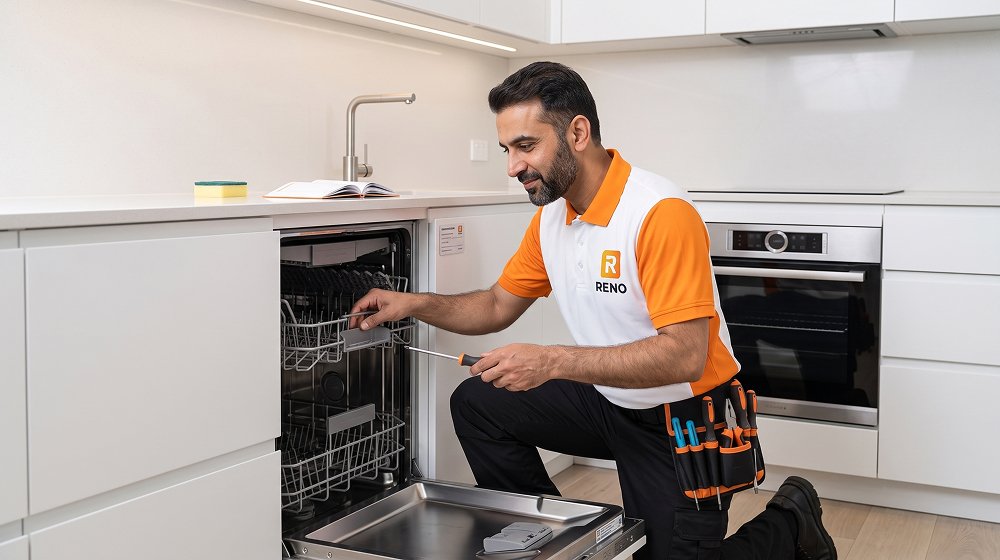
A dishwasher can complete a full cycle and still leave plates greasy, glasses cloudy, or food particles stuck to bowls. The fault often starts with restricted spray coverage, a dirty filter, poor rack loading, weak detergent action, or inadequate wash temperature. Spray arms, filters, loading, detergent, and program selection are among the main checks when dishes come out dirty.
The residue pattern helps narrow the cause. Fixed dirty areas point toward the spray arms. Grit suggests filter or circulation trouble. Grease directs attention toward detergent and heat, while white deposits indicate a possible water-hardness or limescale issue.
This guide explains the 7 main causes of poor wash performance, a 5-step diagnostic process, safe do-it-yourself checks, technician-level faults, and dated repair costs in AED. It also separates wash-pressure problems from water-chemistry faults, including the effect of Dubai building water conditions on dishwasher cleaning results.
Why is your dishwasher not cleaning dishes?

Inspection order, blocked spray-arm jets are the likeliest owner-visible cause among seven diagnostic groups, followed by a clogged filter and poor loading. You can fix those three; pump, heater, or dispenser faults need technician testing.
This ranking shows inspection priority rather than measured failure frequency. No accredited cross-brand dataset establishes one percentage for blocked jets, clogged filters, or poor loading.
A dishwasher not washing properly usually leaves one of four residue patterns:
- Fixed dirty zones indicate restricted spray coverage.
- Grit on several items indicates filter or circulation contamination.
- Greasy surfaces indicate insufficient heat or detergent action.
- White deposits indicate hard-water film, excess detergent, or limescale.
Loading, detergent condition, dispenser release, low fill, water hardness, and temperature are among poor-wash factors.
What causes poor wash performance?
Poor wash performance comes from seven fault groups. The table ranks inspection priority and connects each cause with a measurable or visible clue.
The ranking does not claim universal failure percentages. No accredited cross-brand dataset publishes a reliable percentage for each dishwasher cleaning fault.
| Diagnostic priority | Cause | Observable sign | Authority point |
|---|---|---|---|
| 1 | Blocked spray-arm jets | One rack zone stays dirty | Miele recommends inspection every 2 to 4 months |
| 2 | Clogged filter | Grit returns to cups or bowls | Miele confirms the filter stops soil re-entering through spray arms |
| 3 | Overloading | An item blocks arm movement | Bosch includes loading among 5 primary checks |
| 4 | Detergent or rinse-aid error | Tablet residue, spots, or film | Miele permits a 0 to 6 ml rinse-aid dose on the cited model |
| 5 | Low wash temperature | Grease remains after a hot programme | Whirlpool cites 49°C to 66°C for one platform |
| 6 | Limescale | White crust covers jets or heater parts | Miele activates softening above 5.2 grains per gallon |
| 7 | Weak circulation pump | Both racks receive weak spray | Whirlpool records model-specific arm speeds of 15 to 40 and 20 to 40 rpm |
The official figures above apply to the cited models. Other machines can use different temperatures, hardness limits, doses, and spray-arm speeds.
How do blocked spray arm jets reduce wash coverage?
Blocked spray arms cannot distribute water adequately. Each clogged outlet removes water from part of the intended rack coverage.
Count every blocked opening and record its position. Several blocked center jets affect a wider area than one restricted opening near the arm tip.
Food particles can lodge in spray-arm jets and bearings. Inspect the arms approximately every 2 to 4 months.
Bosch Home Appliances permits tweezers or a cocktail stick for clearing the outlets. Bosch then instructs users to rinse and refit each arm securely.
How does a clogged filter recirculate dirty water?
The filter retains coarse soil before water enters the circulation system. The filter stops that soil from returning through the spray arms.
A blocked filter disrupts water flow and can redeposit dirt on dishes. This mechanism explains grit, seeds, and fine food particles after rinsing.
Clean the full filter stack rather than rinsing only the visible surface. Miele instructs users to rinse every section and use a soft brush where deposits remain.
How does low water temperature leave grease on dishes?
Whirlpool’s technical sheet lists supplying water between 49°C and 66°C for the best wash results on one dishwasher platform. Low temperature appears within Whirlpool’s poor-wash diagnostic section.
That range remains model-specific. Many dishwashers accept cold inlet water and raise the temperature inside the machine.
Check the appliance manual before treating a tap-temperature reading as a failed heater. A machine with internal heating requires a program-temperature test rather than a tap-only test.
Dubai Municipality’s unbottled drinking-water guideline requires building hot-water storage at 60°C or higher. Return water must remain at 50°C or higher. These building targets do not replace the dishwasher manufacturer’s specification.
How does the wrong detergent or missing rinse aid reduce cleaning?
Expired, caked, or clumped detergent is among the causes of dirty dishes.
Rinse aid performs a different task. Rinse aid stops water clinging to dishes, limits marks, and supports faster drying.
The Miele model provides several useful figures:
- The rinse-aid reservoir holds approximately 110 ml.
- The adjustable dose ranges from 0 to 6 ml.
- The factory setting equals 3 ml.
- The refill warning leaves enough rinse aid for about 2 to 3 programs.
These values apply to the cited Miele model, not every dishwasher.
How does overloading block water from reaching surfaces?
Poor loading prevents water from reaching every surface. Large boards and serving plates can also obstruct spray-arm movement.
Place large flat items along the rack sides. Keep visible gaps between plates. Angle bowls downward so water does not collect inside them.
How does a worn circulation pump lower wash pressure?
Technicians should test the pump circuit, wiring, water path, and service mode before pump replacement.
One Whirlpool technical sheet records lower spray-arm rotation at 20 to 40 revolutions per minute. The upper arm runs at 15 to 40 revolutions per minute on that platform.
Those figures provide a model-specific service reference. They do not create a universal dishwasher standard.
Weak spray across both racks after filter and loading checks moves the diagnosis toward fill level, circulation, diverter, or pump faults.
How does limescale on the element and jets reduce performance?
Bosch Home Appliances identifies error E12 as limescale inside the heat pump. Bosch instructs users to descale the dishwasher when that code appears.
Miele’s operating instructions state that water above 5.2 grains per gallon, equal to 5 German degrees, requires softening on the cited model. The integrated softener supports values up to 70 German degrees.
Use a dishwasher-approved descaling process. Correct the hardness setting when mineral deposits return soon after treatment.
How do you diagnose poor wash performance step by step?
Diagnose visible water-path faults first. Test heat and detergent release after clearing those restrictions. This order keeps owner checks separate from electrical service.
- Inspect the spray arms and count blocked jets
Remove the racks and inspect each outlet under bright light. Record the number of blocked jets on each arm.
Push trapped particles inward and rinse the arm under running water.
Repeat the same load after cleaning. A fixed dirty zone that disappears supports a spray-coverage diagnosis.
- Spin each spray arm by hand to test rotation
Spin every arm after loading the racks. Remove any plate, pan handle, or utensil that touches the arm.
Miele requires users to confirm free rotation after reinstalling the lower spray arm and filter.
Stiff movement in an empty machine points toward debris, incorrect fitting, or hub damage.
- Remove and clean the filter stack
Turn off the dishwasher before removing the filter assembly. Miele’s cleaning procedure begins with power isolation.
Remove coarse debris before lifting the filter. Rinse the microfilter and flat sections. Reinstall the stack level and engage its lock.
Running without the filters allows coarse soil to enter and block circulation.
- Run a hot cycle with an empty machine and measure the result
Run the hottest suitable empty programme after cleaning the arms and filter. The empty test removes loading from the diagnosis.
Measure tap temperature only when the machine uses a hot supply. Whirlpool specifies 49°C to 66°C on the cited platform.
Do not place an ordinary glass thermometer inside an operating dishwasher. Whirlpool’s service manual uses a technician service mode and stops one heater test at 57°C.
- Check the detergent dispenser opened during the cycle
Inspect the detergent compartment after the programme. A closed lid, trapped tablet, or damp powder indicates incomplete release.
Incorrect detergent-cup release can cause dirty dishes. Utensils can block the dispenser lid. Remove physical obstructions before requesting an electrical test.
Which checks can you safely do yourself?
You can complete 5 external checks without opening electrical panels:
- Clear the jets. Remove visible particles and rinse each spray arm.
- Clean the filter. Wash every accessible section and engage the lock.
- Reload the racks. Separate dish surfaces and confirm full arm movement.
- Refill rinse aid. Use the product and dose specified for the model.
- Run a hot cycle. Test the empty machine after clearing restrictions.
Spray-arm, filter, loading, detergent, and programme checks are owner troubleshooting.
DIY versus technician decision box
DIY check: blocked jets, dirty filters, poor loading, empty rinse aid, or a physical dispenser obstruction.
Technician check: weak spray across both racks, cold cycles, electrical errors, pump humming, cabinet leaks, or failed powered actuation.
Whirlpool’s service manual limits diagnostic voltage measurements to authorized technicians.
Which of these faults need a technician?
Four listed faults require technician testing: a worn circulation pump, failed heating element, failed dispenser wax motor, and blocked internal sump channel.
A worn pump requires hydraulic and electrical checks. A failed heater requires model-specific resistance testing. Whirlpool’s technical sheet lists 29.5 to 32.5 ohms for one heater design.
A wax motor applies only to models using that actuator. Maytag’s official service manual lists 1.4 to 3.0 kilo-ohms for its dispenser wax-motor test.
A blocked internal sump channel sits below the removable filter. Sump removal involves screws, harnesses, hoses, clamps, and pump access.
How much does it cost to fix poor wash performance in Dubai?
Dubai has no regulated public dishwasher-repair tariff in the official sources reviewed. The table uses dated commercial benchmarks, not government prices.
| Cause or service | Estimated cost |
|---|---|
| Diagnostic visit | AED 100 to AED 150 |
| Filter and spray-arm cleaning | AED 150 to AED 250 |
| Full descaling service | AED 200 to AED 350 |
| Heating-element replacement | AED 350 to AED 600 |
| Pump, valve, seal, or spray-arm work | AED 300 to AED 800+ |
| Motor, heating, or control work | AED 700 to AED 1,000+ |
Ask for the model number, failed part, labor amount, parts amount, warranty term, and post-repair test in writing.
Why do dishes come out with food particles baked back on?
The filter stops coarse soil from re-entering the wash cabinet through the spray arms. A clogged or incorrectly fitted filter breaks that protection.
Full pre-rinsing is unnecessary. Bosch still directs users to scrape away large food pieces because they can block the filter.
Persistent grit after filter cleaning moves the diagnosis toward filter damage, incomplete drainage, a hidden sump restriction, or weak circulation.
How does Dubai’s water supply change dishwasher cleaning results?
Dubai regulates producer water and building water systems through separate documents.
The Dubai Regulatory and Supervisory Bureau requires 52 check-monitoring samples each year for production up to 10,000 cubic meters daily. Production above 500,000 cubic meters requires 730 samples each year.
Dubai Municipality separately covers building tanks, heaters, internal networks, maintenance, and sampling. The guideline requires water-tank cleaning and disinfection at least twice each year.
These documents do not assign one dishwasher hardness value to every Dubai kitchen. Test the kitchen tap when the scale or white film repeats.
Why does hard water require a higher detergent dose?
Whirlpool’s technical sheet states that water at 12 grains per gallon or more may require softening and additional detergent on one platform.
Do not increase detergent without a hardness test. The same Whirlpool sheet links 0 to 4 grains per gallon, temperatures above 71°C, and excess detergent with glass etching.
This comparison separates 2 chemistry faults:
- Too little detergent in hard water can leave film.
- Too much detergent in soft, very hot water can damage glass.
How does the water hardness setting change wash and rinse behaviour?
Enter the measured local hardness value. Select the higher figure when readings fluctuate.
Miele gives this conversion:
- 1 German degree equals 0.18 millimoles per liter
- 1 German degree equals 1 grain per gallon
The cited Miele model supports hardness settings up to 70 German degrees.
A setting below the measured hardness permits calcium deposits. Enter the kitchen-tap result rather than a city-wide estimate.
Why does scale on the heating element lower wash temperature?
Bosch Home Appliances links error E12 directly to limescale inside the heat pump. Bosch instructs users to descale the dishwasher when that code appears.
Descale the machine with the manufacturer-approved product. Repeat the hot-cycle test after treatment.
Persistent cold washing after descaling requires a heater, sensor, pump, wiring, and control diagnosis.
Which related dishwasher problems share the same cause?
Six related dishwasher problems share a component or water condition with poor wash performance:
- A dishwasher not drying dishes shares rinse-aid and heating faults.
- A dishwasher not heating water shares heater, sensor, and circulation faults.
- White film on dishes shares hardness, detergent, salt, and scale faults.
- Dishwasher spray-arm problems share blocked jets and restricted rotation.
- Dishwasher filter problems share restricted flow and soil recirculation.
- Dishwasher detergent-dispenser problems share blocked lids and failed actuation.
Use the residue pattern to choose the next fault node. Fixed dirty zones lead to spray arms. Grit leads to the filter or sump.
Grease leads to heat, detergent, or circulation. White film leads to water chemistry.
Clean dishes start with the right diagnosis
A dishwasher that finishes its cycle but leaves food, grease, or white film does not always need a major repair. The residue pattern often identifies the next check. Fixed dirty zones point toward spray-arm coverage. Grit points toward the filter or sump. Grease points toward heat, detergent, or circulation. White film points toward water chemistry.
Start with the parts you can inspect safely. Clear the jets, clean the filter, reload the racks, refill rinse aid, and run an empty hot cycle. These five checks remove the most common owner-accessible faults before paid diagnosis begins.
Book a technician when weak spray affects both racks, the cycle remains cold, the dispenser stays closed, or the sump requires dismantling. In Dubai, ask for a written fault report, part number, labor cost, warranty period, and completed test cycle before approving the repair.
FAQs
A dirty upper rack usually indicates blocked upper spray jets, restricted arm rotation, poor loading, or weak water delivery to that rack.
Changing detergent cannot correct weak circulation pressure, although Whirlpool confirms that degraded detergent can cause poor cleaning when water flow remains normal.
Limescale forms a pale mineral film or crust, while recirculated food appears as grit, seeds, flakes, or visible particles on several items.
Provide the model number, affected rack, residue type, blocked-jet count, filter condition, dispenser result, error code, and outcome of the empty hot-cycle test.
Ahmed Al Mansoori
Ahmed Al Mansoori is a UAE-based home appliance repair specialist with over 12 years of hands-on experience in diagnosing and repairing washing machines, refrigerators, dishwashers, ovens, dryers, and other household appliances across Dubai and Abu Dhabi. He has worked with leading appliance brands and is known for delivering reliable repair solutions, preventive maintenance guidance, and same-day technical support for residential clients. Ahmed specializes in troubleshooting modern smart appliances and energy-efficient systems commonly used in UAE homes.
