
Dishwasher Not Draining: Causes and Fixes
 July 30, 2026
14 min read
July 30, 2026
14 min read
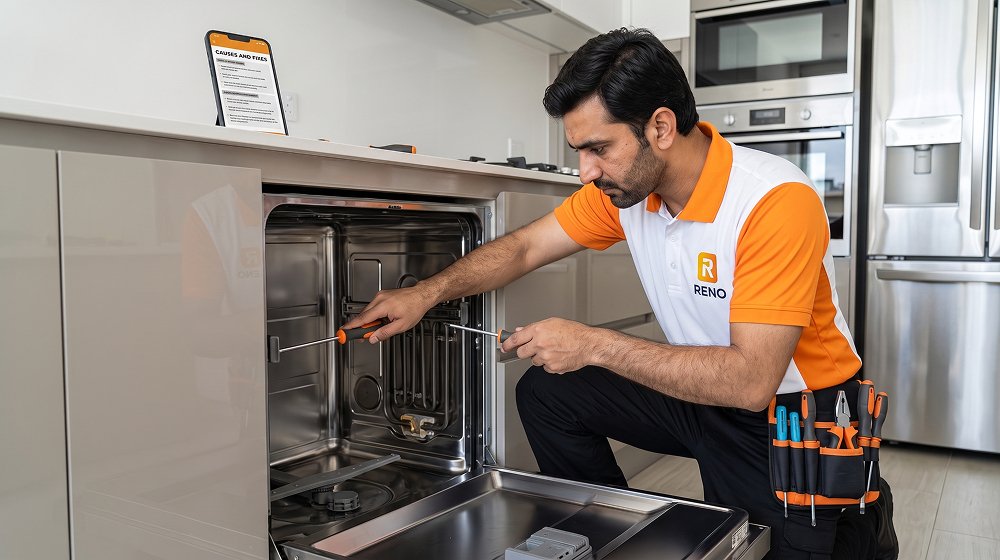
Standing water at the bottom of a dishwasher signals a drainage problem that needs a clear diagnosis. The fault may sit in the filter, drain hose, pump, sink connection, or water-level control system. Replacing parts before checking the complete drainage path can increase the repair cost without fixing the fault.
This guide explains:
- Why is the dishwasher not draining?
- How does each blockage affect water flow?
- Which checks are safe to complete at home?
It also covers pump sounds, filter inspection, hose routing, manual draining, technician-only faults, and current costs of dishwasher repair in Dubai.
Dubai apartment installations require extra attention. A sealed sink-waste spigot, a missing high loop, or mineral buildup can cause standing water even when the dishwasher itself works correctly. The diagnostic steps discussed in this guide separate these installation faults from failed internal components.
Why is your dishwasher not draining?
Among six causes, a blocked filter assembly is the likeliest reason a dishwasher is not draining, followed by a kinked drain hose and blocked drain pump. You can clean the filter and inspect the hose; pump work requires a technician.
Manufacturer troubleshooting sequences support this inspection order. The Bosch dishwasher drainage guide starts with the filter, pump area, and drain hose. Samsung’s drainage guide adds the sink drain, high loop, and installation connection.
The cause-likelihood table ranks diagnostic priority. It does not claim population incidence because no accredited Dubai dataset publishes drainage-fault percentages.
| Rank | Drainage cause | Strongest diagnostic clue | Owner-fixable? |
|---|---|---|---|
| 1 | Blocked filter assembly | Dirty water covers the tub floor after a completed cycle | Yes |
| 2 | Kinked or blocked drain hose | Drainage slows after installation or cabinet work | Usually |
| 3 | Blocked or seized drain pump | The pump hums or grinds without outlet flow | Visible debris only |
| 4 | The sink waste knockout plug remains fitted | The dishwasher has never drained since installation | Connection inspection only |
| 5 | Missing high loop | Water leaves, then returns several minutes later | Yes |
| 6 | Float, wiring, or control fault | The cycle stops, displays an error, or produces no pump sound | No |
Timing also narrows the fault. A permanent problem after installation points toward the drain hose or sink spigot. A gradual slowdown supports debris, grease, or scale accumulation.
What causes a drainage failure?
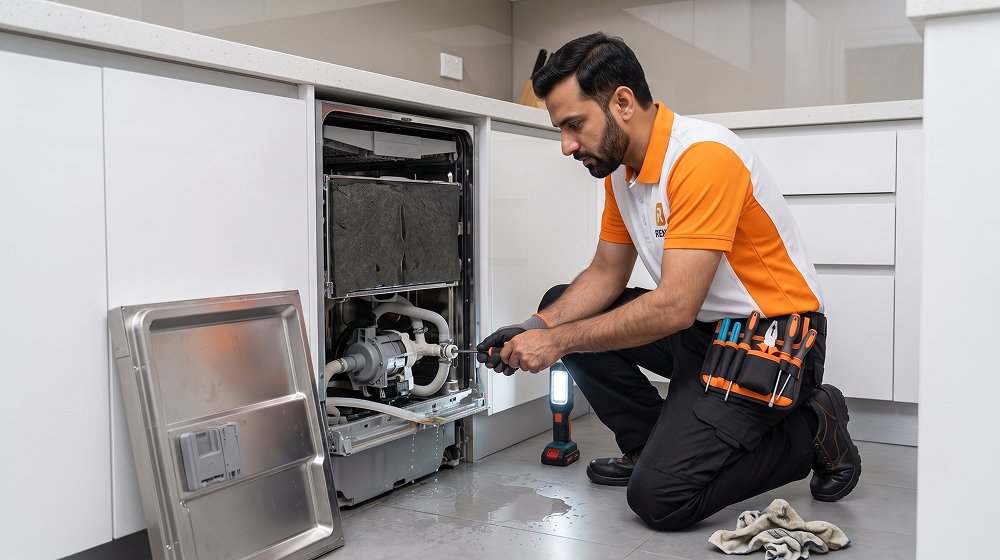
A drainage failure occurs when water cannot pass through the filter, sump, pump, hose, or sink outlet. A float or control fault can also interrupt the programmed drain stage.
How does a blocked filter assembly stop drainage?
A blocked filter assembly restricts water entering the sump and drain pump. Food particles, grease, seeds, labels, and glass can cover the fine mesh.
The pump then receives less water than it can discharge. The motor may sound normal while water remains at the bottom of the dishwasher.
The official Bosch filter-cleaning procedure directs you to remove the cylindrical filter, separate its sections, and rinse both parts. Bosch permits a small brush but warns against abrasive tools that can damage the mesh.
A small amount of clean sump water can be normal. GE states that one or two cups remain in selected models without an ultra-fine filter. One or two US cups equal about 237 to 473 milliliters. Water should not cover the tub floor on models with an ultra-fine filter.
How does a kinked or blocked drain hose hold water in the sump?
A kinked drain hose increases resistance between the pump and sink outlet. A crushed corrugation, grease plug, or trapped food fragment creates the same restriction.
This fault often begins after installation or cabinet work. Samsung identifies a dishwasher resting on its own drain hose as the most common drainage issue directly after installation. A missing high loop follows in Samsung’s diagnostic sequence.
Inspect the complete hose route. A bend can sit behind the appliance where the cabinet hides it. Replace the hose when a flattened section returns after straightening.
How does a seized or blocked drain pump prevent draining?
A blocked drain pump cannot rotate its impeller or push water into the hose. Glass fragments, fruit stones, bones, and label pieces can jam the pump area.
A steady hum without outlet flow supports a mechanical blockage. Grinding supports hard debris. Silence during the drain command shifts attention toward the pump winding, wiring, door interlock, or control output.
Bosch permits owner access to the pump cover on specified models. The Bosch pump inspection instructions require power isolation, water removal, protective gloves, and correct cover refitting.
Stop after removing visible debris. Forcing a seized impeller can damage the pump housing or seal.
How does an unremoved sink waste knockout plug block the outlet?
An unremoved knockout plug seals the sink waste spigot. The drain pump then pushes water against a closed outlet, producing a permanent no-drain condition.
Check this connection after a dishwasher retrofit, sink replacement, food-disposer installation, or kitchen renovation. Cleaning the filter or replacing the pump cannot open a sealed spigot.
The official Whirlpool installation check explains how to inspect a disposer inlet. On that fitting, a pencil entering about 3 inches confirms plug removal. Three inches equals approximately 76 millimeters.
Many Dubai apartments use a sink-waste spigot instead of a food disposer. The connection differs, but the outlet still requires a clear internal bore.
How does a missing high loop cause water to siphon back?
A missing high loop allows dirty sink water to return through the drain hose. The dishwasher can empty correctly, then show standing water again.
Use 600 mm as the initial inspection threshold. Follow the appliance manual when it specifies a higher point.
The Bosch installation manual requires part of the drain hose to sit at least 33 inches, or 84 centimeters, above the cabinet floor. The same manual sets a 150-inch, or 380-centimeter, maximum hose length.
GE specifies a minimum 32-inch-high loop, equal to about 813 millimeters. Both manufacturer measurements exceed the 600 mm inspection threshold.
How does a tripped float switch pause the drain stage?
A float-switch fault interrupts the programmed water-level sequence. The exact response depends on whether the dishwasher uses a tub float or base-tray float.
A base-tray float detects leakage below the tub. Bosch defines error E15 as water detected in the dishwasher base. Bosch directs the owner to close the water inlet and request service.
Whirlpool states that an F8E4 float condition starts a drain sequence and prevents normal operation. Water in the base changes the task from filter cleaning to leak diagnosis.
How do you diagnose a drainage failure step by step?
Diagnose a drainage failure in five stages. Measure the retained water, then follow the water path through the filter, hose, pump, and sink connection.
Measure how much water is standing in the sump
Measure the retained water before removing any component. Its volume and position separate normal sump retention from a failed drain cycle.
Water confined below the filter can be normal on some models. GE permits about 237 to 473 milliliters in specified designs. Dirty water covering the flat tub floor indicates excessive retention.
Record whether the water looks clean or greasy. Greasy water supports a restriction in the filter, sump, hose, or sink drain.
Remove and inspect the filter stack
Disconnect the dishwasher from power. Remove the lower basket and unlock the filter according to the model manual.
Inspect 4 points:
- Check the cylindrical filter for grease.
- Check the fine mesh for seeds and labels.
- Check the flat screen for bones or glass.
- Check the visible sump opening for foreign material.
Wear protective gloves because sharp fragments can remain under cloudy water. Bosch also requires the alignment arrows to meet during reassembly. A loose filter can allow debris into the pump.
Check the drain hose route and loop height
Inspect the hose behind the dishwasher and inside the sink cabinet. Measure the highest hose point from the floor.
Look for 5 installation faults:
- A crushed section behind the appliance
- A sharp bend at the cabinet opening
- A grease blockage near the sink connection
- A high loop below 600 mm
- A loose hose hanging below the outlet
Follow the appliance manual when it specifies more than 600 mm. The Bosch 840 nm requirement exceeds that inspection threshold.
Listen for the drain pump humming without flow
Reassemble the filter and restore power. Start a cancel-and-drain function or short rinse cycle.
Use sound and outlet flow together:
- Normal motor sound with strong sink flow supports a cleared fault.
- Steady humming without flow supports a blockage or jammed impeller.
- Grinding supports glass or hard debris.
- Silence supports an electrical, winding, interlock, or control fault.
Samsung uses codes 5C, 5E, OC, and OE on selected models for drain or overflow conditions. Confirm the exact code in your model manual.
Check the sink waste connection and air gap
Place a bucket beneath the sink connection before loosening the hose. Residual water can leave the hose immediately.
Inspect the spigot for an unremoved knockout plug. Clear the air gap where the installation uses one. Tighten the clamp after reconnecting the hose.
Run the sink tap for 30 seconds. Samsung uses this test to separate a dishwasher fault from blocked household plumbing. A slow sink requires plumbing attention.
Which checks can you safely do yourself?
Five owner-safe checks cover visible water, removable filters, accessible hose routing, and one controlled test.
- Use a cup, sponge, or wet vacuum.
- Remove the filter. Follow the locking direction in the user manual.
- Clean the mesh. Use warm water and a soft brush.
- Check the hose. Straighten bends and confirm the high loop.
- Test a rinse cycle. Watch the sink outlet and inspect the floor.
Bosch recommends removing sump water with a sponge before pump inspection. GE warns against pouring drain cleaner into the dishwasher.
DIY vs technician decision box
Continue with DIY checks when:
- The filter removes without panel dismantling.
- The hose remains visible and accessible.
- The floor and base tray remain dry.
- The appliance has no burning smell.
Call a technician when:
- The pump impeller remains seized.
- The pump winding needs electrical testing.
- Debris sits inside a sealed sump channel.
- The control board does not power the pump.
Which of these faults needs a technician?
Four drainage faults require appliance tools, electrical measurements, or lower-base disassembly.
- Seized pump impeller: The impeller remains locked after visible debris removal.
- Failed pump winding: The pump receives a drain command but cannot run.
- Blocked internal sump channel: Debris sits beyond the owner-accessible pump area.
- Control board relay failure: The relay fails to supply the drain pump.
A technician can test winding resistance, voltage, connector continuity, insulation, and control output. These tests involve mains electricity.
Water in the base also requires service. Bosch classifies an E15 safety-switch activation as a professional repair condition in its official E15 support page.
How much does it cost to fix a drainage failure in Dubai?
A dishwasher drainage repair in Dubai commonly costs AED 150 to AED 700. Diagnosis can cost AED 50 to AED 250, while control-board work can reach AED 1,200.
The table uses publicly advertised Dubai prices checked on 30 July 2026. These figures represent market ranges, not regulated tariffs.
| Drainage cause or service | Indicative Dubai cost | Date set |
| Diagnosis and inspection | AED 50 to AED 250 | 30 July 2026 |
| Filter or minor sump blockage | AED 150 to AED 350 | 30 July 2026 |
| Hose clearing or replacement | AED 180 to AED 350 | 30 July 2026 |
| Knockout plug or high-loop correction | AED 150 to AED 350 | 30 July 2026 |
| Drain pump repair or replacement | AED 200 to AED 700 | 30 July 2026 |
| Internal sump-channel clearance | AED 150 to AED 350 | 30 July 2026 |
| Control-board repair or replacement | AED 300 to AED 1,200 | 30 July 2026 |
The ranges combine four current Dubai price pages. Public listings place diagnosis between AED 50 and AED 250, minor blockage work between AED 150 and AED 350, and pump work between AED 200 and AED 700. Control-board prices extend to AED 1,200.
The knockout-plug and internal-sump figures use the published minor blockage and hose-labor bands. No public source lists those two tasks as separate fixed-price services.
Built-in cabinet access, imported parts, value-added tax, and call-out policy affect the final quote. Ask for labor, parts, diagnosis, testing, and warranty as separate line items.
How do you drain a dishwasher manually when it will not pump out?
Drain the dishwasher manually by isolating power, removing the lower rack, bailing the tub, and absorbing water from the sump.
- Switch off the wall socket or circuit breaker.
- Close the water valve when leakage appears below the appliance.
- Place towels along the lower door and kick plate.
- Remove the lower basket.
- Scoop out water with a cup or small container.
- Remove deeper water with a wet vacuum or large syringe.
- Absorb the remaining sump water with a sponge.
- Remove and clean the filter.
- Refit every part before a drain test.
Manual draining prevents spills and exposes the filter. It does not repair the drainage failure.
Bosch uses the same water-removal sequence before owner-accessible pump inspection. Protective gloves remain necessary because glass can hide in the sump.
Why do Dubai apartment installations cause repeat drainage faults?
Dubai apartment installations can repeat drainage faults when the sink outlet remains sealed, the hose hangs too low, or scale narrows the water path.
Retrofitted dishwashers deserve a connection-first inspection. The appliance can work correctly while the cabinet plumbing blocks or returns its wastewater.
Why is the sink waste knockout plug the most common install error?
The knockout plug deserves first-priority inspection because it creates a complete no-drain condition. A working drain pump cannot move water through a sealed spigot.
No accredited Dubai dataset ranks dishwasher installation errors. The “most common” label applies to diagnostic priority after retrofit work, not a measured citywide percentage.
Whirlpool lists plug removal as a critical newly installed dishwasher check. Samsung also lists an unremoved disposal cap as a direct blockage.
Inspect the spigot after a dishwasher retrofit, sink replacement, kitchen renovation, or drain-hose reconnection. Skipping this check can lead to an unnecessary pump purchase.
Why does a drain hose without a 600 mm high loop siphon waste water back?
A hose below 600 mm lacks the topical map’s minimum inspection height. Dirty sink water can return after the pump stops or the sink drains.
Secure the loop beneath the worktop or high on the cabinet wall. Follow the appliance manual when it specifies a higher position.
Bosch requires 840 mm in its official installment manual. GE requires 813 mm in its high-loop guidance. Both figures exceed 600 mm.
Backflow appears after water has left the tub. A blocked pump leaves water inside during the drain stage. That timing difference helps prevent the wrong component diagnosis.
How does hard-water scale narrow the drain hose bore over time?
Hard-water scale forms when calcium and magnesium deposits attach to internal surfaces. Grease and food particles can then adhere to the roughened hose wall.
The World Health Organization hardness classification defines 120 to 180 mg/L as hard water. Water above 180 mg/L as calcium carbonate is very hard.
The United States Geological Survey reports that long-term scale can narrow pipes, reduce water movement, lower pressure, and clog water equipment. Heated water promotes calcium-carbonate deposition.
Do not assign one hardness value to every Dubai apartment. Building tanks, treatment equipment, and internal plumbing can change the water reaching the dishwasher. Test the supply before changing dishwasher salt settings.
Which related dishwasher problems share the same cause?
Five related problems connect to the same drainage system or failed component.
- Dishwasher odour from standing water develops when food soil remains trapped inside the sump.
- Dishwasher cycle stopping at the drain stage can indicate a pump, hose, float, or control fault.
- Dishwasher drain pump faults explain humming, grinding, silence, and zero outlet flow.
- Dishwasher filler assembly blockages restrict water before it reaches the pump.
- Dishwasher drain hose faults include kinks, grease plugs, low loops, and sink-connection errors.
Fix the drainage path before replacing parts
Standing water does not automatically mean the dishwasher needs a new pump. The real fault may be a blocked filter, pinched hose, sealed sink spigot, missing high loop, or failed electrical component.
Start with the visible water path. Clean the filter, inspect the hose, check the sink connection, and listen during the drain stage. These checks can expose a simple blockage before repair costs rise.
Stop when the pump remains seized, the base tray contains water, or electrical testing becomes necessary. A correct diagnosis protects the appliance and prevents unnecessary part replacement. In Dubai apartments, the sink-waste knockout plug and drain-hose height deserve attention after any retrofit or kitchen work.
FAQs
Yes, a new pump cannot drain through a blocked hose, sealed sink-waste spigot, or unremoved knockout plug.
Dirty water can return when the drain hose lacks a high loop and allows sink wastewater to siphon back.
Humming without outlet flow usually points to a blocked pump area, jammed impeller, or restricted drain hose.
A small amount of clean sump water can be normal, but water covering the tub floor indicates excessive retention.
Ahmed Al Mansoori
Ahmed Al Mansoori is a UAE-based home appliance repair specialist with over 12 years of hands-on experience in diagnosing and repairing washing machines, refrigerators, dishwashers, ovens, dryers, and other household appliances across Dubai and Abu Dhabi. He has worked with leading appliance brands and is known for delivering reliable repair solutions, preventive maintenance guidance, and same-day technical support for residential clients. Ahmed specializes in troubleshooting modern smart appliances and energy-efficient systems commonly used in UAE homes.
