
Washing Machine Motor Repair
 July 23, 2026
12 min read
July 23, 2026
12 min read
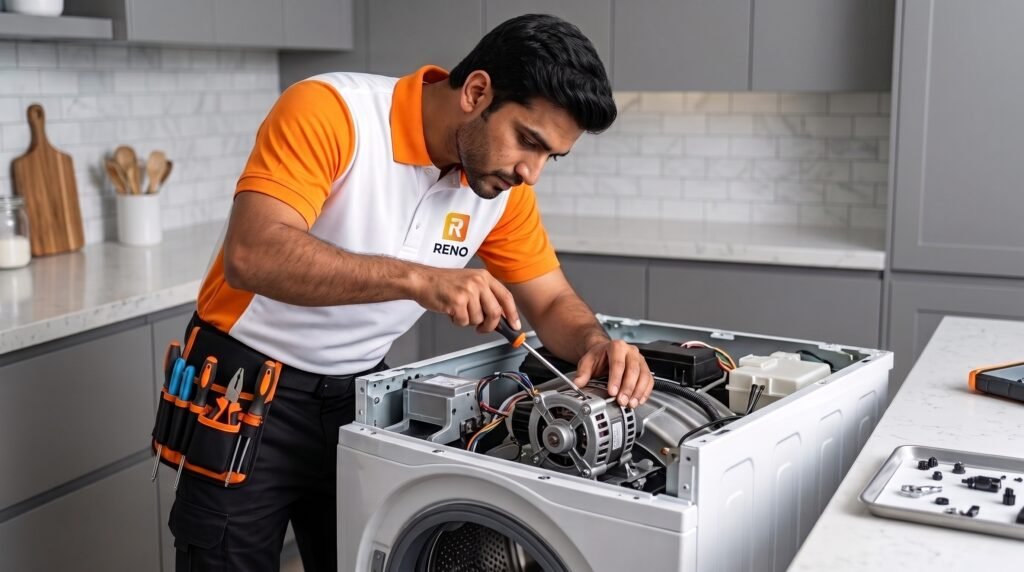
A washing machine that stops spinning, hums without moving, shows repeated error codes, or produces a burning smell may appear to have a failed motor. However, drainage problems, an unbalanced load, worn carbon brushes, damaged wiring, or a faulty speed sensor can cause similar symptoms. A no-spin cycle alone does not confirm that the motor needs replacement.
This guide explains how washing machine motor repair starts with accurate testing. You will learn the common signs and causes of motor faults, which checks you can complete safely, and when to call a technician. It also covers the motor replacement process, typical repair costs in Dubai, warranty considerations, and how to decide whether repairing the motor makes more financial sense than buying a new washing machine.
What are the signs of a faulty motor?
A faulty washing machine motor causes failed drum rotation, irregular spin speed, repeated motor codes, humming, overheating, or electrical smells. One symptom does not confirm motor failure. A technician compares the symptom with drainage, load, belt, sensor, and wiring tests.
Does a no-spin cycle prove motor failure?
A no-spin cycle does not prove motor failure. Whirlpool lists overloading, an uneven load, drainage restrictions, low-spin settings, poor levelling, and power loss as alternative causes. Check those items before requesting washing machine motor replacement.
Motor-related error codes provide a stronger clue. Samsung identifies 3E as a motor-related fault caused by overload, connection problems, or internal failure. Whirlpool uses F7 E1 for a motor-speed sensing error. Codes vary by model, so use the appliance manual.
Which symptoms require motor testing?
6 symptoms justify a professional motor and drive-system test:
- The drum does not rotate during washing or spinning.
- The drum starts, stops, or turns with weak torque.
- The machine hums without starting drum movement.
- The washer displays a recurring motor or speed-sensor code.
- Sparks appear around a brushed motor assembly.
- A burning smell develops during agitation or spinning.
A no-spin complaint can still come from an overloaded drum, excessive detergent, an unbalanced load, incorrect settings, poor levelling, or a blocked drain hose. Whirlpool lists eight common no-spin causes, several of which do not involve the motor.
How do motor-related symptoms compare?
The table connects each symptom with its likely component and the next diagnostic check.
| Symptom | Possible component | What the symptom indicates | Required check |
|---|---|---|---|
| Intermittent drum movement | Carbon brushes | Unstable electrical contact with the commutator | Measure brush length and inspect the commutator |
| Humming without rotation | Capacitor or mechanical blockage | The motor lacks starting torque or cannot turn | Test capacitance and rotate the drum manually |
| Jerking or changing speed | Hall sensor or wiring | The controller receives an unstable speed signal | Test the sensor, harness, and terminals |
| No movement with a motor code | Motor, control board, or connector | The drive circuit cannot operate or confirm rotation | Read codes and test voltage, resistance, and continuity |
| Burning smell | Pump motor, drive motor, connector, or belt | A component has overheated or stalled | Disconnect power and inspect before reuse |
The symptom table narrows the inspection area. It does not confirm the failed part without electrical and mechanical tests.
Is a burning smell a motor warning?
A burning smell is an immediate stop signal, but it does not always come from the main drive motor. Samsung UAE states that a stuck drain pump motor can generate a burning smell during or after spinning. Samsung instructs users to switch off the washer immediately.
Unplug the washing machine when you notice smoke, sparks, scorching, or repeated circuit-breaker trips. Do not run another cycle to confirm the fault.
What causes a washing machine motor to fail?
Washing machine motor failure develops through carbon-brush wear, overheating, electrical overload, damaged wiring, capacitor failure, sensor faults, bearing resistance, or control-board defects.
Professional repair data provides useful context. The Joint Research Centre recorded these failure shares among diagnosed washing machines:
- Electronics: 14%
- Shock absorbers and bearings: 13.8%
- Doors: 11.5%
- Carbon brushes: 9.7%
- Pumps: 7.5%
Carbon brushes accounted for almost one in ten recorded washing machine failure modes. The researchers also recorded 664 completed carbon-brush repairs, placing brushes among the more repairable washing machine components.
How does carbon-brush wear cause motor failure?
Carbon brushes conduct current between stationary terminals and the rotating commutator in a brushed motor. Physical contact wears the carbon material during each cycle.
Short brushes lose consistent contact. The motor then develops weak torque, intermittent rotation, arcing, or complete loss of movement.
Carbon-brush replacement does not apply to every washer. Bosch describes its EcoSilence Drive as a brushless motor, while older universal motors use replaceable brushes.
How does a capacitor fault differ from brush wear?
A motor capacitor stores electrical energy and supports starting or running torque on compatible washer designs. A weak or open capacitor can leave the motor humming without enough torque to rotate the drum.
Capacitor specifications vary by motor. UAE parts listings include washing machine capacitors rated at 25 microfarads and 60 microfarads, both at 450 volts. Those figures show why technicians match the printed rating and part number rather than the casing shape.
A capacitor can retain electrical charge after unplugging. The United States Occupational Safety and Health Administration states that hazardous stored energy must be released and capacitors must be discharged before handling.
Does frequent washing increase motor wear?
Higher cycle frequency increases the operating hours placed on brushes, bearings, wiring, and motor-control components.
European Environment Agency data shows that washing-machine use varies sharply by household size. Single-person households averaged 2.2 cycles each week, while households with at least five people averaged 6.8 cycles.
The European average fell from 226 cycles per machine in 2015 to 174 cycles in 2020. Machine capacity reached 7.6 kg in 2020, but the average load remained 4 kg, equal to 53% of rated capacity.
Do not use those averages as load instructions. Follow the kilogram limit and programme restrictions printed in your model manual.
Can you replace a washing machine motor yourself?
You can perform external checks yourself, but internal washing machine motor replacement requires electrical knowledge, correct test equipment, and model-specific service information.
The risk extends beyond the mains plug. Capacitors can store energy, wet areas increase electrical danger, and a front-load motor sits below a heavy suspended drum.
Which checks are safe before booking a repair?
Complete 4 checks without opening the cabinet:
- Remove excess laundry and run the approved spin or drain cycle.
- Confirm that the drum turns by hand with the appliance unplugged.
- Check the drain filter and hose according to the model manual.
- Record the error code, model number, smell, sound, and cycle stage.
A blocked drain can prevent spinning even when the motor remains functional. Whirlpool states that filter debris and kinked drain paths can stop proper drainage.
Stop testing when the appliance produces smoke, a burning smell, sparks, scorch marks, or repeated breaker trips. Do not restart the washer to see whether the fault clears.
When does the repair require a technician?
Book a washing machine technician when the repair requires the following:
- Live-voltage testing
- Capacitor discharge
- Motor-resistance measurement
- Hall sensor diagnosis
- Control-board output testing
- Carbon-brush removal
- Motor or stator replacement
Opening the machine can also affect warranty coverage. Check the warranty terms before removing panels.
How is a washing machine motor replaced?
A technician replaces a washing machine motor by confirming the failure, isolating electricity and water, accessing the drive assembly, fitting the exact motor, and testing every operating speed.
What happens during motor diagnosis?
A proper diagnosis follows a fixed sequence:
- Read stored error codes.
- Check drainage and load-related causes.
- Inspect the belt, drum, pulley, rotor, or direct-drive assembly.
- Test wiring continuity and earth connections.
- Inspect brushes on compatible motors.
- Test the capacitor and speed sensor.
- Measure motor windings and control-board output.
Skipping this sequence can lead to an unnecessary motor purchase. Samsung’s motor-error guidance lists overload, sensor connections, terminals, foreign objects, and the printed board assembly as separate causes of one motor-related code.
What changes between belt-drive and direct-drive motors?
A belt-drive washer uses a belt to transfer motor rotation to the drum pulley. A direct-drive washer attaches the motor assembly to the tub without a conventional drive belt.
LG describes its Direct Drive motor as a system without a belt or pulley. Bosch’s brushless motor design also removes carbon-brush friction.
The replacement method depends on the motor design:
- A brushed motor may require brushes rather than a complete motor.
- A belt-drive motor requires belt alignment and tension checks.
- A direct-drive design may require rotor, stator, and Hall sensor inspection.
- An inverter motor may require control-board and communication testing.
The replacement part must match the model number, connector layout, mounting points, power rating, sensor arrangement, and control system.
How much does motor replacement cost in Dubai?
Washing machine motor repair in Dubai commonly falls within an advertised range of AED 300 to AED 700. The final figure changes with the motor type, spare-part price, brand, access, and control-system damage.
Two Dubai service providers currently publish comparable figures. One lists motor repair or replacement at AED 300 to AED 600. The other places major motor or control board repairs for between AED 300 and AED 700.
What does the Dubai repair quote include?
Ask the provider to separate six charges:
- Inspection or call-out fee
- Carbon brushes, capacitor, sensor, or full motor
- Technician labour
- Collection and delivery
- Diagnostic or programming work
- Repair warranty
A brush or capacitor repair usually requires fewer parts than full motor replacement. A motor-control board fault can raise the quote even when the mechanical motor remains usable.
How does the repair cost compare with a new washer?
UAE retail listings checked on July 22, 2026, show 7 kg and 8 kg washing machines at approximately AED 698.58 to AED 1,499. Several front-load models appear between AED 804.99 and AED 1,208.
The table converts those prices into practical repair ratios.
| Motor repair quote | New washer price | Repair as a share of replacement |
|---|---|---|
| AED 300 | AED 699 | About 43% |
| AED 600 | AED 699 | About 86% |
| AED 300 | AED 999 | About 30% |
| AED 600 | AED 999 | About 60% |
| AED 600 | AED 1,499 | About 40% |
Compare equivalent capacity, motor type, delivery, installation, and warranty. An AED 600 motor repair looks expensive compared to an AED 699 washer but different against an AED 1,499 inverter model.
Is it worth replacing the motor or the machine?
Motor repair is worth considering when the washer remains mechanically sound, the failed component is confirmed, and the repair costs less than a comparable replacement.
The decision changes when the washer also has bearing noise, drum damage, corrosion, leaks, or repeated electronic faults.
How does machine age affect the decision?
The Joint Research Centre study found an average service life of 12.6 years among washing machines that repair centres did not repair. Carbon-brush and door faults achieved higher repair rates than bearings, drums, tubs, and electronics.
The same research reported repair rates of 24% for bearings, 27.4% for drum and tub faults, 47.4% for shock absorbers and bearings combined, and 48.7% for electronics. These figures explain why a brush repair and a drum repair produce different recommendations.
Does the motor warranty cover replacement?
Check the motor warranty before accepting a paid quote. Several UAE manufacturers advertise a ten-year motor cover on selected inverter or direct-drive models.
Samsung Gulf covers the digital inverter motor for 120 months, but the extended cover applies to the part only. LG UAE also lists ten years for direct drive and smart inverter motors. Bosch UAE advertises a ten-year EcoSilence Drive motor warranty on applicable models.
Labour, transport, diagnosis, and unrelated components can remain chargeable. Confirm the purchase date, registration conditions, model eligibility, and service-agent requirements.
Which option makes financial sense?
Choose washing machine motor repair when:
- The fault involves brushes, wiring, a capacitor, or a sensor.
- The machine has no drum, bearing, leakage, or corrosion problem.
- The required part remains available.
- The warranty covers the motor or reduces the part cost.
- The complete quote remains reasonable against a comparable washer.
Choose replacement when the motor fault appears with several expensive defects. Replacement also becomes stronger when a repair approaches the price of a new machine with installation and warranty.
European Union ecodesign rules require manufacturers to make specified washing machine parts available for ten years. The listed professional-repair parts include motors and motor brushes. This rule does not control Dubai prices, but it confirms the recognised repair value of these components.
Washing machine motor repair starts with component-level proof. Separate carbon-brush wear from capacitor, wiring, sensor, drainage, and control-board faults. Stop the machine after a burning smell, then compare the complete Dubai repair quote with the cost and warranty of an equivalent washer.
Repair the Fault, Not the Symptom
A washing machine that stops spinning does not automatically need a new motor. The real fault may sit in the carbon brushes, capacitor, wiring, speed sensor, drainage system, or control board. Accurate testing prevents you from paying for a motor that was never defective.
Stop using the washer if you notice sparks, smoke, a burning smell, or repeated breaker trips. For less urgent symptoms, record the error code, check the load and drainage path, and arrange a proper diagnosis before approving internal repairs.
The final choice should come down to evidence and total cost. Repair is usually reasonable when the fault is limited, the drum and bearings remain sound, the correct part is available, and the quote stays well below the price of an equivalent washer. Replacement makes more sense when motor trouble appears alongside leaks, corrosion, bearing noise, drum damage, or repeated electronic failures.
Do not let one symptom decide the fate of the machine. Ask what failed, what testing confirmed it, what the quote includes, and how long the repair is covered. Those answers will tell you whether you are paying for a sensible repair or postponing a more expensive replacement.
FAQs
Yes. Worn brushes may make unstable contact, causing the drum to start normally in one cycle and stop or jerk during another.
Yes. The quote should identify the exact motor or component because similar-looking parts may have different connectors, ratings, and control requirements.
Yes. Running a washer with overheating, arcing, or restricted drum movement can place extra strain on the wiring, belt, controller, and motor assembly.
Usually not. Extended motor warranties may cover the motor part while diagnosis, labour, transport, programming, and unrelated components remain chargeable.
Ahmed Al Mansoori
Ahmed Al Mansoori is a UAE-based home appliance repair specialist with over 12 years of hands-on experience in diagnosing and repairing washing machines, refrigerators, dishwashers, ovens, dryers, and other household appliances across Dubai and Abu Dhabi. He has worked with leading appliance brands and is known for delivering reliable repair solutions, preventive maintenance guidance, and same-day technical support for residential clients. Ahmed specializes in troubleshooting modern smart appliances and energy-efficient systems commonly used in UAE homes.
