
Washing Machine Bearing Replacement
 July 23, 2026
10 min read
July 23, 2026
10 min read
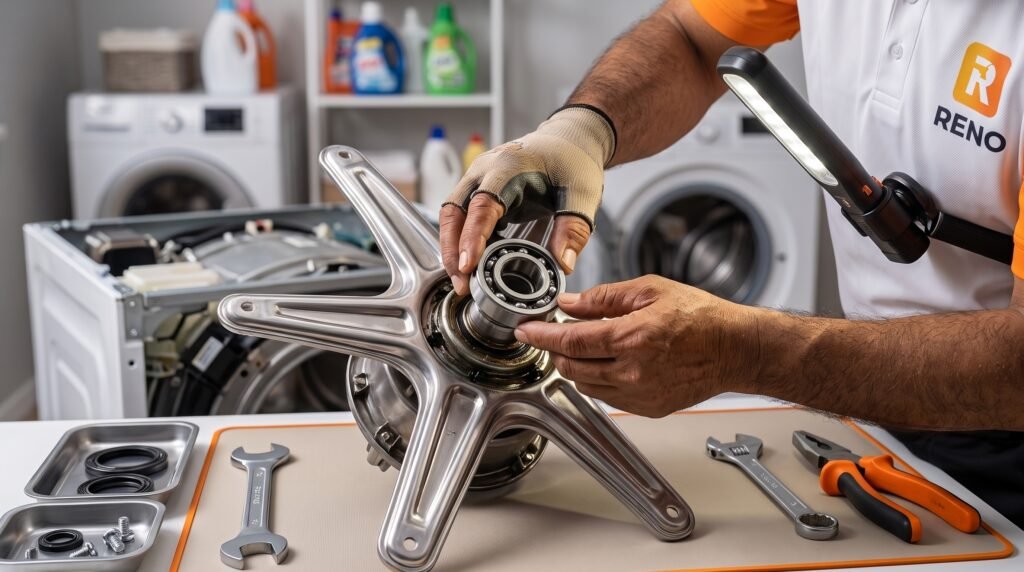
Washing machine bearing replacement removes worn drum bearings, renews the shaft seal, and restores smooth drum rotation. Grinding or rumbling that rises during spin is the clearest warning after you rule out load imbalance, poor leveling, or trapped debris.
A grinding noise during the spin cycle can point to a worn drum bearing, but noise alone does not confirm the fault. An unbalanced load, damaged suspension, trapped debris, or a loose component can create similar symptoms. A wrong diagnosis can lead to unnecessary repair costs or continued damage to the drum shaft and seal.
A precise diagnosis prevents payment for bearing work when the fault sits in the laundry load, suspension, pump, or drum.
This article explains how to identify worn bearing symptoms, what causes bearing failure, and when a do-it-yourself repair is realistic. It also covers the bearing replacement process, current repair costs in Dubai, and the factors that determine whether repairing the washer than replacing it makes more financial sense.
What are the signs of a worn drum bearing?
A worn drum bearing causes speed-related rumbling, rough hand rotation, or excess movement between the inner drum and outer tub. The sound becomes stronger as the spin cycle accelerates. AEG identifies worn drum bearings as a cause of excessive washing machine noise and vibration.
Look for four washing machine bearing failure signs:
- Grinding during spin: The noise follows drum speed and remains during an empty spin.
- Rough manual rotation: The empty drum feels gritty or uneven.
- Vertical drum play: The inner drum lifts or drops with a clunk.
- Spin interruption: Severe drag can prevent the washer from reaching full spin speed.
Noise alone does not confirm bearing failure. Samsung and Whirlpool list overloading, poor leveling, shipping bolts, foreign objects, and uneven laundry as other causes of spin-cycle noise or vibration.
The table separates common bearing symptoms from faults that produce similar sounds.
| Symptom pattern | Likely cause | First check |
|---|---|---|
| Rumble rising with speed | Bearing or shaft damage | Turn the empty drum |
| Banging with one heavy item | Unbalanced load | Redistribute the laundry |
| Rattle while draining | Pump or filter debris | Inspect the drain filter |
| The washer moves across the floor | Levelling or suspension fault | Check all four feet |
An unbalanced load can reduce spin speed, extend cycle time, increase vibration, and leave clothes wetter. These symptoms often disappear after load correction. Bearing noise usually remains during an empty test.
How can you test the bearing without dismantling the washer?
Disconnect power, empty the drum, and rotate it slowly by hand. Listen near the rear tub. A damaged bearing produces a dry growl, rough movement, or a repeating resistance point.
Lift the inner drum gently at the door lip. Clear movement can indicate bearing clearance, shaft wear, or spider damage. Stop using the appliance when the drum rubs the door gasket.
What causes a washing machine bearing to fail?
Washing machine bearings fail through seal leakage, poor lubrication, contamination, overloading, incorrect fitting, or metal fatigue. Water ingress creates the main washer-specific risk because the bearings sit beside a water-filled tub.
SKF attributes 36% of premature bearing failures to poor lubrication, 14% to contamination, 16% to poor fitting, and 34% to fatigue. These figures cover general bearing applications, but the same mechanical damage processes affect washing machine bearings.
How does seal ingress damage the drum bearing?
The shaft seal keeps wash water away from the greased bearings. A worn seal lets detergent solution and moisture enter the bearing cavity.
Water degrades the lubricant and corrodes the rolling tracks. SKF identifies moisture, ineffective sealing, lubricant degradation, and particle contamination as common causes of bearing damage.
Replace the shaft seal during washing machine bearing replacement. Reusing the failed seal leaves the original water path in place.
How does overloading increase bearing wear?
Overloading increases drum movement and transfers greater forces through the shaft, spider, bearings, springs, and shock absorbers. Samsung also links repeated overloading with abnormal washing machine noise that requires service.
AEG recommends filling a washing machine to approximately 75% of drum volume. Another measure leaves one hand-width of free space above the laundry. The recommendation applies to AEG machines, so your model manual remains the primary capacity reference.
A European Commission Joint Research Centre study examined more than 7,000 washing machine repair services. Shock absorbers and bearings represented 13.8% of recorded failure modes. Multiple failures appeared in 30% of cases.
Can you replace a washing machine bearing yourself?
You can replace a washing machine bearing yourself when the outer tub opens, the correct kit remains available, and you can control electrical and sealing risks. Most front-load bearing jobs exceed routine home maintenance.
AEG warns that incorrect self-repair can create safety consequences and affect warranty coverage. Its bearing procedure also requires model-specific tools and correct earth-connection reassembly.
When is DIY bearing replacement realistic?
DIY washing machine bearing replacement requires four conditions:
- Confirm the complete model and product number.
- Obtain a matched bearing pair, shaft seal, and tub gasket.
- Verify that bolts join the outer-tub sections.
- Inspect the shaft and drum spider before fitting new parts.
Bearing dimensions vary between models. AEG lists one replacement bearing at 25 x 52 x 15 millimeters and another at 25 x 62 x 17 millimeters. Visual similarity does not establish compatibility.
DIY becomes unsuitable when the tub is sealed, the shaft has grooves, or the spider shows corrosion. The Joint Research Centre found that repairers completed only 24% of diagnosed bearing repairs, mainly because labor and tub design raised total cost.
How is a washing machine bearing replaced?
A technician removes the tub, separates its serviceable sections, extracts the drum, replaces both bearings and the shaft seal, and then tests the rebuilt washer. Front-load tub removal creates most of the labor.
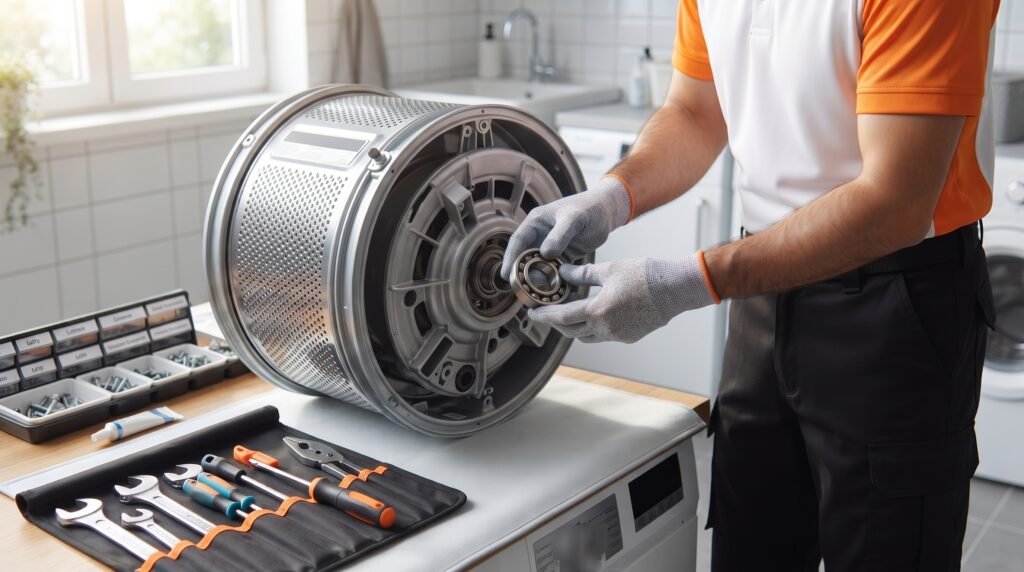
A typical washing machine bearing replacement follows 8 stages:
- Isolate the appliance. Disconnect electricity, close the inlet tap, and drain residual water.
- Open the cabinet. Remove the panels specified by the model design.
- Release connections. Label wiring and detach hoses, belt, pulley, and motor connections.
- Remove tub supports. Support the tub before releasing springs, shock absorbers, and counterweights.
- Split the outer tub. Remove the perimeter fasteners and separate the tub sections.
- Extract the inner drum. Inspect the shaft, spider, bearing seats, and seal surface.
- Install the bearing kit. Press both bearings squarely and fit a new shaft seal.
- Test the repair. Reassemble the washer, inspect for leaks, and run an empty spin.
AEG’s published bearing procedure confirms that access, removal direction, specialist tools, pulley work, and earth connections vary by model.
Why does a front-load bearing repair take so much labor?
The bearings sit behind the inner drum rather than behind a small exterior cover. Access can require removal of the front panel, pulley, motor, counterweights, suspension, wiring, hoses, and complete tub assembly.
Tub construction changes the repair scope and price.
| Tub design | Bearing access | Repair scope |
|---|---|---|
| Bolted split tub | Tub sections separate | Bearings, seal, and gasket |
| Bearing-carrier design | Carrier removes from the tub side | Carrier or bearing unit |
| Sealed plastic tub | The tub does not open normally | Rear tub or complete wash unit |
| Damaged shaft or spider | Bearings cannot correct the wear | Drum assembly and bearing parts |
The Joint Research Centre found that sealed plastic-tub bearing work could cost 60% to 100% of the washing machine’s original price. A bolted two-piece tub can support a less expensive bearing-only repair.
How much does bearing replacement cost in Dubai?
Washing machine bearing replacement in Dubai appears between AED 350 and AED 800 in published 2026 market samples. Diagnosis, sealed-tub parts, shaft damage, and imported components can move the quote outside this range.
These prices come from Dubai service listings and UAE retailers. They are market samples, not regulated tariffs.
| Cost item | Published Dubai or UAE price |
|---|---|
| Diagnostic inspection | AED 80 to AED 150 |
| Drum bearing replacement | AED 350 to AED 700 |
| Major bearing repair | AED 500 to AED 800 |
| Current 8 kg front-load washer examples | AED 919 to AED 1,275 |
Many repair guides list washing machine drum bearing replacement at AED 350 to AED 700. Some service places major bearing repairs at AED 500 to AED 800. Many list diagnoses at AED 100 to AED 150.
Current UAE retailer listings place several 8 kg front-load washing machines between AED 919 and AED 1,275. Promotions, stock, installation, and warranty terms change these prices.
What changes the bearing replacement quote?
Ask for a written breakdown covering:
- Diagnosis or call-out charges
- Bearing pair and shaft seal
- Tub gasket
- Tub-removal labour
- Shaft, spider, pulley, or rear-tub damage
- Parts and workmanship warranty
A bearing-only quote can change after drum removal exposes a scored shaft or corroded spider. Set a maximum authorized price before the technician orders additional assemblies.
Is it worth replacing the bearing or the machine?
Bearing replacement makes financial sense when the tub opens, the shaft remains sound, and repair costs remain far below replacement cost. Buying another washer becomes stronger when multiple faults push the quote near the new-machine price.
The United States Department of Energy estimates an average residential clothes-washer life of 13.4 years. Its analysis used household-stock data collected across multiple residential energy consumption survey years.
Compare machine age, total repair price, and a like-for-like replacement price. An AED 350 repair against an AED 1,275 washer equals about 27%. An AED 700 repair against an AED 919 washer equals about 76%.
The Joint Research Centre findings explain the commercial difference. Repairers completed only 24% of diagnosed bearing repairs, while sealed plastic-tub work reached 60% to 100% of the original purchase price.
Repair fits these conditions:
- The washer remains well below the 13.4-year average.
- The outer tub separates without destructive cutting.
- The shaft and spider pass inspection.
- The quote includes both bearings and a new seal.
- No major electrical or suspension fault exists.
Replace the washer when the quote includes a complete tub assembly, the machine has repeated faults, or compatible parts no longer exist. Efficiency can affect the final calculation. ENERGY STAR certified washers use about 20% less energy and 30% less water than regular models.
Grinding during spin is a diagnostic starting point, not a final verdict. Confirm the bearing, identify the tub design, and compare the complete Dubai quote with a like-for-like replacement.
Confirm the fault before paying for the repair
A grinding spin cycle deserves attention, but it does not prove that the drum bearings have failed. Check the load, machine level, drain filter, drum movement, and empty-spin noise first. Persistent rumbling that follows drum speed gives a technician a stronger reason to inspect the bearing, shaft seal, and drum spider.
The final decision depends on what sits behind the tub. A serviceable split tub and an undamaged shaft can make bearing replacement financially sensible. A sealed tub, corroded spider, or heavily scored shaft can turn a bearing job into a major assembly repair.
Ask for a written quote that separates diagnosis, bearings, shaft seal, gasket, labor, and possible drum damage. Then compare the maximum repair price with a similar new washer. That single comparison protects you from approving a small-sounding repair that becomes an expensive rebuild after dismantling.
FAQs
Yes, replace the shaft seal because a worn seal can let moisture reach the new bearings and restart the corrosion process.
Yes, worn bearings can create internal drum movement, although poor leveling, an uneven load, and worn suspension can produce similar shaking.
Stop using the washer when grinding persists during an empty spin because continued drum movement can increase damage around the shaft, seal, and bearing housing.
The price can rise after tub removal reveals a scored shaft, corroded spider, damaged bearing seat, or sealed-tub design that requires a larger assembly.
Ahmed Al Mansoori
Ahmed Al Mansoori is a UAE-based home appliance repair specialist with over 12 years of hands-on experience in diagnosing and repairing washing machines, refrigerators, dishwashers, ovens, dryers, and other household appliances across Dubai and Abu Dhabi. He has worked with leading appliance brands and is known for delivering reliable repair solutions, preventive maintenance guidance, and same-day technical support for residential clients. Ahmed specializes in troubleshooting modern smart appliances and energy-efficient systems commonly used in UAE homes.
